Pipe Lining vs Full Repipe: Which Drain Repair Method Actually Makes Sense for an Aging Toronto Semi-Detached

Last updated: August 17, 2026
Published August 17, 2026 · Updated August 17, 2026
On pipe lining vs full repipe aging semi detached toronto which repair method costs less – lining almost always wins the invoice on a single buried run under a finished basement, and a full repipe wins the 30-year math the moment the pipe has structural failures in more than one place. That’s the whole answer. The rest of this article is how we tell those two situations apart with a camera before anyone spends money.
- Lining (cured-in-place pipe) is a repair to an existing host pipe. If the host is collapsed, offset at a joint, or crushed, there is nothing to line to – that’s a replacement, full stop.
- On a Toronto semi-detached with a finished basement, lining usually avoids the two biggest hidden costs: concrete cutting and restoration. That difference can be the largest single factor in what the job ends up costing.
- Full repipe / open-cut replacement gives you a new pipe with a known material, known diameter and known slope. Lining preserves whatever slope the old pipe already had – including a belly.
- Diagnosis first, always. Our drain camera inspection is the only honest way to scope and quote either method, and we give you that quote in writing before any work starts.
- Repeat drain-cleaner pours are the most expensive DIY habit we see – lye eats the rubber gaskets in a trap and turns a simple clog into a trap replacement.
Pipe Lining vs Full Repipe in an Aging Semi-Detached: Which Repair Method Costs Less, Side by Side
If you own a pre-1960s semi-detached in Toronto – Danforth, Leslieville, the older pockets of North York, the east end of Etobicoke – you’re the person this article is for. Specifically: you’ve had two or three backups in the last year, someone snaked it, it cleared, and it came back. That pattern is not a clog problem. That’s a pipe condition problem, and it’s the fork in the road between lining and replacing.
Here’s the honest comparison. Dollar figures for lining and open-cut replacement vary enormously by access, depth and length, so we’ve described the cost drivers instead of pretending there’s one number. The prices we quote as exact figures below are our own published rates.
| Attribute | Pipe Lining (CIPP) | Full Repipe / Open-Cut | Spot Repair |
|---|---|---|---|
| Where the money goes | Liner material, resin, cure equipment, access points | Excavation, concrete cutting, disposal, new pipe, restoration | One small opening plus a short section of new pipe |
| Finished basement impact | Minimal – usually one or two access points | Significant – slab cut along the pipe route, floor and possibly walls | Localized – one patch |
| Fixes bad slope / bellies? | No. Preserves existing geometry | Yes. New pipe is laid to proper fall | Only within the section replaced |
| Works on a collapsed pipe? | No – needs an intact host pipe | Yes – the failure point is removed | Yes, if the collapse is short and reachable |
| Interior diameter | Slightly reduced (liner sits inside host) | Full spec diameter, correctly sized | Full spec in that section |
| Downtime | Typically same-day to next-day | Multiple days including restoration | Usually one visit |
| Best fit | Root intrusion, cracking, corroded cast iron with sound alignment | Collapse, joint offsets, multiple failures, undersized line, renovation already underway | One identified defect in an otherwise healthy line |
| Warranty reality | Covers the liner – not the host pipe outside it | Covers new material and workmanship end to end | Covers the patch only |
Option 1 – Cured-In-Place Pipe Lining (CIPP)
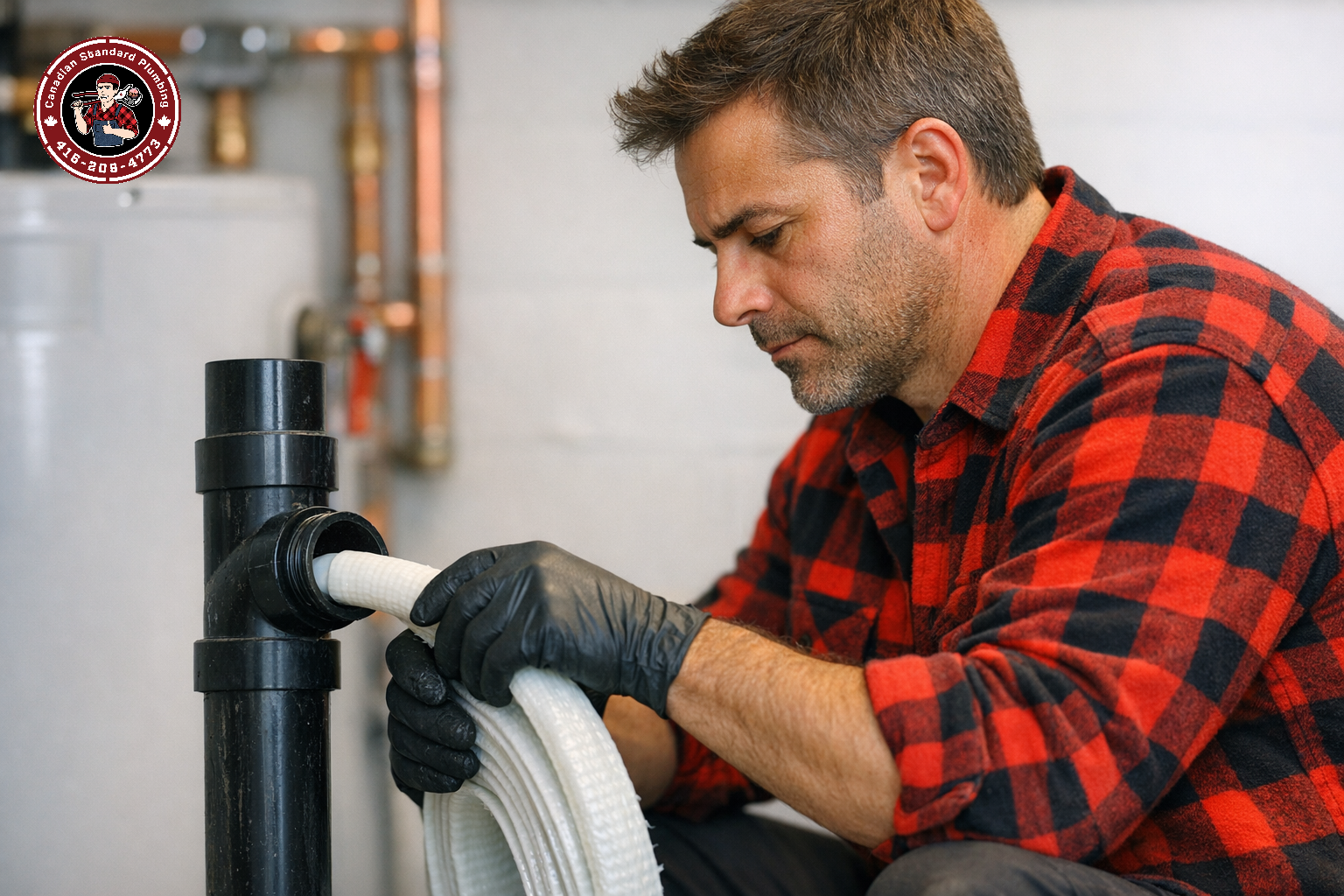
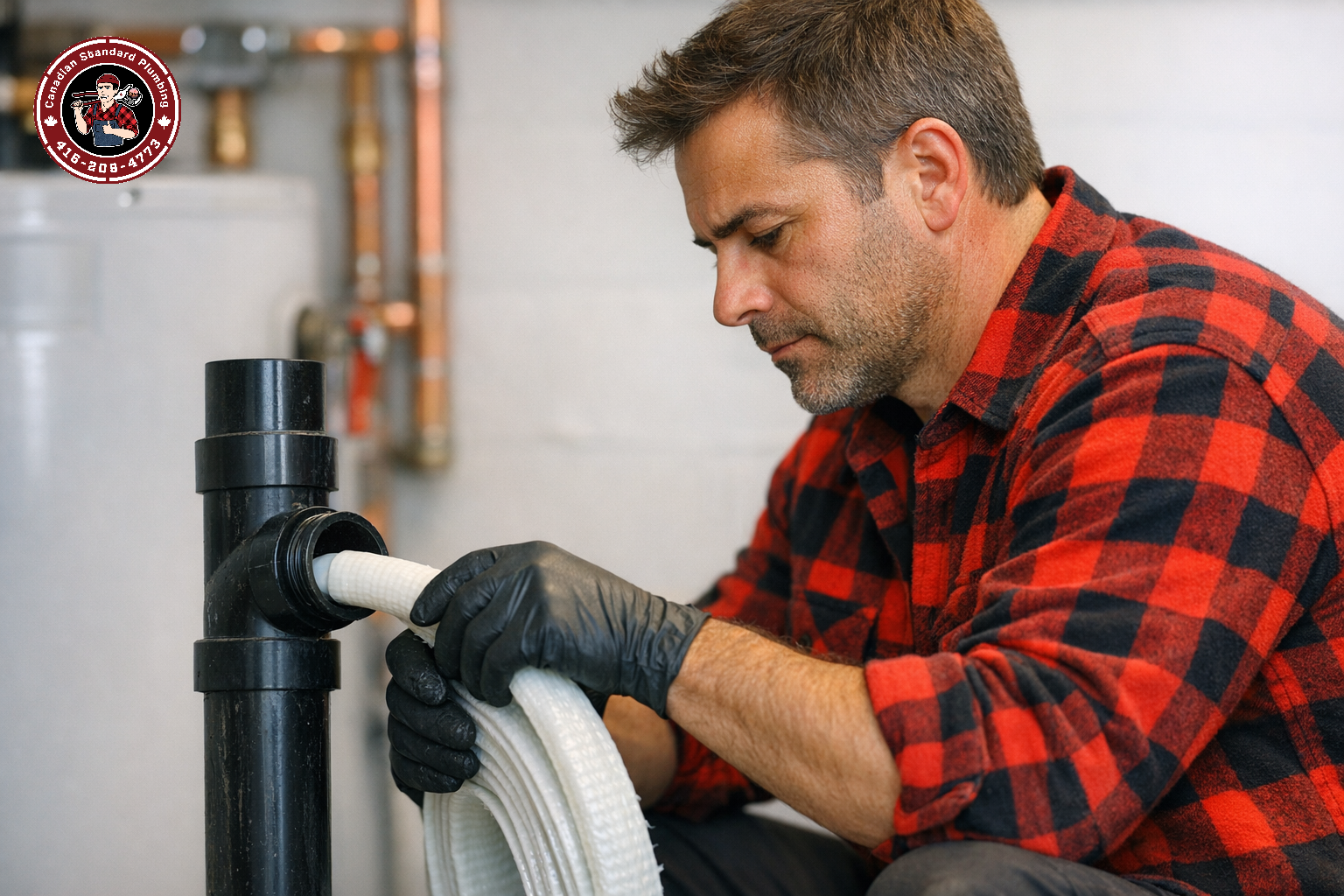
Pipe lining installs a resin-saturated liner inside your existing drain line and cures it in place, creating a jointless pipe-within-a-pipe. The old pipe becomes the mold. Nothing gets dug up along the run – access is typically through a cleanout or one or two small openings, which is why it’s the method Toronto homeowners with finished basements ask about first.
Where lining genuinely shines: root intrusion through cast iron or clay joints, longitudinal cracking, and the flaky, scaled-out interior of a 70-year-old cast iron main that still holds its shape. A jointless liner removes the thing roots exploit – the joint. That’s not marketing. That’s mechanics.
Where it fails, and where we say no: a belly. If the camera shows standing water sitting in a low spot with no visible defect, lining that section gives you a smooth, corrosion-proof, permanently sagging pipe. You’ll still get solids settling. You’ll still get calls. Lining also can’t fix a joint that has shifted sideways, because the liner has to follow a continuous path.
“Lining is a repair to the pipe you have. It inherits your slope, your alignment and your diameter. When someone asks us whether lining will fix their recurring backups, our first question isn’t about budget – it’s whether the camera shows a defect or a belly. Those two words lead to completely different invoices.” – Canadian Standard Plumbing Team
One more thing nobody on page one of Google tells you: lining requires the host pipe to be clean first. Mechanical cleaning or hydro-jetting to bare wall is part of the job, not an add-on. If a quote for lining doesn’t mention preparation, ask what it includes.
Option 2 – Full Repipe / Open-Cut Replacement
Full drain replacement removes the failed pipe and installs new – typically PVC or ABS for buried drainage, sized and pitched to code. It’s the more disruptive option and, on a per-foot basis before restoration, often the cheaper material. The cost lives in everything around the pipe: breaking slab, hauling spoil, backfilling, compacting, and putting your basement back.
Replacement is the only correct answer in four situations we see repeatedly. A collapsed section. Multiple offset joints along one run. A line that was undersized or improperly pitched when the house was built – common in older additions and DIY basement bathrooms. And any case where the basement floor is coming up anyway for a renovation.
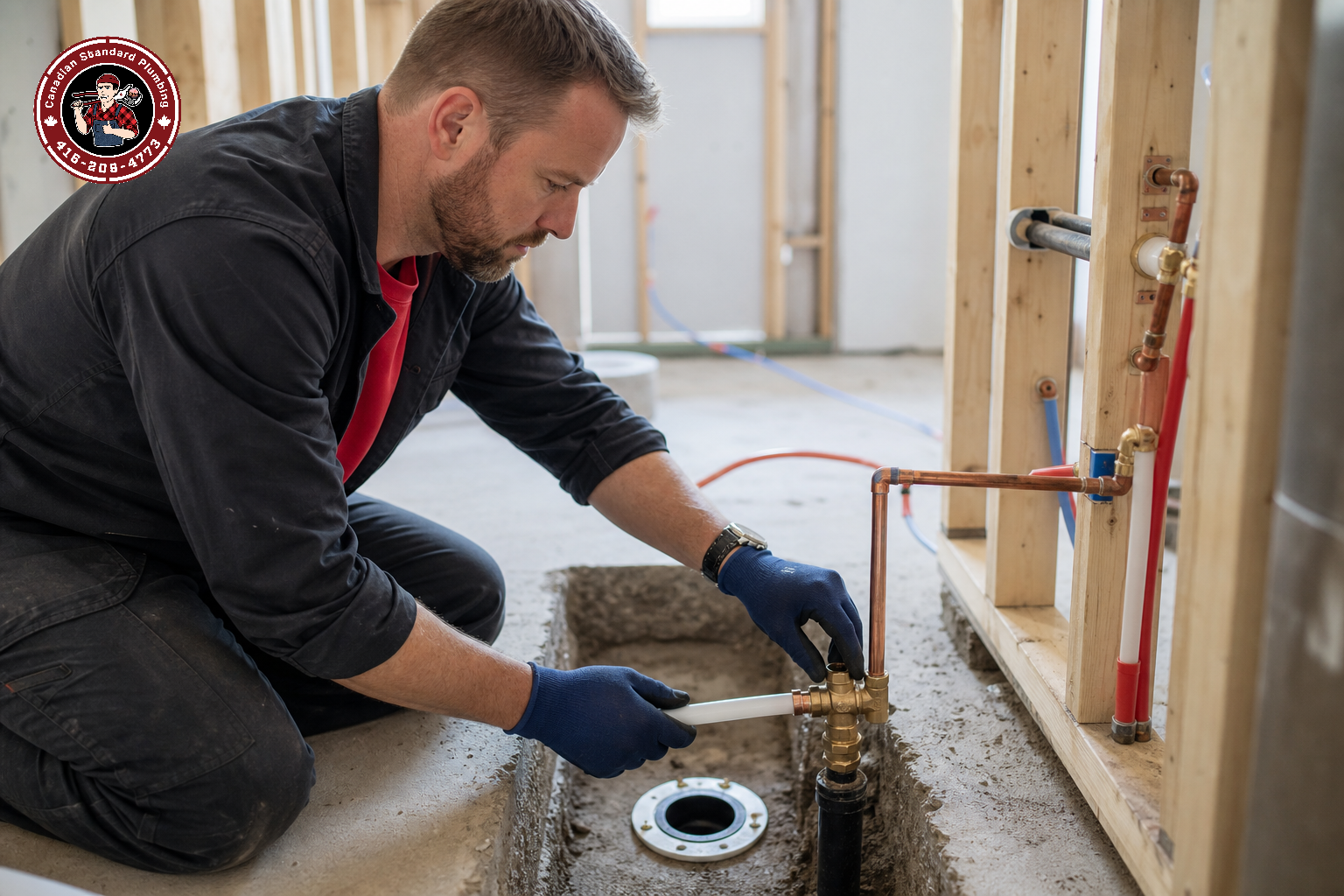
That last one is the sleeper. If you’re already gutting a bathroom, the marginal cost of doing the waste line properly is a fraction of doing it later. That’s exactly the call we got from a King City client renovating their primary bathroom – cracked terrazzo around the toilet from years of a slow leak. We did a full rough-in repipe of that bathroom’s waste line in PEX, set a Toto Aquia IV, and there’s been nothing since. Doing it during the reno was the cheapest version of that job that will ever exist.
Full replacement costs more up front on a finished basement because of concrete and restoration, but it’s the only method that corrects slope, diameter and alignment. Our bathroom rough-in work is priced by scope – how much pipe is being replaced, how accessible it is, and what has to be put back afterward – and we quote it in writing first. If your floor is already open for a renovation, this is the moment that work is least disruptive and least expensive it will ever be.
Option 3 – Spot Repair: The Option Most Quotes Skip
Spot repair replaces or sleeves a single short defect instead of treating the whole line, and it’s the option that quietly disappears from most sales conversations because it’s the smallest ticket. On an aging Toronto semi-detached where a camera shows one cracked hub at a fitting and 40 otherwise sound feet, a spot repair is the correct engineering answer and the correct financial one.
We recommend it more often than homeowners expect. It also buys you information: fix the one defect, use the drain for a season, and re-camera. If the line performs, you’ve saved five figures of disruption. If two more defects appear, you now have real evidence for a full repipe rather than a guess.
The catch is honest: a spot repair carries no promise about the rest of the pipe. Anyone who tells you it does is selling. We say it plainly on every quote – this fixes this defect, and here’s the condition of everything else we saw.
Why an Aging Toronto Semi-Detached Changes the Math
A semi-detached home in Toronto has one constraint a detached home in Aurora or King City doesn’t: a shared wall and a narrow side yard. The drain run to the street often exits at an awkward angle, sometimes under a walkway shared with the neighbour, occasionally under a mutual drive. Excavation access is the single biggest cost variable, and on a semi it’s usually the worst.
That’s the structural reason lining looks so attractive on these houses. Less access needed, less to restore, no negotiation with a neighbour about their pavers. In the older Toronto and North York semis we work in, the interior line is frequently original cast iron and the exterior run to the street is clay tile – two different materials, two different failure modes, sometimes two different recommendations on the same property.
The other semi-detached wrinkle: shared or combined drainage arrangements in some older builds. Before anyone commits to a method, it matters who owns which section of pipe and where the property line falls. City of Toronto’s Basement Flooding Protection Subsidy Program can also change the financial picture for backwater valve and related work, so it’s worth checking eligibility before you finalize scope.
When to Choose Which
How we actually get to the recommendation
Clear the line first
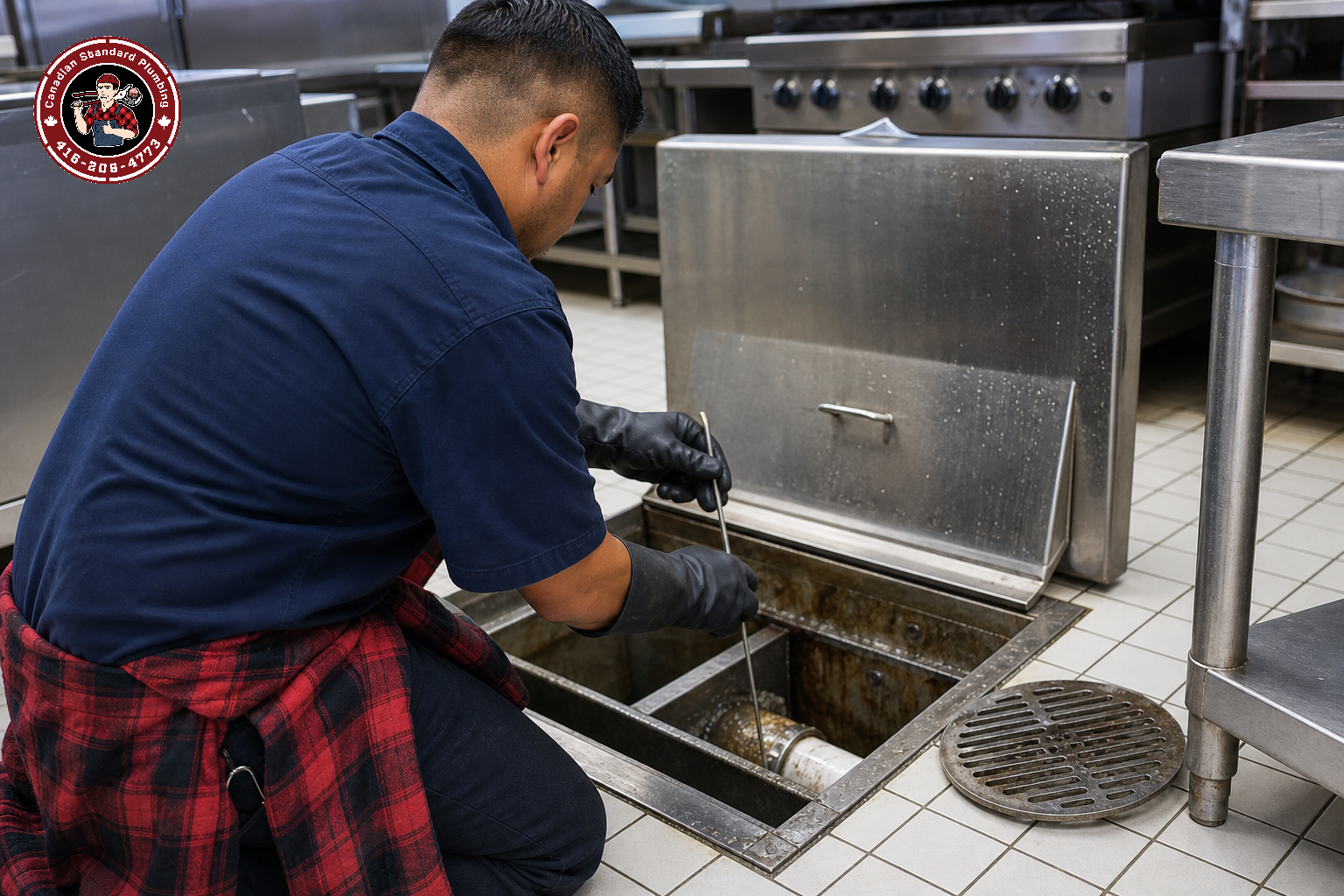
A camera in a partially blocked, water-filled pipe shows you murk. Clearing a single drain is a small, self-contained job we quote before we start, and it’s a prerequisite for a meaningful inspection.
Camera the full run, on video
We quote our drain camera inspection in writing before we book it. You get the footage. If a contractor won’t hand over video, that’s your answer about the quote.
Locate and mark depths
Where the pipe runs and how deep it sits determines whether open-cut is a morning or a week. This is where a semi-detached lot either helps you or hurts you.
Separate defects from geometry
Cracks, root intrusion and corrosion are defects – lining candidates. Bellies, offsets and wrong diameter are geometry – replacement territory. Most lines have some of both.
Price both, in writing, same visit
Lining, replacement and spot repair where each is technically valid – with restoration included, not as a footnote. Then you decide. Not us.
Our Verdict on Pipe Lining vs Full Repipe for an Aging Toronto Semi
For the typical aging Toronto or North York semi-detached with a finished basement, root intrusion, and a drain that still holds its alignment, pipe lining is the method that costs less – because the savings aren’t in the pipe, they’re in the concrete and drywall you never touch. That’s the majority scenario in the older semis we work in.
For the long-hold owner whose camera shows a belly, a collapse, or joints that have walked out of line, full replacement is cheaper over ten years even though it’s dearer this month. Lining a sagging pipe is buying a beautifully finished version of the same problem. We’ve watched other people’s lined bellies come back to bite, and it’s a bad conversation to have with a homeowner who thought they were done.
And for the multi-unit landlord or property manager – the person fielding tenant calls at 8 PM across three addresses in Vaughan and Richmond Hill – the deciding factor usually isn’t the quote at all. It’s callouts. We converted three aging 40-gallon tanks in one Vaughan rental building to a single Navien tankless because the recurring “no hot water” calls were the real cost, and the owner reported a 28% cut in monthly gas afterward. Drainage works the same way: the method that ends the calls is usually the one that wins, even at a higher sticker.
One thing we’ll say bluntly: nobody should quote you either method without a camera. If you’ve been handed a five-figure replacement price off a snake and a hunch, get a second opinion. And if you’re mid-crisis with water coming up a floor drain, our 24/7 emergency line exists for exactly that – stabilize first, decide the method when the floor is dry.
Related mistakes that turn small drainage bills into big ones
- Ignoring a slow toilet refill. Usually nothing more than a fill valve swap. Left alone it works the tank seal loose and turns into a much bigger tank-to-bowl gasket job – more parts, more labour, more mess. We quote both in writing before we touch anything.
- DIY shutoff valve swaps without isolating the main. We get 2-3 emergency calls a month from a half-finished DIY where the valve snapped off and there was no way to stop the flow.
- Assuming a supply leak is a drain problem. A Richmond Hill homeowner called us at 11 PM with water pooling under the kitchen sink – it was a failed braided supply connector, not the drain. We replaced it with a stainless braided line and installed an emergency shutoff that night. Different system, different fix, and far less involved than it looked at midnight.
FAQ: Pipe Lining vs Full Repipe
Does pipe lining actually cost less than a full repipe on a Toronto semi-detached?
Pipe lining usually costs less on a Toronto semi-detached with a finished basement, because it avoids slab cutting, spoil removal and restoration – the three items that dominate an open-cut invoice. The comparison flips when the line has a belly or a collapse, since lining can’t correct geometry and you’d end up paying twice. Both approaches are driven by length, depth and access, which is why we camera the line first and put a written quote in your hands before you commit to either.
Can you line a drain pipe that has already collapsed?
A collapsed drain pipe cannot be lined, because cured-in-place lining needs a continuous, intact host pipe to form against. If the collapse is short and reachable, a spot replacement of that section can restore the run – and in some cases lining the remainder afterward is viable. If the camera shows collapse in more than one place along an old clay or cast iron run, full replacement is the honest recommendation.
Will pipe lining reduce my drain’s capacity?
Pipe lining does slightly reduce interior diameter, since the liner sits inside the host pipe – but the new surface is smooth and jointless, which typically offsets the loss on a corroded or scaled cast iron line. It becomes a genuine concern when the original pipe was already marginally sized for the fixtures on it, common in older additions and after-the-fact basement bathrooms. In those cases we’d rather replace and size the line correctly than line a pipe that was undersized from day one.
Do I need a permit for drain repair in Toronto or York Region?
Plumbing and drain work in Toronto, Vaughan, Markham and across York Region is regulated under the Ontario Building Code, and drain replacement or alteration generally requires a plumbing permit taken out by the contractor doing the work. Requirements differ between an interior repair, an exterior sewer connection and any work in the municipal right-of-way, so confirm scope with your municipality or have your plumber handle the application. We pull permits as part of the job where the work requires them.
Sources
- Basement flooding subsidy eligibility and backwater valve program referenced in the semi-detached section – City of Toronto – Basement Flooding Protection Subsidy Program
- Ontario Building Code as the governing standard for plumbing and drainage work in Toronto and York Region – Government of Ontario – Ontario’s Building Code
- Plumbing permit requirements for drain alteration and replacement – City of Toronto – Building Permits
- All exact dollar figures for camera inspection, drain cleaning, bathroom rough-in, after-hours callout and the case examples cited are Canadian Standard Plumbing’s own published rates and job records – Canadian Standard Plumbing
Canadian Standard Plumbing
Owner-operated and run by Daniel and our team, serving Toronto, Vaughan, Thornhill, Richmond Hill, Markham, North York and Etobicoke. Camera footage in your hands and a written quote before anyone talks about a repipe. 24/7 emergency response.
Book a Drain Camera Inspection Before You Commit to a Repipe →
🎧 Listen to article
- Moen Flo vs Moen Smart Water Shutoff: Which Smart Leak Monitor Actually Makes Sense for a Toronto Condo
- A Markham Homeowner Asked: “Can You Fix a Pinhole Copper Pipe Leak Without Replacing the Whole Line?” — Our Fi
- A Customer Asked: “Does Drain Camera Inspection Actually Find the Problem or Is It Just an Upsell?” — We Answe
- A Etobicoke Customer Asked: “What’s the Difference Between Hydro Jetting and Drain Snaking — and Which Do I Ac
- Moen Flo vs Phyn Plus: Which Whole-Home Leak Detection System Actually Earns Its Price Tag in a North York Sem