A Etobicoke Customer Asked: “What’s the Difference Between Hydro Jetting and Drain Snaking — and Which Do I Actually Need?”

Last updated: August 14, 2026
Published August 14, 2026 · Updated August 14, 2026

A snake (cable auger) punches a hole through a blockage and restores flow; hydro jetting scours the full inside diameter of the pipe with high-pressure water and removes the grease, scale and sludge layer that caused the blockage in the first place. If your drain has backed up once, snake it. If it has backed up three times in a year, you’re paying for the same clog repeatedly and jetting is the cheaper long game – but only after a camera confirms your pipe can take it.
- Snaking = mechanical cable, opens a channel, fast, and the lower-cost option. Best for a first-time clog, a hair-clogged tub, a root intrusion needing a cutter head.
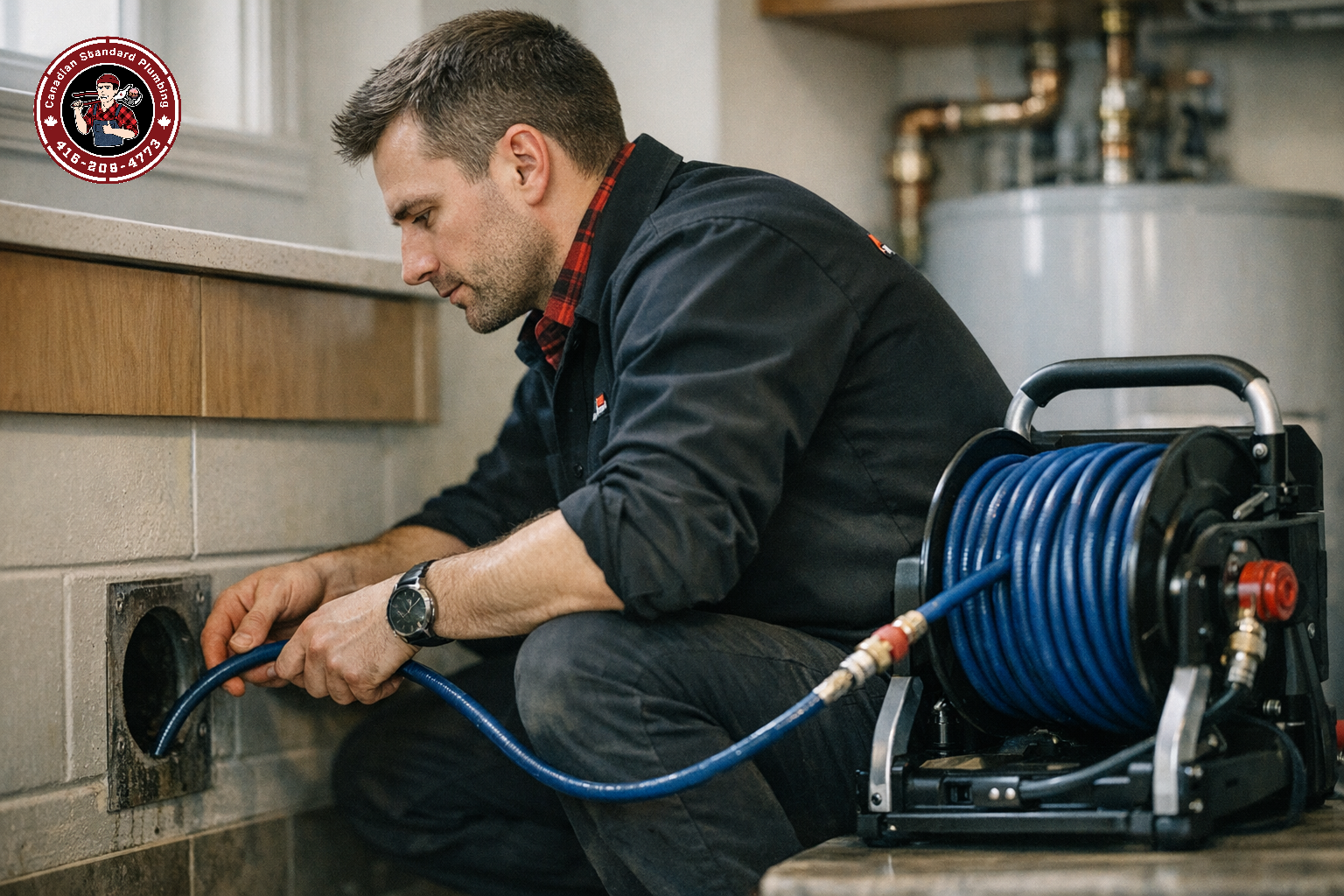
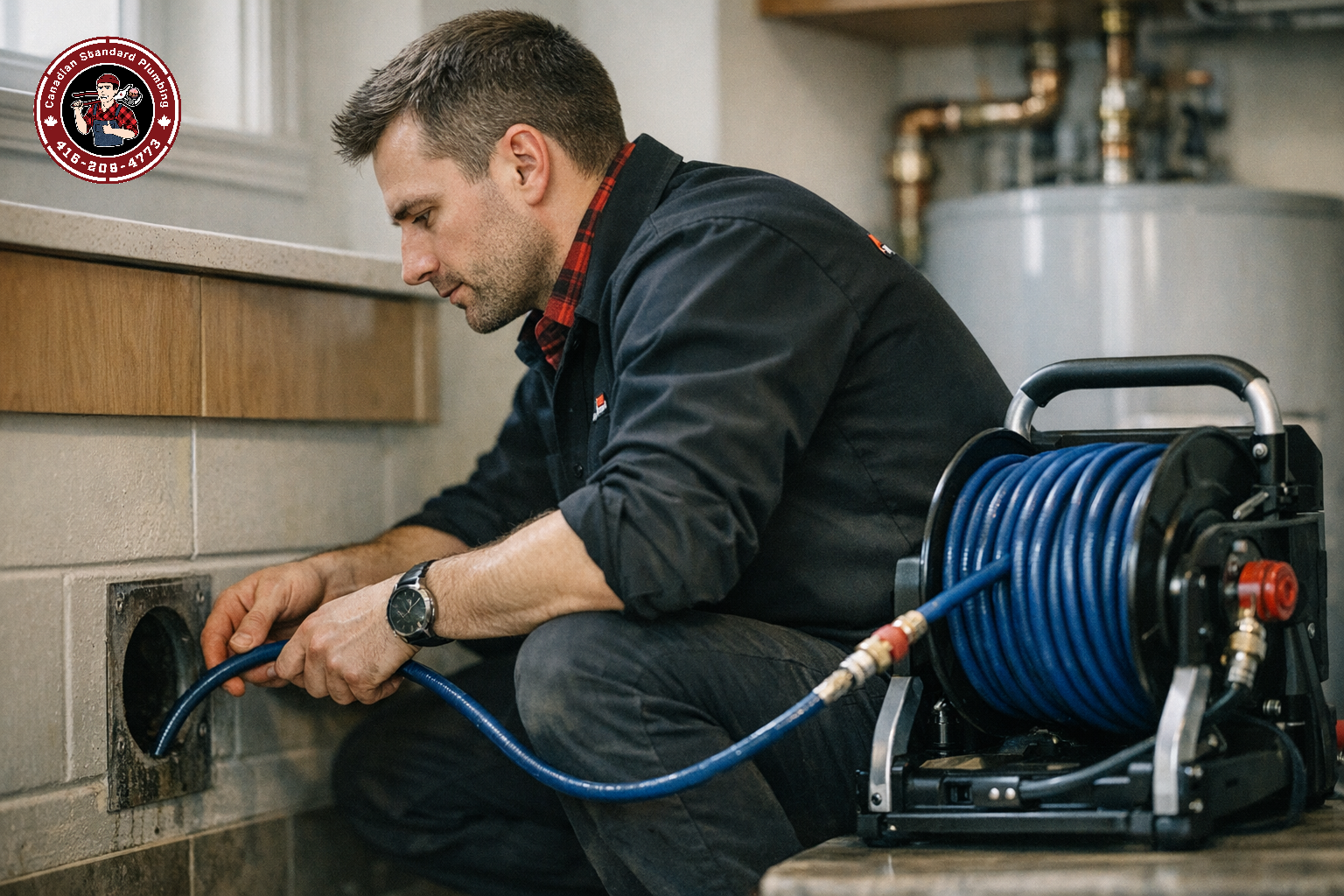
- Hydro jetting = pressurized water at multiple nozzle angles, cleans wall-to-wall. Best for grease-lined kitchen and restaurant lines, repeat backups, sludge in cast iron.
- Neither should be sold to you blind. A drain camera inspection is what tells us which tool your pipe can survive.
- Drain cleaning and after-hours emergency work are quoted in writing before we start, so you can see what’s driving the number on your line.
- Old, thin-walled, or already-cracked pipe is a reason to not jet. Anyone who jets an Etobicoke pre-war cast iron stack without looking first is gambling with your money.
The Short Answer: The Hydro Jetting vs Drain Snaking Difference, and Which Service You Need
The core hydro jetting vs drain snaking difference is hole versus wall. A drain snake is a rotating steel cable with a head on the end – it drills, hooks, or cuts through whatever is plugging the pipe, and water starts moving again within minutes. Hydro jetting sends water down the line under high pressure through a nozzle with rear-facing jets, so it both propels itself upstream and blasts the pipe walls clean on the way back, flushing debris downstream to the municipal main.
Which one you need comes down to a single question: is this a blockage or is this buildup? A toy, a wipe, a hairball, a root ball – that’s a blockage, and a cable is the right tool. Years of cooking fat, soap scum, coffee grounds and food solids fused to the inside of a 3-inch kitchen branch – that’s buildup, and a cable just bores a straw-sized hole through it that re-closes by fall.
Snaking clears a path; hydro jetting restores the pipe’s full diameter. First backup in years: snake it. Third backup in twelve months: put a camera down the line first, then decide about jetting. Repeat snaking on a greased-up line is the single most common way GTA homeowners overspend on drains.
The Full Answer
1. What a drain snake actually does to your pipe (and what it leaves behind)
A drain snake – cable machine, auger, “the rooter” – is a flexible steel cable spun by a drum motor, fitted with an interchangeable head: a spear for hair, a corkscrew for retrieval, a C-cutter or expanding blade for roots. It’s mechanical, tactile work. You feel the head load up, you back off, you feed again. A good operator can tell root from grease from a collapsed section by how the cable behaves in their hands.
Here’s the part almost nobody explains to you at the door: on a grease-coated line, the cable follows the path of least resistance. It carves through the soft center of the obstruction and the water rushes out – the sink drains, the basement floor drain stops burping, you’re happy, we leave. But the grease ring on the pipe wall is still there, and it’s still sticky. It starts catching solids again immediately.
That’s why snaking is honest work with a specific limit. It fixes today. It doesn’t reset the clock.
2. What hydro jetting actually does – and why it costs more
Hydro jetting uses a pump, a heavy hose, and a nozzle whose jets are aimed backward so the hose crawls upstream while the water sheets against the pipe wall on its return. Grease liquefies. Soap scum and detergent film peel. Sludge in the bottom of an old cast iron line gets lifted and carried away instead of being shoved forward into the next fitting. When we pull the hose out and re-run the camera, you can see bare pipe wall – which is the whole point.
The cost difference isn’t a markup on the same job. It’s a different job: bigger equipment, water supply and containment setup, longer time on site, and a mandatory camera pass before and ideally after. For a residential kitchen or laundry branch in Etobicoke, jetting is a half-morning. For a restaurant grease line in Toronto or a shared stack in a Thornhill low-rise, it can be a full day with a wet-vac crew.
“We won’t jet a line we haven’t seen on camera. Pressurized water finds every weakness a pipe has – and in the older parts of Etobicoke and North York, plenty of drain lines have a hairline crack or a bad joint that a snake would have quietly slid past. Looking first is not an upsell. It’s the difference between cleaning a pipe and finishing it off.” – Canadian Standard Plumbing Team
3. The camera comes first – that’s how you know it isn’t an upsell
If you’re an Etobicoke homeowner in a 1950s-60s bungalow or semi with original cast iron below the slab, and a plumber recommends hydro jetting without putting a camera down the line, ask why. A drain camera inspection answers the three questions that decide the whole job: what material is the pipe, what’s the failure mode (grease, roots, scale, belly, offset joint), and is the pipe structurally sound enough to jet. We quote it in writing before we book the visit.
Roots on camera mean a cutter head first, then a decision about the joint they came through. Grease glazing on camera means jetting is worth the money. A sagging section holding water – a belly – means neither tool fixes it; you’re looking at excavation or a liner, and any company selling you repeat cleanings on a bellied line is selling you a subscription.
Honestly, the camera is the part of drain work we’d keep if we had to give up everything else. It converts an argument into a picture you can see on the screen with us, standing in your own basement.
4. Side-by-side: which tool wins for which situation
| Your situation | Better tool | Why |
|---|---|---|
| Tub or shower draining slowly, hair suspected | Snake (small cable / hand auger) | Hair grabs onto a spear head. Jetting a small tub branch is overkill. |
| Kitchen line backing up 2-4× per year | Camera, then hydro jetting | Repeat pattern = grease film on the wall, not a discrete object. |
| Toy, wipes, dental floss ball, foreign object | Snake with retrieval head | Water pressure can push an object further into a fitting. |
| Tree roots in the main from a mature front-yard maple | Snake with cutter first, jetting after | Blades cut the mass; jetting flushes the debris and cleans the joint face. |
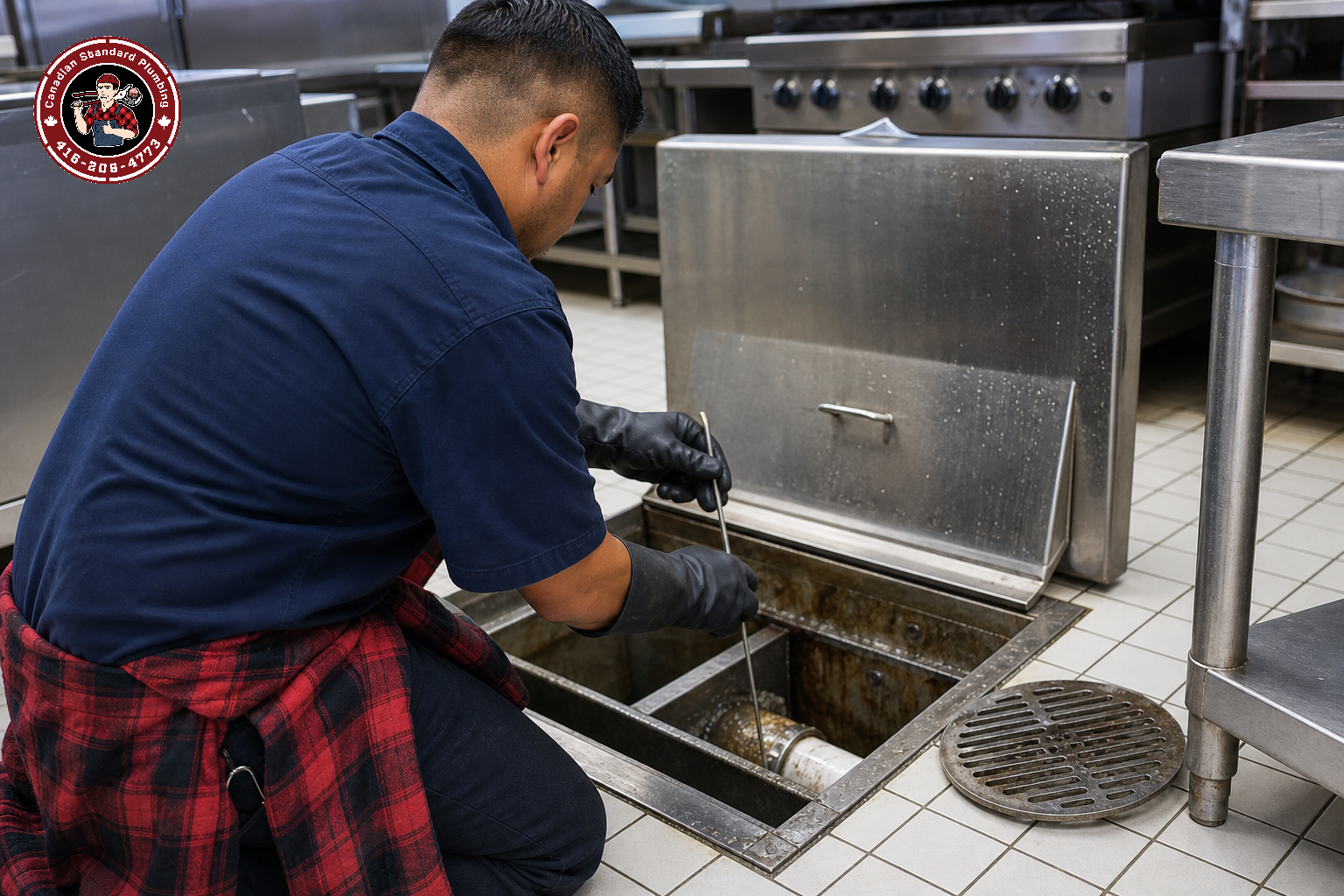
| Restaurant / café kitchen line, grease trap downstream | Scheduled hydro jetting | Commercial FOG volume rebuilds fast; cabling never keeps up. |
| Scale/tuberculation in old cast iron stack | Jetting only if camera shows sound wall | Thin, flaking iron can be perforated by pressure. |
| Line holds standing water between cleanings (belly) | Neither – repair | Cleaning a low spot buys weeks. Re-grading or lining fixes it. |
5. Residential vs commercial: the same tools, a completely different calculation
This part is for the persona national blog posts always skip: the property manager running a handful of buildings across Vaughan, Concord and Richmond Hill, or the restaurant operator on a Toronto strip with one kitchen line and no second option. Your math is not a homeowner’s math.
For a homeowner, a backup is an inconvenience and a cleanup. For a café, a backed-up floor drain at 11 AM on a Saturday is closed doors, dumped prep, and a health inspection risk. That asymmetry is why commercial clients are usually right to buy the more thorough service on a schedule instead of the cheaper one on an emergency. Jetting a grease line every few months at a planned time beats paying our after-hours emergency callout premium on top of the work itself.
One more pattern from the multi-unit side. When a Vaughan property manager with three rental units kept getting tenant calls about no hot water, the fix wasn’t three separate patch jobs – we converted all three from aging 40-gallon tanks to a single Navien tankless serving the building, and per their reports the monthly gas bill dropped 28%. Drains follow the same logic: for buildings, the repeated small call is almost always more expensive than the one correct intervention.
6. The mistake that turns a routine drain call into a much bigger repair
Before either tool enters the picture, there’s a decision most homeowners make in the grocery aisle. Pouring caustic drain cleaner into a slow drain, repeatedly, is the field mistake we see more than any other. The lye eats the rubber gaskets in the trap – and a straightforward drain cleaning turns into a trap replacement, because now we’re not clearing a clog, we’re rebuilding the fitting. That’s a bigger job, and we’ll put the difference in writing before we touch it.
There’s a second problem with chemical cleaner. If it’s still sitting in the trap when we open it up, that’s a face full of caustic liquid for whoever is under your sink. Tell your plumber what you poured. Every time. We’d rather suit up than guess.
Stop pouring anything down it
No lye, no enzyme, no boiling water into a PVC trap. Note what’s already gone in so we know before we open the trap.
Count the backups
How many times in the last 18 months, and which fixtures? One fixture points to a branch. Multiple fixtures or a floor drain points to the main.
Clear the access
Find your cleanout and move the storage off it. Time spent digging out a cleanout is time you’re paying for.
Ask for the camera footage
Watch it with us. If someone recommends jetting and can’t show you why on a screen, get a second opinion before you spend.
Decide on maintenance, not just repair
Homeowners: reassess after the next season. Commercial kitchens: put jetting on the calendar so it never becomes an after-hours call.
When the Answer Is Different
Hydro jetting vs drain snaking isn’t always the right question. There are several Etobicoke and York Region scenarios where the answer to “which service do I need” is neither one.
When it’s not a clog at all – it’s venting
If a fixture gurgles, drains sluggishly but never fully blocks, and the trap keeps losing its seal so you smell sewer gas in the bathroom, that pattern points at the venting side of the drainage system rather than an obstruction in the pipe. Drainage and venting are two halves of the same system and a blocked or improperly configured vent produces symptoms that look exactly like a clog. Cabling a vent problem produces a clean cable and an unchanged fixture. We check the venting when the symptom pattern says to.
When the real problem is upstream of the drain entirely
Water on the floor under a sink is not always a drain issue. A Richmond Hill homeowner called at 11 PM with water pooling under their kitchen sink – the culprit was a failed braided supply line connector, not the drain. We replaced it with stainless braided and installed an emergency shutoff that night. Nothing about that job involved a snake or a jetter. If the water is clean and appearing when nobody’s running the tap, you have a supply-side leak, and the tool you need is leak detection – a diagnostic visit and written report. What it costs depends on how accessible the line is and how much of the building has to be traced, and we give you that in writing before we start.
When you’re renovating anyway
If the bathroom is coming apart regardless, cleaning the old waste line is often the wrong money. A King City client renovating their primary bathroom had cracked terrazzo around the toilet from years of slow leaking – we did a full rough-in repipe of the bathroom waste line in PEX and installed a Toto Aquia IV. No leaks since. A bathroom rough-in is priced on scope: how much of the waste and supply is being reworked, whether fixtures move, and what the access is like. A toilet swap on its own is a far smaller job, and a high-end unit costs more than a standard one. Either way we quote it in writing first – because paying to clean a pipe you’re about to demolish makes nobody happy.
When it’s January and the line runs cold
In an Etobicoke or North York winter, a “clog” in a laundry standpipe or a garage-adjacent drain in an unheated space can be ice. Cabling frozen sludge accomplishes nothing and jetting cold water into a frozen line makes more ice. Thawing and then insulating the run is the actual fix, and it belongs to our frozen and burst pipe work, not our drain cleaning work. Any drain line running through an uninsulated crawlspace, garage wall, or exterior-wall chase deserves attention before the first hard freeze.
When you’d rather stop the next flood than clean the last one
Drain cleaning is reactive by nature. If your worry is the finished basement rather than the slow sink, a smart water monitor with automatic shutoff changes what a failure costs you. A Moen Flo is supplied and installed as one job, and we quote it in writing once we’ve seen where it has to tie into your main. It watches supply-side flow and shuts the water off on an abnormal pattern – it won’t stop a sewage backup, but it will stop the burst supply line that soaks a basement while you’re in Muskoka for the weekend. Two different risks, two different products. Don’t let anyone sell you one as protection against the other.
What This Costs in the GTA – Straight Numbers
Etobicoke, Toronto, Vaughan, Thornhill, Woodbridge, Maple, Concord, Richmond Hill, Markham, Aurora, King City and North York all get the same pricing structure from us. Here’s the drain-relevant part of it, so you can judge any quote you’re holding.
| Service | Typical range (CAD) | When it’s the right spend |
|---|---|---|
| Drain cleaning, single drain | Quoted in writing before work starts | First-time or occasional backup on one fixture. |
| Drain camera inspection | Quoted in writing before work starts | Repeat backups, pre-purchase, before any jetting decision. |
| Emergency after-hours callout | Quoted in writing before we start | Active overflow, sewage, or a commercial kitchen that can’t open. |
| Leak detection visit + written report | Quoted in writing after we assess the site | Clean water appearing with no fixture running. |
| Bathroom rough-in (renovation) | Depends on scope – written quote before work begins | The waste line is old and the room is coming apart anyway. |
| Moen Flo smart shutoff, supplied + installed | Depends on the device and shutoff location – quoted in writing | Finished basement, travel often, or a supply-line history. |
Hydro jetting itself we quote per line after we’ve seen the camera footage, because the honest range for a small residential branch and a full commercial grease line aren’t the same number and pretending otherwise wastes your time. The camera pass tells us length, material, access and severity – that’s what a real quote is built on.
Two More Things We’d Tell You Standing in Your Kitchen
First: small plumbing symptoms escalate on a predictable curve, and drains are only one example. A toilet that refills slowly is usually a worn fill valve – a small part and a short visit. Left alone, the constant cycling and seeping can work on the tank seal and turn a minor part swap into a tank-to-bowl gasket job with the tank pulled off. The lesson transfers directly to drains: a sink that has started draining noticeably slower than it used to is cheaper to look at now than after the trap and its seals have given up. If you want to know what a specific repair involves at your place, we’ll look at it and put a quote in writing before any work starts.
Second: on the DIY side, please don’t replace a shutoff valve without isolating the main. We take two to three emergency calls a month from a half-finished DIY where the valve snapped off and there was no way to stop the flow. It’s a Saturday afternoon, the shop is closed, and the water is winning. Know where your main shutoff is and confirm it actually closes – before you need it.
FAQ
How long does hydro jetting keep a kitchen drain clear compared to snaking?
Hydro jetting on a grease-fouled residential kitchen line typically holds far longer than cabling because it removes the wall film, not just the plug – in our experience the difference is a season versus a year or more, depending entirely on what goes down the sink. A snaked grease line in a household that cooks with a lot of fat can re-block within months. Busy commercial kitchens in Toronto need jetting on a recurring schedule regardless of technique.
Do I need a camera inspection every time my drain backs up?
A camera inspection isn’t necessary for a one-off tub or sink clog that clears with a cable and never returns. It becomes worth doing the moment the same line backs up a second or third time, before any hydro jetting decision, and before you buy a home in Etobicoke or North York with original cast iron or clay drains. We’ll put the scope and the cost in writing before we start, and the footage also gives you leverage with a seller or an insurer.
Is hydro jetting safe on older Etobicoke homes with cast iron drains?
Hydro jetting is safe on cast iron that still has sound wall thickness, and unsafe on cast iron that’s flaking or already cracked – which is why we run the camera first on every older Etobicoke, North York or Toronto property before quoting a jetting job. If the footage shows heavy tuberculation with thin spots, we’ll recommend gentler mechanical cleaning or a repair/lining conversation instead. Jetting a dying pipe converts a cleaning bill into an excavation bill.
Can I rent a jetter or use a store-bought drain snake myself?
A small hand auger on a tub or bathroom sink is reasonable homeowner work; a rental cable machine or pressure jetter on a main line is not, because both can damage the pipe, trap the cable in a fitting, or perforate compromised drain walls. Add the fact that a rented jetter needs proper containment and PPE, and having a professional clear that single drain starts looking like the cheaper route – we’ll quote it in writing before any work begins. Our 24/7 line exists for the calls that start with “I was trying to fix it myself.”
Sources
- Service pricing, camera-first drain diagnosis policy, after-hours surcharge, and the case studies cited (Richmond Hill supply line, Vaughan tankless conversion, King City bathroom repipe) – Canadian Standard Plumbing internal service records, as supplied by the business – Canadian Standard Plumbing
- Fats, oils and grease disposal rules and sewer-use requirements affecting Toronto commercial kitchens – City of Toronto – Sewers and Drains
- Plumbing work in Ontario is regulated under the Ontario Building Code; confirm any specific requirement with your local municipal building department – Government of Ontario – Ontario’s Building Code
- Moen Flo smart water monitor and automatic shutoff product information – Moen Canada
Have a similar question about your drain?
Owner-operated, serving Etobicoke, Toronto, North York, Vaughan, Thornhill, Woodbridge, Maple, Concord, Richmond Hill, Markham, Aurora and King City. Camera first, written quote second – and a 24/7 line for emergencies, for homes and commercial properties alike.
🎧 Listen to article
- A Customer Asked: “Does Drain Camera Inspection Actually Find the Problem or Is It Just an Upsell?” — We Answe
- A Customer Asked: “My Hot Water Runs Out After 8 Minutes — Is My Bradford White Tank Dying or Just Sediment-Lo
- A Thornhill Property Manager Asked: “Our Condo Building Has Low Water Pressure on the Top Two Floors — What’s
- Moen Flo vs Moen Smart Water Shutoff: Which Smart Leak Monitor Actually Makes Sense for a Toronto Condo
- A Vaughan Customer Asked: “Why Is My Water Heater Popping After 8 Years?” — The Real Cause