How We Cleared a Grease-Clogged Main Stack in a Concord Townhouse — and Why Snaking Alone Wasn’t Enough

Last updated: August 16, 2026
Published August 16, 2026 · Updated August 16, 2026

A grease clogged main stack in a Concord townhouse needs drain cleaning plus camera inspection – snaking alone punches a hole through the blockage and buys you about six weeks. That’s the honest version of a job we run constantly through Concord, Maple and Woodbridge townhouse blocks, and the version most homeowners never hear until the second backup.
- A cable machine restores flow. It does not restore pipe diameter. Grease re-narrows the line within weeks.
- Camera inspection before cabling tells us what is actually in the pipe. Looking first is usually the cheaper route than two blind snaking visits, and we put both the inspection and the cleaning in writing before any work starts.
- Cast iron stacks in older Concord and Thornhill townhouses hold grease because the pipe wall is cold, rough and scaled – grease sticks to scale the way frost sticks to a freezer coil.
- Repeated chemical drain cleaner is the most expensive “free” fix we see: the lye attacks rubber trap gaskets and turns a simple clog into a trap replacement.
- Shared stacks in townhouse rows are a neighbour problem, not just your problem. One unit’s habits load the whole column.
The Situation
What We Found: A Grease-Clogged Main Stack in a Concord Townhouse (Drain Cleaning + Camera Inspection)
A grease-clogged main stack in a Concord townhouse announces itself before you ever open a cleanout. The smell is the first tell – not sewer gas, which is sharp and sulphurous, but a stale, faintly rancid warmth, like the inside of a restaurant hood that hasn’t been degreased since spring. You get it strongest at the basement floor drain.
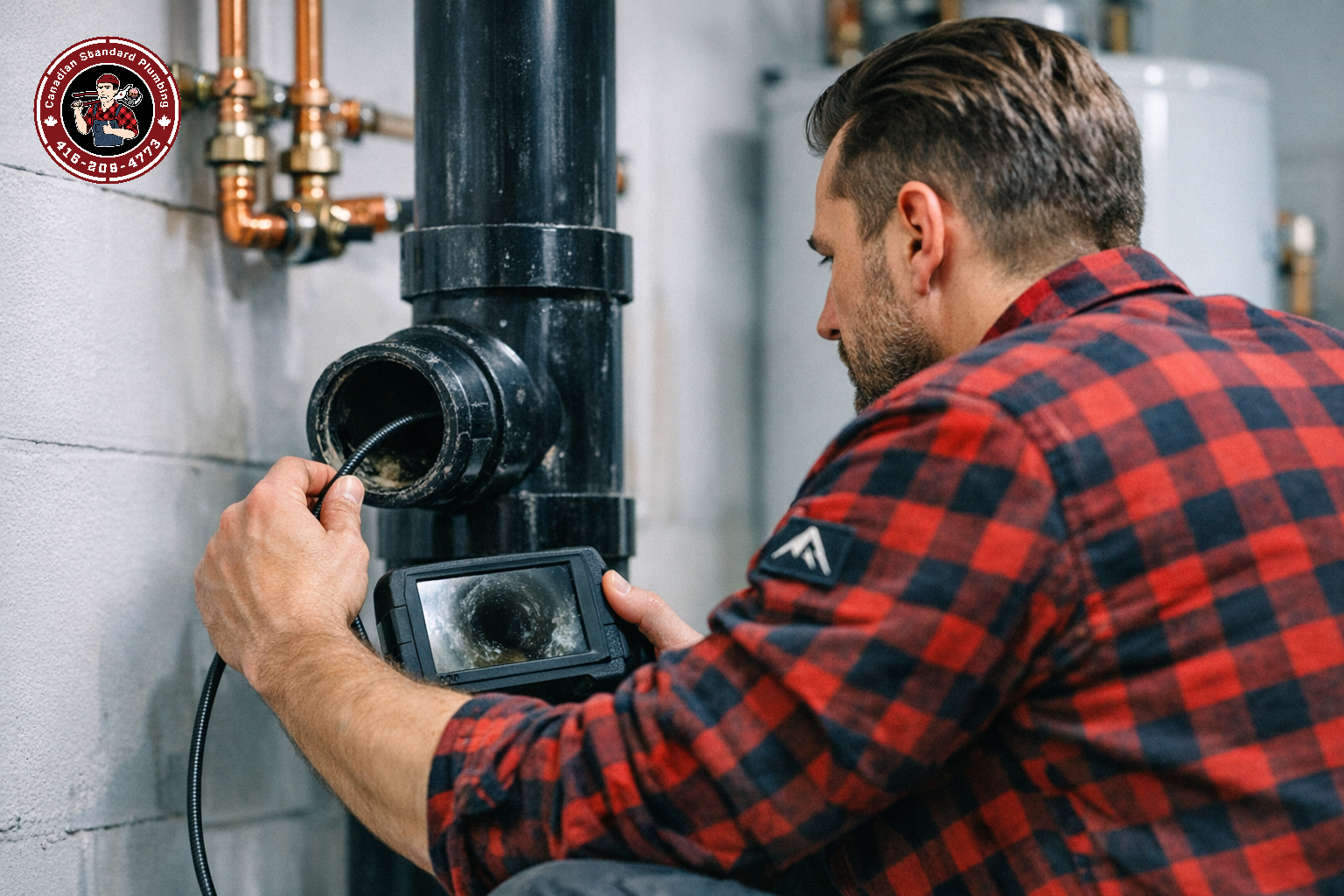
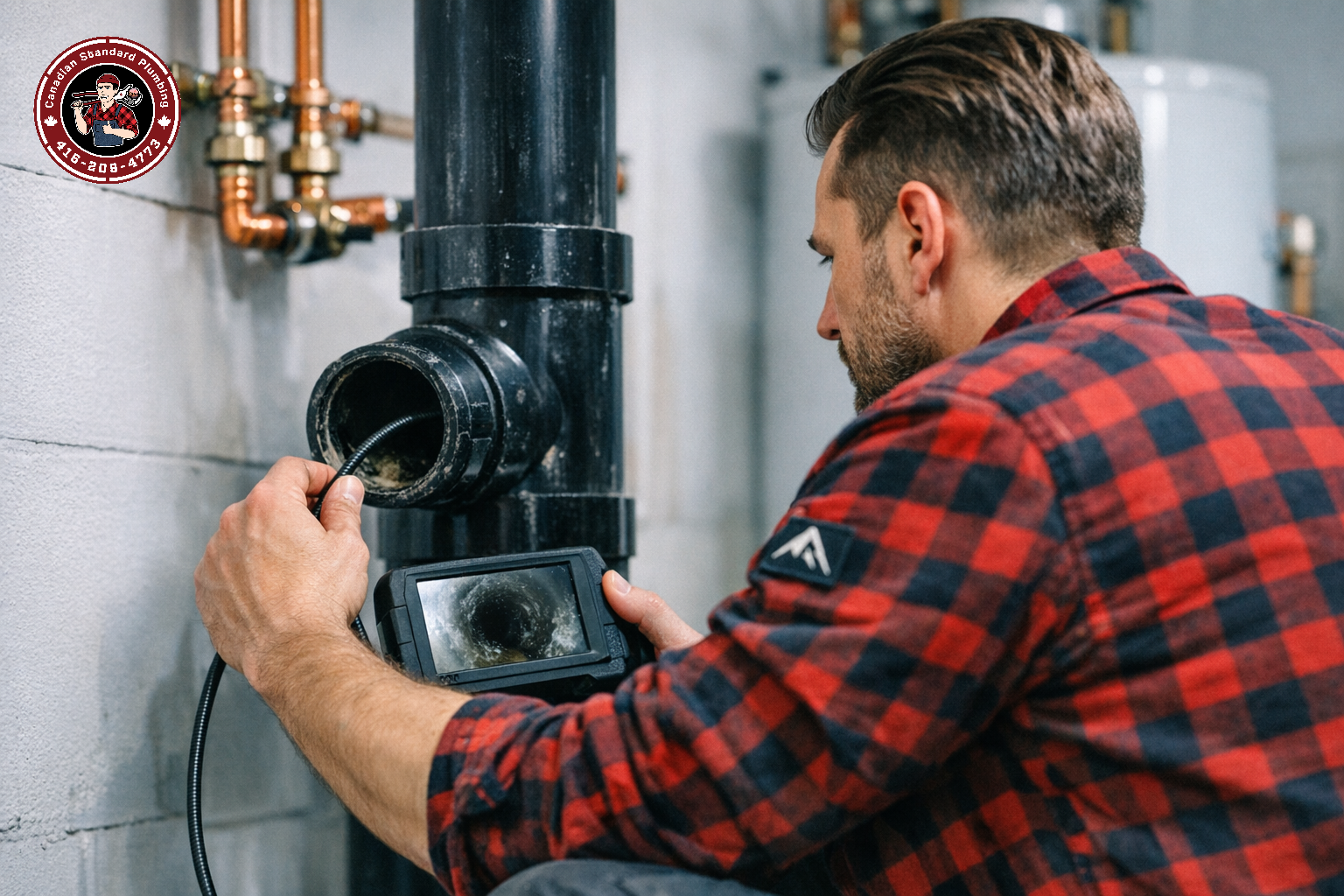
We pulled the cleanout at the base of the stack and ran the camera up. What came back on the monitor was the picture we expect and homeowners never do: the pipe wasn’t blocked in the way people imagine, with a plug sitting in one spot. It was lined. A pale, waxy shelf of congealed fat built up on the lower half of the wall, thickest just below where the kitchen branch ties in, tapering as it went down toward the building drain.
Embedded in that shelf: lint fibres from the laundry line, a strip of what looked like plastic wrap, and coffee grounds packed into the grease like grit in butter. Below the grease, the cast iron wall was scaled and rough – and that roughness is the reason this house has the problem and the neighbour two doors down doesn’t. Grease doesn’t stick to smooth, warm pipe nearly as well. It grabs scale.
One more finding worth naming: the gurgling toilet. A stack that’s partially occluded doesn’t just drain slowly, it breathes badly. The same stack continues up through the roof as the vent, so when a slug of laundry water falls past a narrowed section, it drags air behind it and pulls water out of nearby traps. That gurgle wasn’t a toilet problem. It was the stack telling us its effective diameter was gone.
“Homeowners describe a blockage as a thing sitting in the pipe. Nine times out of ten with grease, it’s not a thing – it’s the pipe getting smaller from the inside out. That’s why a cable ‘fixes’ it and the fix doesn’t last: you cored a channel through a pipe that’s still 70 percent full of fat.” – Canadian Standard Plumbing Team
Camera inspection on a Concord townhouse stack showed a continuous grease lining below the kitchen branch, not a single plug. Scaled cast iron gave the grease something to grip. The gurgling toilet was a venting symptom of the narrowed stack, not a separate fault.
Why Snaking Alone Wasn’t Enough
Snaking a grease-clogged main stack works – briefly. A cable machine with a standard head spins through the fat and opens a channel roughly the diameter of the tool. Water flows. The customer sees the sink empty, pays, and everyone’s happy for about six weeks. Then the channel closes.
Two visits had already happened in this townhouse before we got there. Both cleared it. Neither ran a camera. That’s the part we’d push back on across the whole trade: if a drain has backed up twice in the same year, cabling it a third time isn’t diagnosis, it’s a subscription.
There’s a second problem specific to grease in cold cast iron. Cable heads glaze the surface – they smear and compact the fat against the wall rather than removing it. On camera, a freshly cabled grease line often looks smoother than before, which is precisely why it re-blocks fast: you’ve built a polished tube of fat that catches the next lint bundle beautifully.
What surprised us the first few times we compared before-and-after footage was how little of the original diameter a cable actually recovers. Flow returns long before the pipe does. That gap between “draining” and “clean” is the entire argument for camera-verified drain cleaning and camera inspection.
How We Solved It
Clearing a grease-clogged main stack properly is a sequence, and skipping steps is how the callback happens. Here’s the order we work in on a Concord or Woodbridge townhouse with a shared or single-unit stack.
- Contain the space before touching anything. Floor protection, drop sheets, a wet vac staged at the cleanout. Grease backup water is dark, oily and it stains. In a finished townhouse basement this step is not optional.
- Locate and open the correct cleanout. Base-of-stack cleanout first. If it’s been painted over or drywalled in – common in Concord townhouses built with finished basements – we find it before we start, not halfway through a backup.
- Run the camera before any cutting. This is the step that separates a real diagnosis from a guess. We record the run, note where the grease starts and stops, check the branch connections, and confirm the pipe material and whether the wall is intact. The camera inspection is a defined piece of work that we quote in writing up front, and it decides everything that follows.
- Cable first, but only to open a working path. A sectional machine with a head sized to the line opens a channel so water and debris have somewhere to go while we clean. This is a means, not the fix.
- Hydro-jet with a head chosen for grease. A rotating or reverse-thrust jetting nozzle shears fat off the wall and flushes it downstream instead of smearing it. Pressure and nozzle selection get set to the pipe material and its condition – an older cast iron stack with thinning wall does not get treated like modern PVC. If the camera shows compromised pipe, we don’t jet aggressively; we plan a repair.
- Descale where the camera justifies it. Heavy scale in cast iron holds grease. Where the wall is sound, a chain-knocker style descaling head restores a genuinely smooth surface so fat has nothing to grip. Where the wall isn’t sound, this step is skipped and the conversation shifts to pipe repair or partial replacement.
- Re-camera the full run and show the homeowner the footage. Same route, same landmarks. If the pipe wall isn’t visibly clean on video, the job isn’t done. We hand over the recording – it becomes the baseline for the next inspection in a year.
- Fix the contributing fixture issues. In this kind of townhouse it’s usually a kitchen basket strainer with no screen, a laundry standpipe with no lint control, and a trap that’s been eaten by repeated chemical cleaner. Cheap parts. Big difference.
Diagnose, then cut
Camera before cable. Every time. Cutting blind on a stack you haven’t seen is how a hairline crack becomes a flooded basement at 2 a.m.
Remove, don’t reshape
Jetting shears grease off the wall. Cabling mostly moves it. On a fat-lined stack the difference shows up on the calendar, not on the day.
Verify on camera and hand over the video
If a company won’t show you the after-footage, you have no way to know whether you paid for a clean pipe or a cored channel.
When we camera a stack before touching it, the goal is full-diameter flow rather than a channel punched through grease. We can tell you whether a gurgling fixture is actually a fixture fault or a venting and stack issue, because those are separate systems and the footage shows which one is misbehaving. You end up with recorded footage of the pipe wall, a written note of where the scale is heaviest, and a realistic maintenance interval instead of a standing emergency. We quote the inspection and the cleaning separately and in writing before we begin, so you can decide how far to take it.
What a Job Like This Costs in the GTA
Drain work in Concord, Vaughan and Richmond Hill gets quoted wildly differently, mostly because “drain cleaning” covers everything from a ten-minute sink auger to a full stack descale. These are our published figures, so you can compare like for like.
| Service | Price (CAD) | When it applies |
|---|---|---|
| Drain camera inspection | Quoted in writing before work starts | Any repeat backup; pre-purchase; before any cutting on a stack |
| Drain cleaning, single drain | Quoted in writing before work starts | One fixture – kitchen sink, lav, laundry standpipe |
| Emergency after-hours callout | An after-hours premium applies over our standard rate – confirmed in writing before we start | Active backup at night, weekend or holiday |
| Leak detection visit + written report | Quoted in writing after we see the site and the suspected leak area | Staining or damp near the stack after a backup |
| Moen Flo smart shutoff, supplied + installed | Quoted in writing – depends on the device chosen and the shutoff location on your main | Supply-side protection for rentals and unoccupied units |
Run the math on the two-cable-visits pattern. Two blind clearings at typical single-drain rates land in roughly the same territory as one camera inspection plus a proper jetting – except after the two blind visits, you still own the grease. That’s the whole case for spending the diagnostic money first.
What This Means for Concord Townhouse Owners and Property Managers
If you own or manage a townhouse unit in Concord, Maple, Thornhill or Woodbridge and you’ve had the same drain backup twice in twelve months, this is aimed squarely at you – not at someone with a one-off hairball in a shower trap. A stack that clogs on a schedule is a stack with a physical condition, and no amount of cabling changes a physical condition.
For the property manager running multiple units, the calculus is different again. In townhouse rows with shared or adjacent stacks, tenant habits in one unit load the column for everyone. We’ve seen the same dynamic on the water-heating side – a Vaughan property manager with three rental units kept fielding no-hot-water calls until we converted all three aging 40-gallon tanks to a single Navien tankless serving the building, and their reported monthly gas bill dropped 28%. The lesson transfers cleanly: recurring tenant complaints across units are almost always one shared piece of infrastructure, not three separate faults.
Then there’s the chemical question, and we’ll be blunt about it. Repeatedly pouring drain cleaner into a slow drain is the single most expensive habit we encounter in GTA homes. The lye eats the rubber gaskets in the trap, so what would have been a straightforward drain cleaning turns into a trap replacement as well – plus you’ve now got caustic standing water sitting on top of the grease when we arrive, which is a safety problem for whoever opens that cleanout. Enzyme-based maintenance products behave completely differently; they digest organics slowly and don’t attack gaskets. Whichever route the drain needs, we put the scope and the cost in writing before we pick up a tool.
The habits that actually keep a stack clear
Bacon fat, pan drippings and cooking oil go into a can, cool, then into the garbage – not down the sink with hot water. Hot water only moves the problem to where the pipe is colder, which in a Concord townhouse is the section running through an unheated basement wall. That’s exactly where the shelf built up in this case.
Fit a fine mesh strainer at the kitchen sink and a lint trap on the laundry discharge. Lint is the binder – grease alone tends to build a lining, but grease plus fibre builds a mat that catches everything after it. And if you run a light-commercial kitchen anywhere in Vaughan or North York, your grease interceptor maintenance schedule is not a suggestion; municipal sewer-use rules across the GTA restrict what can be discharged, and an undersized or unserviced interceptor puts the whole building drain at risk.
One last thing worth saying out loud, because it costs people real money: never start a DIY shutoff valve swap without isolating the main first. We take two to three emergency calls a month from half-finished DIY jobs where the valve snapped off and the homeowner had no way to stop the water. Backups are messy. Uncontrolled supply water is a renovation.
FAQ
My drain was snaked six weeks ago and it’s backing up again. Do I need another snaking or a camera?
A repeat backup six weeks after a cabling almost always means grease lining or scale, and the answer is a drain camera inspection rather than a third cable. Cabling recovers flow but not pipe diameter, so the interval between backups shortens each time. The camera tells you whether you’re looking at grease, roots, a bellied section, or a broken pipe – four very different repairs, and we’ll quote whichever one you actually need in writing before we start.
Why does my toilet gurgle when the washing machine drains in my Concord townhouse?
Toilet gurgling during a laundry discharge in a townhouse usually points at a partially blocked main stack, not a toilet fault. The stack carries drainage down and continues up through the roof as the vent, so when a narrowed section restricts airflow, a falling slug of water pulls air through the nearest trap and you hear it in the bowl. Fixing the toilet won’t help; clearing and camera-verifying the stack will.
Is hydro-jetting safe on the old cast iron stack in a townhouse?
Hydro-jetting is safe on sound cast iron when the pressure and nozzle are matched to the pipe’s material and condition – which is exactly why we camera the line first. If the footage shows thinning wall, cracking or a failed joint, we do not jet aggressively; we quote a repair instead. Any plumber willing to jet a stack they haven’t looked at is gambling with your basement.
If the stack is shared with my neighbours, who pays for the drain cleaning?
In GTA townhouse blocks, responsibility for a shared main stack depends on your condominium declaration or freehold arrangement, so check that document before authorizing work. What helps in every case is recorded camera footage showing where the grease sits relative to each unit’s branch connection – it turns a neighbour argument into a factual one. We provide that footage as standard on every camera inspection.
Sources
- Municipal guidance on fats, oils and grease disposal and sewer-use rules – City of Toronto, Water & Environment
- Regional wastewater and sewer-use information for York Region municipalities including Vaughan and Richmond Hill – Regional Municipality of York
- Local sewer and drainage services for Concord, Maple and Woodbridge – City of Vaughan
- Pricing for drain camera inspection, drain cleaning and after-hours callouts quoted in this article – Canadian Standard Plumbing
Canadian Standard Plumbing
Owner-operated, led by Daniel Klasner and our team. Serving Concord, Vaughan, Thornhill, Woodbridge, Maple, Richmond Hill, Markham and across the GTA – with 24/7 emergency response when a backup is active.