A Markham Restaurant Owner Asked: “Our Floor Drain Backs Up Every Friday Night — Is That a Grease Trap Problem or a Blocked Main?”

Last updated: September 4, 2026

Published September 4, 2026 · Updated September 4, 2026
A restaurant floor drain backup that repeats every Friday night in Markham is a grease trap and capacity problem far more often than a blocked main, because a true blockage does not respect your reservation book. If the drain fails at peak volume and clears on its own overnight, you are looking at a line that is partially restricted by fats, oils and grease (FOG) and simply cannot swallow Friday’s flow rate. If it fails on a slow Tuesday afternoon too, that is when we start suspecting the main.
- A time-of-week pattern (Friday night, Saturday brunch, catering days) points to a grease and flow-capacity restriction, not a hard blockage.
- A true blocked main in a Markham commercial kitchen usually shows up as multiple fixtures failing at once: floor drain, mop sink, dish pit and the staff toilet gurgling together.
- The floor drain is normally the lowest opening in the building, so it is the first place backed-up water appears, regardless of where the actual restriction sits.
- Hot water and detergent do not remove grease, they emulsify it and move it downstream, where it cools and hardens in the lateral, often past the interceptor.
- Camera inspection is the only way to separate a grease-coated pipe wall from roots, a sagging line or a collapsed section, and it also tells you whether the problem sits on your side of the property line.
- Repeated chemical drain cleaner is the most expensive “cheap fix” we see: the lye attacks rubber gaskets in traps and fittings and turns a service call into a parts replacement.
The Short Answer: Restaurant Floor Drain Backup, Grease Trap or Blocked Main in Markham
A restaurant floor drain backup in Markham that happens on a schedule is a grease problem until proven otherwise. Grease does not block a pipe the way a rag or a root mass does. It narrows it. A narrowed line handles Tuesday lunch fine and drowns on Friday, when the dish machine, three prep sinks, the mop bucket and a wok station all discharge inside the same twenty minutes.
A blocked main behaves differently. It gets worse every day, it does not care what time it is, and it usually takes the toilets with it. If your floor drain is the only fixture misbehaving and it self-clears overnight as the flow drops off, the interceptor, the kitchen branch line and the lateral downstream of the trap are where we look first. The only way to know for certain is a flow test plus a drain camera inspection run from a proper cleanout.
The Full Answer
1. Why “every Friday night” is the single most useful clue you have
If you run a restaurant, cafe or bakery in Markham, Richmond Hill or Unionville and your floor drain only overflows during your two busiest services, you already have half the diagnosis. Blockages are binary. Capacity restrictions are behavioural.
Think of the drain line as a two-lane road that grease has slowly narrowed to one lane. Weekday traffic still flows. Friday’s rush arrives all at once and it backs up at the lowest point, which is your floor drain. Then service ends, the flow stops, and overnight the standing water slowly finds its way through the remaining gap. By 8 a.m. the floor is dry and everybody decides it fixed itself.
It did not fix itself. It just went quiet.
“When an operator tells us the backup clears by itself overnight, we stop guessing about the main and start looking at flow rate. A pipe that drains at 3 a.m. and floods at 8 p.m. is not blocked, it is undersized for what is left of its inside diameter after years of grease build-up.” – Canadian Standard Plumbing Team
2. What a grease interceptor actually does, and the four ways it quietly stops doing it
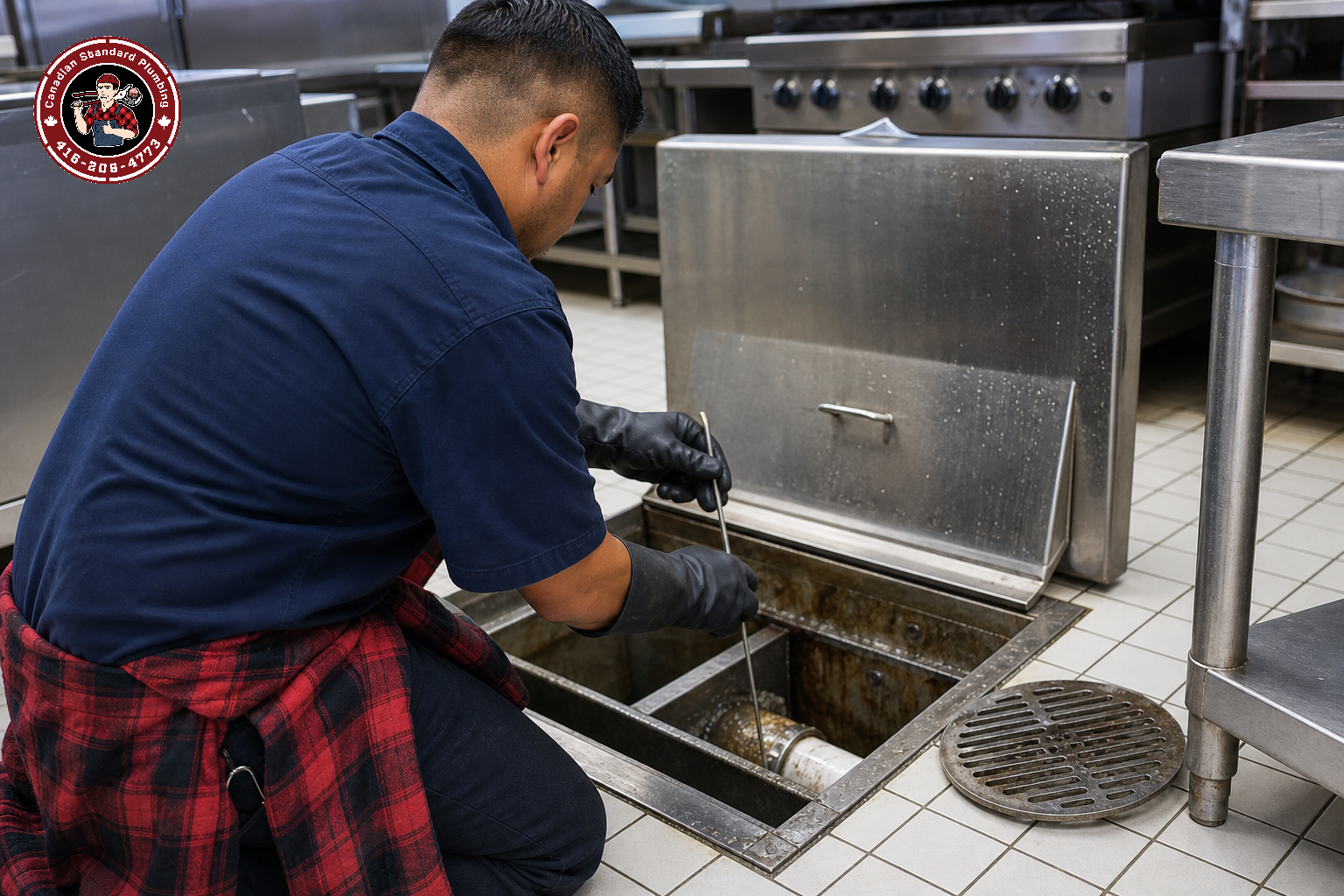
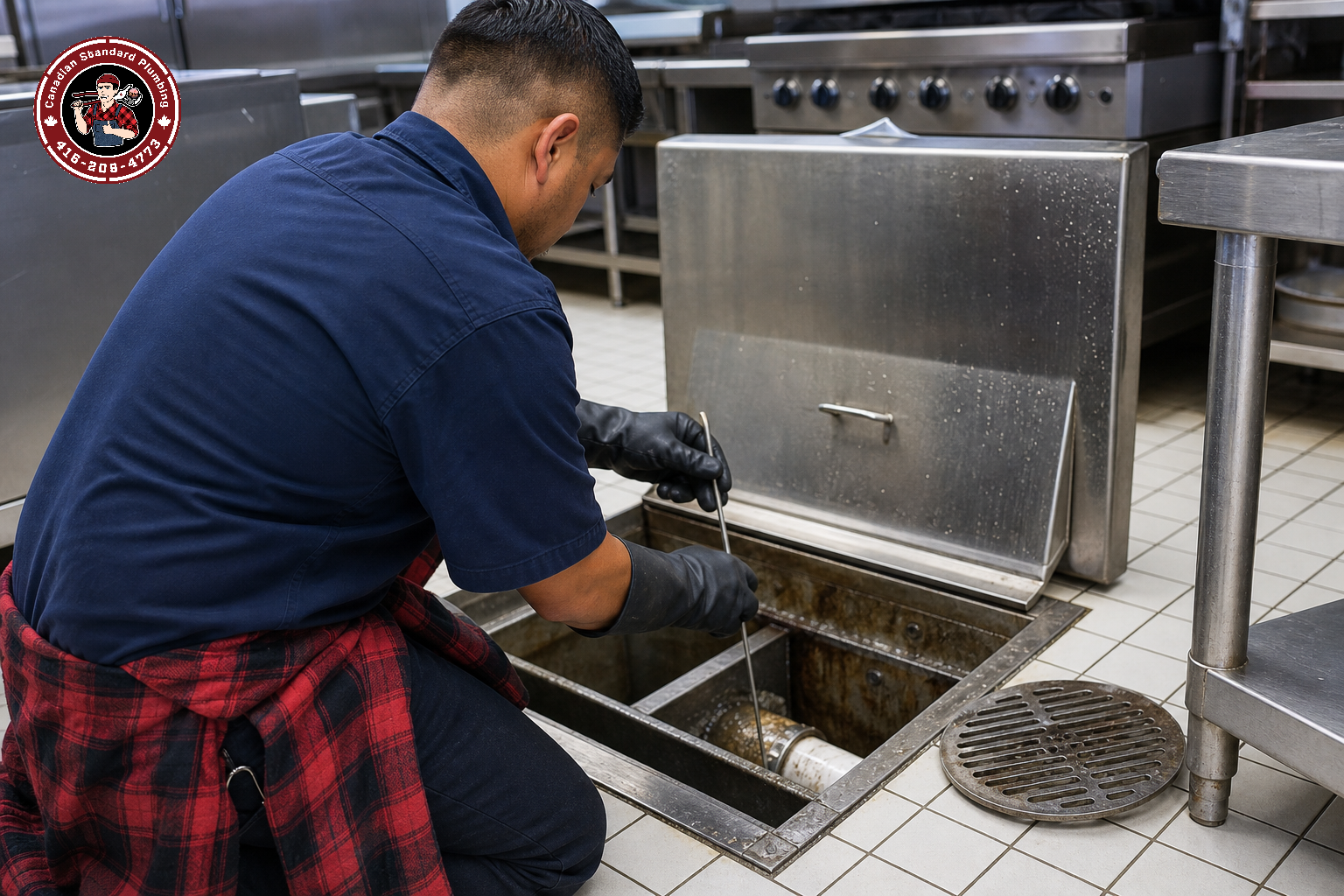
A grease interceptor works on retention time and temperature. Warm wastewater enters, slows down, cools, and the FOG floats to the top while solids settle to the bottom. Relatively clean water leaves from the middle. That is the whole trick, and every failure mode is a variation on “the water did not slow down or cool down enough”.
Here is what we find in Markham kitchens, roughly in order of frequency:
| What we find | Why it causes a Friday-night backup | What it usually takes to correct |
|---|---|---|
| Interceptor overdue for cleaning | The grease layer thickens until there is almost no clean water zone left, so FOG carries straight through to the branch line | Full pump-out plus a realistic service interval based on your actual volume, not a generic schedule |
| Dish machine or high-temp sink discharging into a small under-sink unit | Hot, detergent-heavy water keeps grease liquid and emulsified so it never separates, then it cools and hardens further down the pipe | Re-routing fixtures or moving to properly sized interception, confirmed against local requirements |
| Missing, broken or displaced internal baffle / inlet tee | Water short-circuits across the top of the unit instead of slowing down, so separation barely happens | Internal component replacement, sometimes unit replacement if the housing is degraded |
| Interceptor is fine, but the line downstream is coated | Years of pre-interceptor or bypassed grease has already lined the branch and lateral walls | Hydro jetting to scour the pipe wall, then camera verification |
That last row is the one owners hate hearing, because they have been paying for interceptor service faithfully and still get water on the floor. Pumping the interceptor does nothing for a lateral that is already lined with hardened FOG. Two separate problems, two separate fixes.
A grease interceptor separates FOG using retention time and cooling, so anything that speeds water up or keeps it hot (dish machine discharge, a broken baffle, an overdue pump-out) sends grease downstream. A clean interceptor does not guarantee a clean lateral, which is why camera inspection matters after the pump-out truck leaves.
3. What an actual blocked main looks like in a commercial kitchen
A blocked main in a Markham restaurant or a Thornhill plaza unit announces itself across the whole building, not just at the kitchen floor drain. The tells we look for:
- The staff or customer toilet gurgles or bubbles when the dish pit drains. That is air being displaced by water it cannot get past.
- Water appears at the floor drain when nothing in the kitchen is running, because someone flushed elsewhere in the building.
- The problem is getting monotonically worse week over week rather than tracking your service volume.
- The exterior or basement cleanout is under pressure, damp, or weeping when you crack the cap. Handle that one carefully.
- There is a sewage odour rather than a rancid-fat odour. They are genuinely different smells, and once you have smelled a two-year-uncleaned interceptor on a humid August afternoon you never mistake it again.
Causes of a genuine main blockage in older parts of Markham, Unionville and neighbouring Richmond Hill skew toward root intrusion at joints, a sagging or bellied section holding water and solids, and old clay or cast sections that have scaled and cracked. In newer plaza builds and strip retail, we see construction debris and, more often than anyone admits, wipes and dish-pit debris from a missing sink strainer.
4. How we separate the two in one visit
We work the system in order, from the fixture outward. Skipping steps is how a shop ends up jetting a lateral that was never the problem.
Open and inspect the interceptor
We measure the grease cap and solids layer, check the inlet and outlet tees and baffle, and confirm which fixtures actually discharge into it. Kitchens get renovated; drainage rarely gets re-documented.
Run a real flow test, not a trickle test
We load the system the way Friday service loads it: multiple fixtures at once. A restriction that only shows under load will never appear if you run one tap and watch.
Camera the branch and the lateral
The camera shows the difference between a smooth pipe with a soft grease coating, a root mass, a belly holding water, and a fractured section. Those four findings lead to four completely different repairs.
Locate and mark the defect above ground
If there is a structural defect, we locate the camera head from the surface so you know whether it sits under your kitchen slab, under the parking area, or beyond your property line where responsibility may shift.
Written findings and a written quote before anything else happens
You get the footage, the location, and a scope you can hand to a landlord or property manager. Nobody should be approving underground work off a verbal description.
5. Cabling versus hydro jetting, and why it matters for grease specifically
A drain cable punches a hole through the obstruction. For a root mass or a hard object, that is often exactly right. For grease, it is a temporary reprieve, because the pipe wall stays coated and the hole closes back in as the FOG rebuilds around it. That is why so many restaurants end up on a monthly cabling cycle that never actually improves anything.
Hydro jetting scours the full circumference of the pipe wall and flushes the material out rather than through. For a grease-lined commercial lateral it is usually the correct tool. The caveat: jetting an old, cracked or heavily deteriorated line can make an existing structural problem obvious in an unwelcome way, which is exactly why we camera first and jet second, never the reverse.
6. The mistake that turns a service call into a parts job
The single most common self-inflicted wound we see, in homes and in kitchens alike, is repeated chemical drain cleaner poured into a slow drain. The lye attacks the rubber gaskets inside traps and fittings. What started as a slow drain becomes a trap and fitting replacement, and in a commercial kitchen that means downtime you did not schedule.
There is a second problem nobody mentions: if the caustic sits in a partially blocked line and the next person on site opens that joint or runs a cable, they are working in it. We would rather arrive to an untouched slow drain than a chemically loaded one.
Enzyme and bacterial dosing programs are a different animal and can genuinely help maintain a line between services. They are maintenance, not rescue. Nothing in a jug clears a lateral that is already restricted.
When the Answer Is Different
The “Friday night means grease” rule is a strong starting point for a Markham restaurant floor drain backup, but there are real exceptions and they change the plan entirely.
You share a lateral with other units in the plaza
In multi-tenant retail plazas across Markham, Richmond Hill and Concord, several units often tie into a shared building drain. If the bubble tea shop two doors down or the hair salon next to you is loading that shared line, your floor drain can back up while your own kitchen behaves perfectly. This is a landlord and property manager conversation, and camera footage with a surface-marked location is what turns that conversation into action instead of a shrug.
It only happens after heavy rain or spring melt
If your backup correlates with weather rather than service volume, grease is probably not the driver. Now we are looking at groundwater infiltration through cracked pipe, a compromised joint, or a downstream surcharge condition. Same camera, entirely different findings and repair path.
The drain smells but never overflows
A floor drain that stinks without backing up is usually a dried-out trap seal, especially in a rarely used mop area or a walk-in vestibule, or a venting issue pulling the seal out. Pouring water down it periodically is a legitimate first test. If the smell returns within days of refilling the trap, that points toward a venting problem, and venting is its own system with its own rules that need to be checked against the Ontario Building Code by your plumber.
You are a residential homeowner reading this because your basement floor drain backs up
The logic transfers, but the culprits change. In a Thornhill or North York home there is no grease interceptor, so a basement floor drain backup that happens on laundry day is usually a restricted main from roots, scale in older galvanized or cast sections, or a belly. The floor drain is still the lowest opening in the house, which is why it floods first even when the actual problem is fifteen metres out in the front yard.
Our take after years of GTA drain work
Restaurant owners overweigh the interceptor pump-out and underweigh the pipe between the interceptor and the street. We understand why: the pump-out is the visible, invoiced, scheduled thing. But we have opened cameras into laterals behind spotless, freshly serviced interceptors and found the pipe wall lined like an artery. The interceptor was doing its job for today’s grease. It has no ability to undo five years of yesterday’s.
What actually matters, in order: know which fixtures feed your interceptor (a surprising number of kitchens have a prep sink or a wok station bypassing it entirely after a renovation), get a camera baseline of your lateral once so you know what “normal” looks like for your building, and match your service interval to your real volume rather than the interval the last operator used. A dessert cafe and a Korean BBQ house on the same street do not have the same FOG load.
The one thing we would tell a friend opening a kitchen in Markham: train the staff on the scrape-and-strainer routine before you spend a dollar on drain service. Dry-wiping pans into the waste bin and keeping strainers in every sink does more for your drainage than anything we sell you. And the emergency calls we take at 11 p.m. are rarely from operators who did that. We do run 24/7 emergency response, and we would genuinely rather see you on a Tuesday morning with a camera than on a Friday at 9 p.m. with a shop vac.
On cost: what drives the number is access (is there a usable cleanout, or do we need to create one), the length and condition of the run, whether jetting is required versus cabling, and whether the camera turns up a structural defect that needs excavation. We quote in writing before the work starts, and the camera findings come with it, so you are approving a scope and not a hope.
Frequently Asked Questions
How often should a Markham restaurant have its grease interceptor cleaned?
Grease interceptor cleaning frequency in Markham depends on your unit’s capacity and your actual FOG volume, not on a universal calendar rule, and local sewer use requirements set the baseline you must meet. A high-volume fryer or wok kitchen typically needs service far more often than a cafe or bakery. Confirm your required interval with the City of Markham and York Region requirements and have your plumber verify it against the grease layer you are actually accumulating between services.
Can hot water and dish soap clear grease out of a restaurant drain line?
Hot water and dish soap do not clear grease from a restaurant drain line, they relocate it. Detergent emulsifies FOG and hot water keeps it liquid just long enough to travel past your interceptor, where it cools in the cooler underground lateral and hardens onto the pipe wall. This is one of the most common reasons a Markham kitchen with a well-maintained interceptor still gets a Friday-night floor drain backup.
Who pays for a blocked sewer line, the restaurant tenant or the landlord?
Responsibility for a blocked sewer line in a Markham commercial tenancy is determined by your lease and by where the defect physically sits, which is why a located camera inspection is the deciding document. If the restriction is inside your leased premises and caused by kitchen FOG, that is usually the tenant. If it is a structural failure in the shared building drain or beyond, the landlord or property manager is generally on the hook, and municipal responsibility may begin at the property line.
Is a drain camera inspection worth it if you already know the drain is slow?
A drain camera inspection is worth it precisely because “slow” has at least four different causes, and each one has a different fix: soft grease coating (jetting), roots (cutting plus a root plan), a belly holding water (excavation or relining), or a fracture (repair). Without footage, a Markham restaurant can spend a year cabling a line every month and never address the actual defect. We provide the footage and the surface-marked location so you can hand it to a landlord or insurer.
Sources
- Municipal requirements for grease interceptors and discharge to the sanitary sewer in Markham – City of Markham
- Regional wastewater collection and sewer use responsibilities for Markham, Richmond Hill, Vaughan and Aurora – The Regional Municipality of York
- Plumbing, drainage and venting requirements referenced in this article – Ontario Building Code, O. Reg. 332/12
- Sewer use and fats, oils and grease guidance for commercial kitchens in the wider GTA – City of Toronto, Water and Environment
Diagnostic patterns and field observations described above reflect our own service experience across Markham, Richmond Hill, Vaughan, Thornhill, Concord, North York and Etobicoke. If you want your building’s specific situation assessed, reach out and we will book a camera inspection.
Have a similar question about your kitchen drains?
Owner-operated, led by Daniel Klasner and his team. Emergency response available 24/7 across the GTA and York Region, with written findings and a written quote before any work begins.
🎧 Listen to article
- The Thornhill Family Whose Drain Backed Up into Three Fixtures at Once — What Our Camera Found at 11 PM
- A Thornhill Property Manager Asked: “Our Condo Building Has Low Water Pressure on the Top Two Floors — What’s
- How We Cleared a Grease-Clogged Main Stack in a Concord Townhouse — and Why Snaking Alone Wasn’t Enough
- A Customer Asked: “Does Drain Camera Inspection Actually Find the Problem or Is It Just an Upsell?” — We Answe
- A Customer Asked: “Why Is My Water Heater Making a Popping Noise at Night?” — Our Honest Answer