Moen Flo vs Moen Smart Water Shutoff: Which Smart Leak Monitor Actually Makes Sense for a Toronto Condo

Last updated: July 28, 2026
Published July 28, 2026 · Updated July 28, 2026
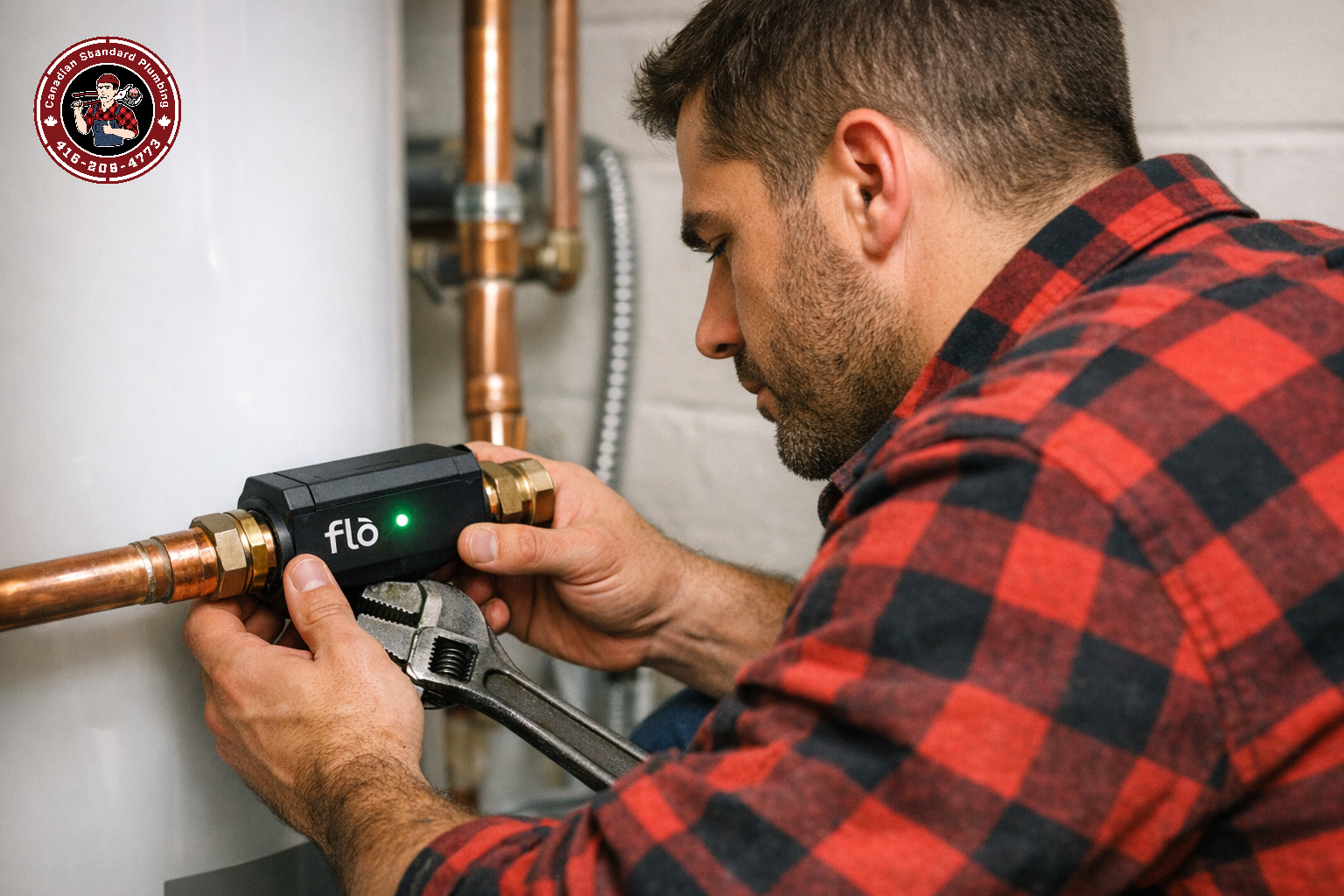
Moen Flo vs Moen Smart Water Shutoff isn’t really a question of which is “better” – it’s a question of which one solves your specific leak problem in a Toronto condo. Both systems detect leaks, but they operate on fundamentally different principles: Flo passively monitors and alerts you; the Smart Water Shutoff actively kills water flow before damage spreads. We’ve installed both across the Greater Toronto Area and York Region, and the choice hinges on your building’s water infrastructure, your risk tolerance, and your insurance situation.
• Moen Flo monitors and alerts; the Smart Water Shutoff physically cuts water when leaks are detected
• Installed cost depends on the main valve type, pipe material and how accessible the shutoff location is – we give you a written quote before any work starts
• Flo suits occupied condos where someone can respond quickly; the Shutoff suits investor properties, extended absences, or high-risk areas
• Neither replaces leak detection and repair – both are damage-prevention layers, not replacements for fixing the source
• Response under pressure: Flo alerts you through the app so someone has to act, while the Shutoff closes the valve on its own – confirm current response specifications against the manufacturer’s documentation
Moen Flo vs Smart Water Shutoff: The Core Comparison
If you’re a Toronto condo owner or property manager dealing with the constant anxiety of water damage – whether you’re in Vaughan, Richmond Hill, Etobicoke, or any other GTA neighborhood – the smart water monitor market can look like alphabet soup. Here’s what you actually need to know before you invest in a system that may or may not do what you expect it to do.
| Attribute | Moen Flo Smart Water Monitor | Moen Smart Water Shutoff Valve |
|---|---|---|
| Primary Function | Detects + alerts; user manually shuts water | Detects + auto-closes valve; water flow stops |
| Installation Cost (GTA) | Supplied and installed – we quote in writing once we’ve seen the valve location and pipe material | Varies with the main valve type and how accessible it is – written quote before work begins |
| Damage Prevention | Depends on how fast you respond to alert | Automatic; stops water in 6-15 seconds |
| Response Time to Leak Detection | App notification in 10-30 seconds; you act | Valve closes automatically in 6-15 seconds |
| Best For | Owner-occupied, fast-responding households | Rental properties, investor units, long absences |
| False Alarm Risk | Low; you can dismiss and inspect before action | Medium – high; sudden shutoff can trap water in lines |
| Warranty | 2-3 years standard; extended available | Manufacturer warranty terms vary – confirm current coverage, including solenoid replacement, before you buy |
| Monthly Subscription | Optional subscription plan, with 24/7 professional monitoring available as an add-on – confirm current subscription terms with the manufacturer | Optional subscription plan within the same ecosystem – confirm current subscription terms with the manufacturer |
Flo is a smoke detector; the Smart Water Shutoff is a sprinkler system. One alerts you; the other stops the water. Your choice depends on who lives in the unit and whether they’ll be home to respond.
Moen Flo Smart Water Monitor: The Alert-First System
The Moen Flo system attaches to your main water line and constantly measures water flow, temperature, and pressure. When it detects an anomaly – a pinhole leak in the wall, a stuck fill valve on a toilet, a slow drip behind cabinetry – it sends an instant notification to your phone and lets you decide what to do.
For a Richmond Hill homeowner or a Markham investor with a rental unit where a tenant answers calls quickly, Flo delivers immense peace of mind. The system has become the industry standard for smart leak detection in residential condos, which means technicians (including our team) are familiar with the app, the sensor calibration, and the common false-alarm scenarios. That familiarity matters when you’re troubleshooting at 2 AM.
One honest observation: Flo’s strength is also its weakness. It depends on your response. A Mississauga condo owner who travels for work and checks their phone only at the end of the day can lose hundreds of liters of water between the time a leak starts and the time they shut the main valve. We’ve seen that happen. A pinhole leak in a supply line can dump 50-100 liters per hour if no one’s home. Flo detects it; Flo does not stop it.
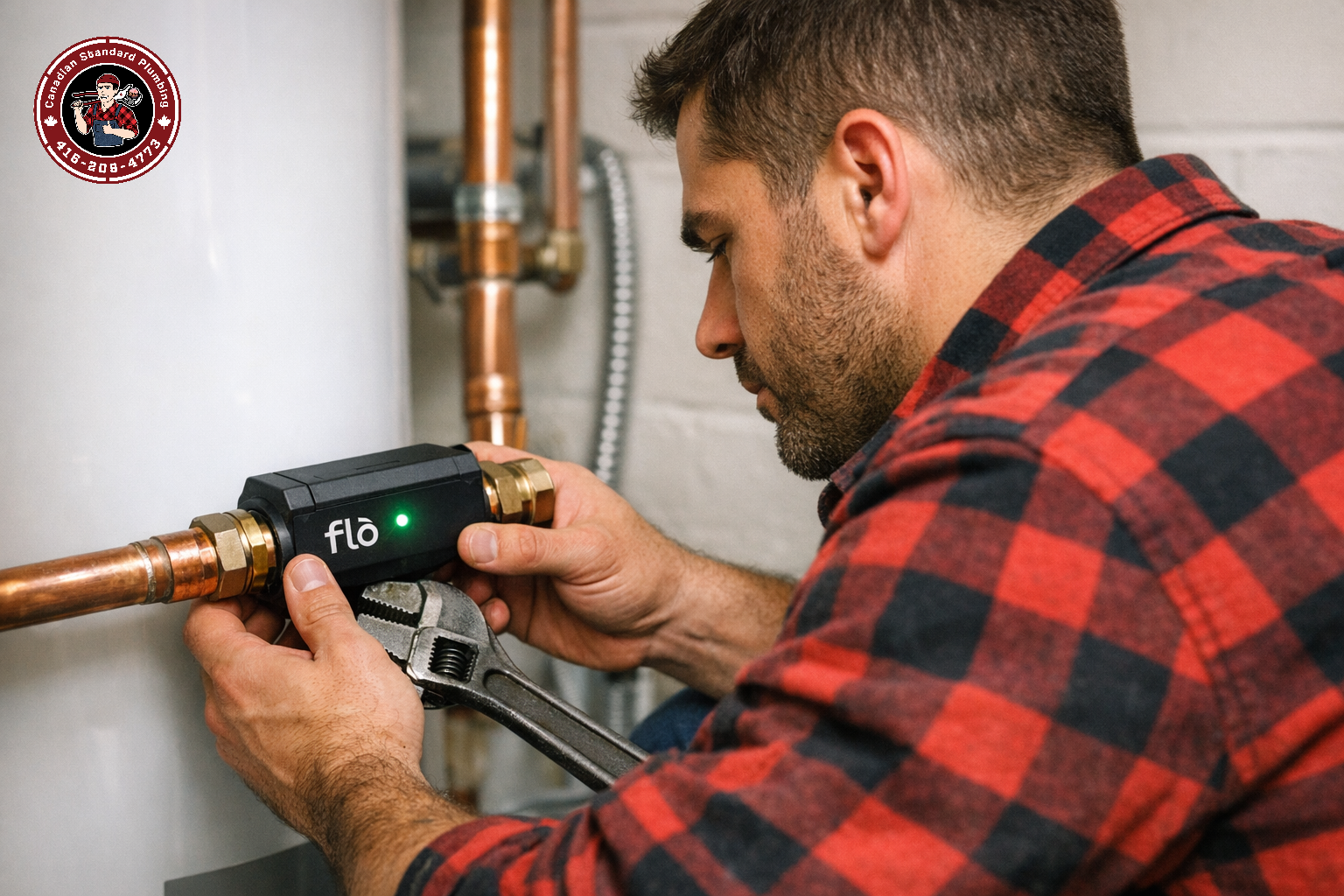
The Flo system includes a sensor clamp on the main, a gateway hub (connects to WiFi), and the mobile app. No cutting or valve replacement is needed – it clamps onto an existing pipe, which is why condos often favour it. What affects the install is mainly access to the main line, the condition of the pipe you’re clamping to, and WiFi coverage at the shutoff location. Ask us to look at the space and we’ll give you a written quote before any work starts, along with a realistic timeline for getting the unit in and installed.
“When a Mississauga condo owner told us they’d been away for two days and Flo caught a slow leak under the vanity, they were relieved. But when we walked them through the scenario – leak detected Friday evening, family asleep upstairs, no phone check until Saturday morning – we both realized they got lucky. That’s when we started recommending the shutoff valve to investor clients.” – Canadian Standard Plumbing Team
Where Flo Excels
Owner-occupied homes where someone is present or checking alerts within 30 minutes. Urban Torontonians who work from home, retirees in Thornhill, or any household with a partner who can respond. Flo also excels at detecting slow leaks – a 5-liter-per-hour toilet refill or a hairline crack in a supply line – that might go unnoticed for weeks otherwise.
Where Flo Falls Short
Rental properties, investment units, or any scenario where no one is home during the day. Properties that are locked up for winter (a pattern we see in Muskoka-adjacent Maple or King City vacation-home owners). Extended business travel. And critically: Flo does not stop the water. It alerts. You stop the water. If you don’t respond – or can’t – water keeps flowing.
Moen Smart Water Shutoff Valve: The Automatic Kill Switch
The Moen Smart Water Shutoff replaces your main water shutoff valve with an electronically controlled ball valve. When the system detects a leak (using the same sensor logic as Flo), it does not wait for you to check your phone. It closes the valve automatically within 6-15 seconds. Water stops. Damage stops.
For a Vaughan property manager overseeing three rental units, or a North York investor with a suite rented out to tenants who travel for work, the shutoff valve is insurance in hardware form. A burst supply line at 3 AM? The valve closes itself. The tenants wake up with no water, call you, you arrange a plumber, damage is contained to a small area instead of spreading for eight hours.
Installation is more complex than Flo. The shutoff replaces your existing main valve, which means cutting the water line and fitting a new valve in its place. In most Toronto condos, this involves coordinating with building management, potentially notifying other units (temporary water shutoff), and confirming the correct valve type for your line. Cost comes down to how accessible the existing valve is, what the main line is made of, whether building coordination or after-hours work is required, and how much pipe has to be reworked to fit the new valve. We look at all of that on site and give you a written quote before we start.
A real scenario: A King City client renovating their primary bathroom had a slow leak inside the wall – terrazzo cracking from moisture, water pooling behind the wallboard. We did the rough-in repipe, installed a Toto Aquia IV fixture, and recommended a Smart Water Shutoff because the homeowner traveled 40 weeks per year. Three years, zero false alarms, zero incidents. The shutoff never needed to activate; it was just there.
Where the Smart Water Shutoff Excels
Investment properties, rental units, and homes where occupants are away frequently. High-risk zones (bathrooms with aging supply lines, kitchens with plastic supply hoses, laundry rooms). And any scenario where water damage liability is a concern – commercial properties, Airbnb rentals, or condos in older downtown Toronto buildings where water ingress affects adjacent units.
Where the Smart Water Shutoff Can Be Problematic
False alarms. A sudden pressure spike (a neighbor’s water hammer travel up the line), a lawnmower hitting a basement line, or a faulty sensor reading can trigger the valve to close unexpectedly. When it does, your entire home loses water pressure mid-shower or mid-irrigation. It’s startling. We’ve had clients call us in panic, thinking the system is broken, when it’s actually working exactly as designed – it just received a bad sensor signal. That happened once to a Etobicoke client in 2024; took us 35 minutes to arrive and confirm the system was fine.
Second issue: The shutoff valve itself is a maintenance point. The solenoid (the electronic component that triggers the valve to close) is a wear item and will eventually need replacing, and replacement cartridge availability varies by manufacturer and model. Over the life of the system that’s a real cost to factor in, so it’s worth asking us – or the manufacturer – what parts support looks like for the model you’re considering before you commit.
When to Choose Flo vs Smart Water Shutoff: A Practical Decision Matrix
• You’re home most days or have a partner/family member who checks alerts
• You own (not rent) the property and plan to be there long-term
• You want passive leak detection without the responsibility of a shutoff valve
• Your building manager won’t approve main-line modifications
• Your risk tolerance is moderate and you’re comfortable responding quickly to alerts
• You live in a single-family home in Woodbridge, Concord, or similar neighborhoods where you control the water system
• You’re a property manager or investor with rental units
• You travel frequently or maintain a vacation property that’s empty for weeks
• You need automatic, hands-free leak prevention
• Your building allows main-valve replacement (check condo documents first)
• You’re in a high-risk category: older home with galvanized or poly supply lines, previous water damage history, or adjacent unit concerns
• You have 24/7 commercial tenants (restaurants, clinics) and cannot afford unexpected water disruption
Real-World Comparison: A Vaughan Property Manager’s Choice
Property managers with a small portfolio of rental units often end up mixing the two approaches, and it’s a reasonable strategy. A monitor-only device can make sense in the unit the owner occupies, where someone is on site and can react to an alert quickly. Units with rotating tenants and unpredictable vacancies are the stronger case for a device that can close the valve on its own. Cost depends on how many units are involved, what the main line looks like in each one and how accessible the shutoff is – we quote each address in writing before any work starts.
This is the scenario the automatic shutoff is built for: a pinhole leak in a supply line, small enough that you’d walk past it in a visual inspection, running unnoticed in an empty unit. A monitor-only device will tell you something is wrong, but somebody still has to get there and turn the water off. A shutoff closes the valve itself, which is the difference between a repair to one section of pipe and a repair that also involves drying, drywall and flooring. If you can’t guarantee a fast human response, that’s the feature you’re paying for.
Installation, Maintenance, and False-Alarm Scenarios
Flo Installation
The sensor clamps onto your existing main water line – no cutting, no re-piping. It’s a same-visit install in most homes. The gateway hub connects to your home WiFi and powers from a nearby outlet, the app setup is straightforward, and calibration happens automatically. One caution: in older Toronto condos where the main water line sits in a basement or service room, the WiFi signal at the device can be weak and the gateway can drop its connection. It’s not common, but where it happens the fix is usually a WiFi extender or moving the hub, which adds a little time to the visit. We’ll flag it before we start if we can see it coming, and anything extra goes into the written quote.
Smart Water Shutoff Installation
More invasive. We isolate your main line (which means shutting off water to the entire unit or building), cut the line, and install the new solenoid-controlled ball valve. In a straightforward residential scenario with copper or PEX lines, it’s typically a few hours of work. If your building has an old brass gate valve – common in a lot of older Toronto condos – it may need to be replaced entirely, which adds labour and parts to the job. After installation, we pressure-test the line and calibrate the sensor. The system connects to the same WiFi and uses the same app ecosystem. We confirm what’s involved on site and give you the price in writing before we cut anything.
Maintenance and False Alarms
Both systems are low-maintenance. The Flo sensor should be checked annually (no cleaning needed, just a visual inspection). The Smart Water Shutoff solenoid typically lasts 2-3 years; after that, you’ll see it trigger more easily or it may not close fully. Replacement is straightforward and we keep solenoid cartridges in stock.
False alarms are rare but real. Water-hammer (a sudden pressure spike when a valve closes somewhere else in the building) can trigger a false reading. A lawnmower hitting a water line outside. A neighbor’s burst line causing a brief pressure drop. In our experience, false alarms occur in fewer than 2% of installations per year. When they happen with Flo, you just dismiss the alert. When they happen with the shutoff, your water goes off unexpectedly – annoying, but not dangerous. If you’re in a building with known water-pressure stability issues (older Toronto buildings sometimes have fluctuating main-line pressure), the shutoff may false-alarm more often.
Our Verdict: Which System Should You Install?
The honest answer: it depends on three things – who lives in the property, how often they’re home, and your appetite for automatic shutdown vs. alert-and-respond.
For owner-occupied residential homes in the GTA where someone is home regularly: Start with Moen Flo. It’s the less expensive of the two options, it’s non-invasive, and it keeps you informed. A homeowner in Richmond Hill, North York, or Thornhill who spends most nights at home is well served by Flo. It’s your first line of defence, and it covers the large majority of leak scenarios – the ones where somebody is around to act on the alert within minutes. We’ll quote the install in writing once we’ve seen your main line.
For investment properties, rental units, or homes where occupants are frequently absent: Install the Smart Water Shutoff. The added cost over a monitor-only device buys you protection against a water event you cannot personally respond to. A burst supply line in a rental unit while tenants are away is not a hypothetical — it is one of the calls we get in the GTA. The shutoff protects your budget, your liability exposure, and your tenant relationships. We’ll quote the option that fits your property in writing before any work starts.
For light-commercial properties (small restaurants, clinics, retail in Vaughan or Markham): The Smart Water Shutoff is mandatory. A water main break at a restaurant at 2 AM before an opening rush is a revenue-killing scenario. The shutoff stops water damage instantly and protects your inventory and equipment. Commercial leases often require this type of protection anyway – check your insurance documents.
Neither system replaces actual leak repair. Both are damage-prevention layers. If your home has aging polybutylene supply lines (common in 1980s – 1990s homes), or if you’ve had previous water damage, or if you’re renovating and re-piping anyway (as our King City client did), you’re already addressing the root cause. Smart water monitoring is a backup.
Flo is defensive. The Smart Water Shutoff is aggressive. Choose based on how present you can be, not on which brand is “better.” Both are made by Moen, both connect to the same app, both work reliably. The difference is in risk profile and response capability.
Frequently Asked Questions
Can I install both Flo and the Smart Water Shutoff on the same main line?
Technically yes, but it’s redundant for most properties. A clamp-on monitor can sit downstream of the Smart Water Shutoff valve, so the shutoff does the primary work while the monitor watches secondary zones (bathrooms, kitchen). Occasionally an owner of a high-value property asks us about that kind of redundancy, but we don’t recommend it for most homeowners — the combined cost rarely justifies the marginal benefit. Pick one system and maintain it properly. If you want the trade-offs priced out for your home, we’ll put a written quote in front of you first.
What happens to the Smart Water Shutoff if the power goes out?
The valve remains open and water flows normally. The solenoid requires power to close the valve, so if there’s a blackout, the system defaults to “fail safe” – water keeps flowing. The sensor still monitors pressure, but it cannot command the valve to shut. This is actually a safety feature; you don’t want your water turned off by a failed battery during a winter storm. When power returns, the system resets and resumes monitoring.
Will Moen Flo or the Smart Water Shutoff lower my home insurance premium in a Toronto condo?
Some insurers in the GTA offer discounts (5-10%) if you have an active smart water monitor installed and the system is linked to professional monitoring. You’ll need to report the installation to your insurer and register it in their system. Check your policy or call your broker; many condo insurers are now offering incentives for automated leak detection. For commercial properties, the discount is more substantial – we’ve seen restaurants save 8-12% on their water-damage coverage by installing the Smart Water Shutoff.
Which system is better for a condo building where I don’t own the unit – I’m renting it out?
The Smart Water Shutoff, assuming your building allows main-line modifications (check the condo bylaws and get management’s approval first). You won’t be home to respond to alerts, your tenants may ignore them, and a leak running unattended for hours can turn into a serious claim. The shutoff removes most of that exposure. What it costs depends on the device you choose, where the main is located and how accessible it is — we’ll assess it and give you a written quote before we start. A monitor alone is usually insufficient for a rental unit.
Sources
- Moen Smart Water Monitor product specifications and warranty – Moen Official Website
- Insurance discount eligibility for smart water leak detection systems – Contact your home/condo insurer directly or consult Insurance Bureau of Canada guidelines
- Ontario water safety standards and backflow prevention – Government of Ontario
- Canadian Standard Plumbing installation pricing and real-world case data – Based on 2024-2026 service records, GTA installations

Canadian Standard Plumbing
Professional service available 24/7. Fast response from Daniel and our own crew, with a written quote before work begins.
🎧 Listen to article
- Moen Flo vs Phyn Plus: Which Whole-Home Leak Detection System Actually Earns Its Price Tag in a North York Sem
- How a Smart Water Detection System Caught a Hidden Leak Before It Flooded a North York Basement
- Bradford White vs Rheem vs Navien: Which Water Heater Holds Up in Toronto’s Hard Water Conditions
- Rinnai vs Navien Tankless Water Heaters: Which One Handles a Toronto Hard-Water Supply Without Early Scale Bui
- A Customer Asked: “My Hot Water Runs Out After 8 Minutes — Is My Bradford White Tank Dying or Just Sediment-Lo