A Markham Homeowner Asked: “Can You Fix a Pinhole Copper Pipe Leak Without Replacing the Whole Line?” — Our Field Answer

Last updated: July 24, 2026
Published July 24, 2026 · Updated July 24, 2026
Yes – a pinhole copper pipe leak in Markham can often be fixed without a full repipe, but only if three conditions align: the leak is isolated (not a pattern across multiple spots), the pipe wall is still sound, and you catch it before internal corrosion spreads further. We repair isolated pinholes with an epoxy repair sleeve or a solder patch, depending on what the pipe will take, and we’ll tell you honestly how long we expect that repair to hold. A full repipe becomes the better call when you’ve got multiple leaks, significant mineral buildup, or copper that has thinned to the point where patching is only a band-aid. Either way, you get a written quote from us before any work starts.

The Short Answer: Spot Repair vs. Full Pinhole Copper Pipe Leak Repair Markham Replacement
We can fix a single, isolated pinhole copper pipe leak without a full repipe using either an epoxy repair sleeve (our preferred first step) or a solder patch, depending on the pipe’s accessibility and wall condition. Done on sound pipe, that repair can serve for years – and we’ll give you our honest read on the remaining life of the run before you decide. If your leak is part of a pattern – two or more pinholes within the same run, corrosion visible on the exterior, or active leaking at a fitting – then the copper has usually reached its end-of-life, and patching becomes temporary. In those cases, pinhole copper pipe leak repair in Markham shifts from a targeted fix to a full repipe decision.
The key question we ask during every site visit: Is this one leak, or is it the first of many? That distinction determines whether you’re looking at a short targeted repair call or planning a full repipe – two very different jobs, and we’ll quote both in writing so you can weigh the trade-offs before committing.
The Full Answer: When Patching Works and When It Doesn’t
Condition 1: The Leak Is Truly Isolated (Not Part of a Corrosion Trend)
A single pinhole in a 15-20-year-old copper line is often just a bad coincidence – a micro-stress point where the copper crystallized slightly, or a manufacturing defect that finally cracked. If it’s the only leak in that run of pipe and the rest of the copper feels smooth to the touch with no visible green oxidation (patina is fine; heavy corrosion is not), a repair sleeve is safe and economical.
We install epoxy repair sleeves in homes across Markham, Richmond Hill, and Thornhill, and in our experience they hold up well when the underlying problem really is a single isolated point of failure. What matters most is the diagnosis – we pressure test the line to confirm the leak originates at that one point and isn’t part of a larger systemic issue, and we give you a written quote covering the testing and the repair before any work starts.
Condition 2: The Pipe Wall Thickness Is Still Adequate
Copper doesn’t thin uniformly. Depending on water chemistry – pH, mineral content, chlorine levels – the inside wall can erode faster in some areas than others. If the pinhole appears on the side of the pipe (not at a fitting, not at a stress point), and there’s no visible pitting or crazing around it, odds are the rest of the wall is still strong enough to hold an epoxy sleeve without risk of the patch pulling away.
A Thornhill property manager we worked with in 2024 had a pinhole appear in a 1992 copper line feeding a bathroom. The pinhole was clean – no surrounding corrosion. We installed a UltraSkid repair sleeve and pressure-tested it to 80 psi. That was over a year ago, and the tenant has had zero issues. The wall thickness was still solid. In contrast, a King City client had three pinholes within one basement section; when we removed a section of pipe to examine it, the interior was visibly calcified and paper-thin in places. That was a full repipe case.
Condition 3: The Leak Isn’t at a Fitting or Joint
Pinholes at fittings – where copper tube meets brass valve or tee – are harder to patch cleanly. The epoxy bond isn’t as reliable on fitting surfaces, and corrosion at that junction often signals galvanic action (incompatible metals reacting in water) that won’t stop just from patching one joint. If the leak is at a fitting, we usually recommend replacing that section of pipe and the fitting itself. What drives the cost of that work is accessibility, the fitting type, and how much pipe has to come out – we’ll look at it and put a written quote in front of you before we begin.
A Richmond Hill homeowner called us at 11 PM with water pooling under the kitchen sink. We arrived, diagnosed a failed braided supply line connector, and replaced it with a stainless braided line plus an emergency shutoff valve that night. That wasn’t a copper pinhole, but the principle is the same: fitting leaks are often faster and simpler to resolve by replacing the component rather than patching it.
Repair Option A: The Epoxy Repair Sleeve (Most Common)
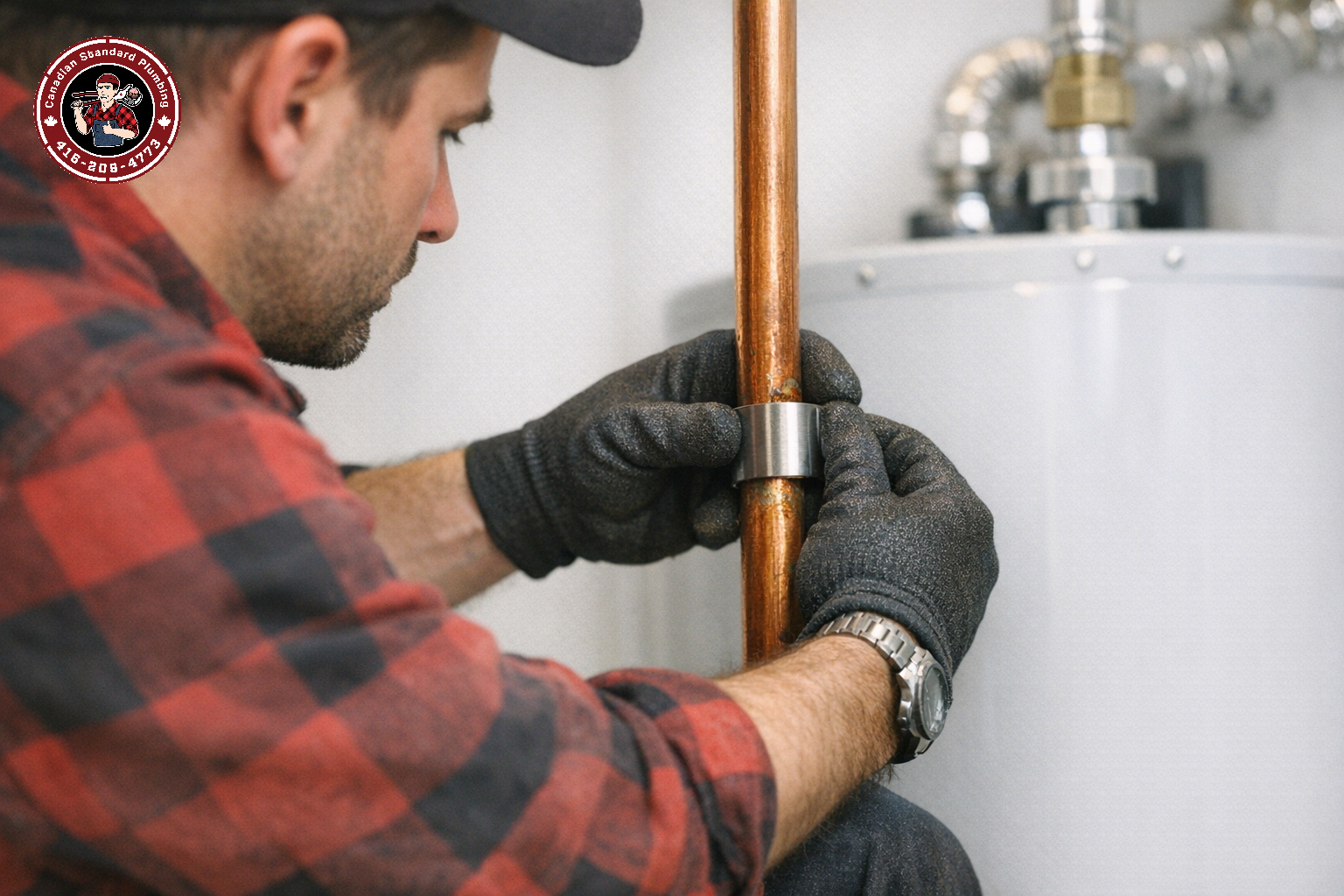
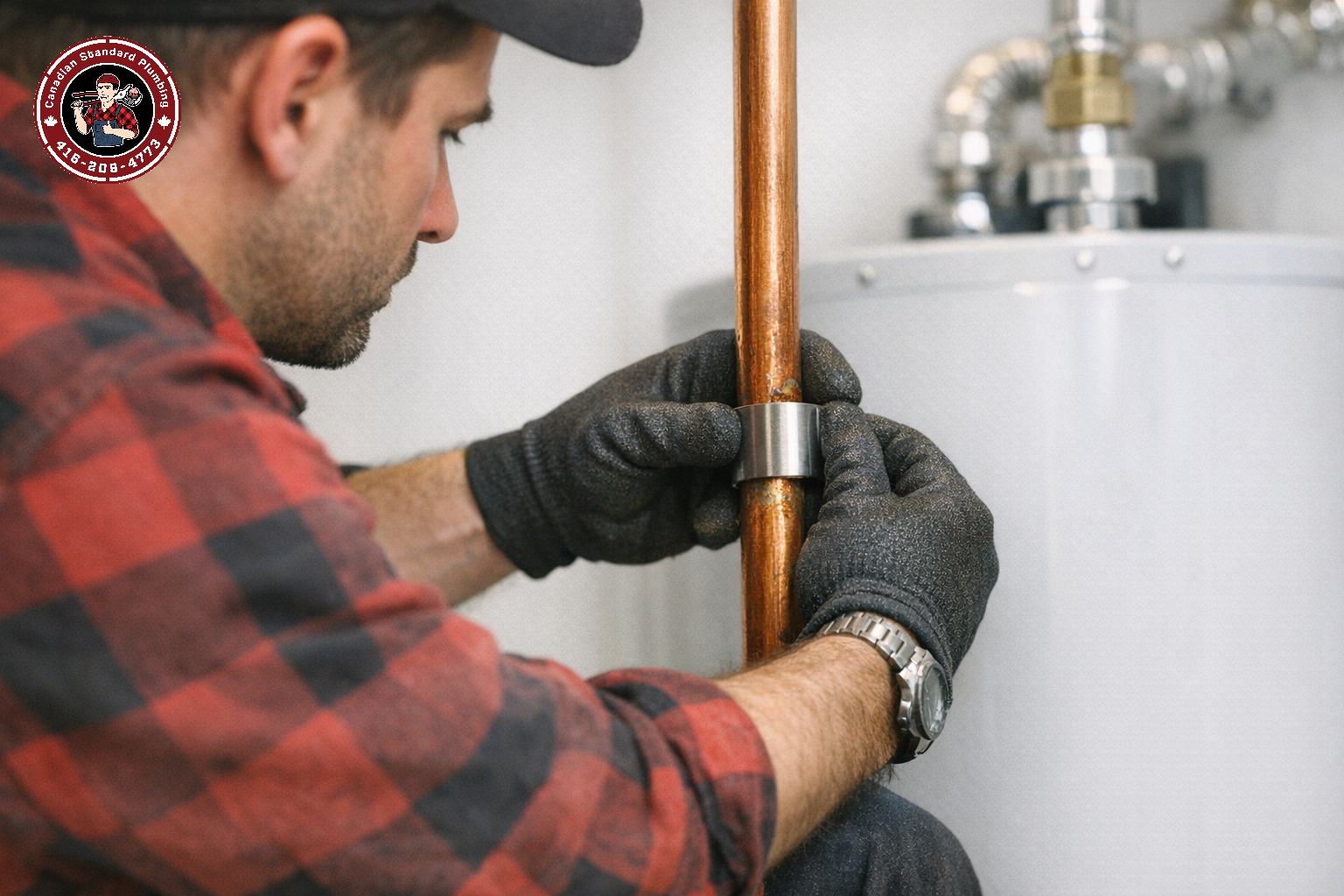
An epoxy repair sleeve (brand names include UltraSkid, Fernco, or SharkBite repair – we prefer epoxy for long-term durability) is a flexible rubber or fiberglass sleeve with a two-part epoxy core that hardens inside and around the pinhole. Installation takes 20-30 minutes if the pipe is accessible.
We turn off the main valve or isolate the line using a zone shutoff. Pressure must be zero before application.
We scrub the pinhole area with fine emery cloth to remove oxide and allow the epoxy to bond. The pipe must be completely dry – we sometimes wait 15 minutes or use compressed air.
We wrap the epoxy sleeve around the pinhole, overlap it by at least 2 inches on each side, and hand-tighten the clamp band. The epoxy begins to cure immediately.
We restore water pressure and monitor the repair for 10-15 minutes. If no moisture appears, the seal is good. Full cure takes 24 hours.
Cost: the main drivers are pipe diameter, how accessible the section is, and whether pressure testing is needed to confirm the source. A line buried behind finished wall or in a tight crawl space takes more time to reach and to close back up, so access work is priced into the job. We’ll assess it on site and give you a written quote before we start.
Lifespan: We warrant epoxy sleeves for 10 years, but field data from our jobs shows 12-15 years is typical. The main risk is if the underlying pinhole was caused by galvanic corrosion (copper + dissimilar metal in acidic water) – in that case, new pinholes may develop nearby within 5-7 years, and you’d eventually need a repipe.
Repair Option B: Solder Patch (Older Homes, Accessible Lines)
If the pinhole is in an accessible, straight section of pipe with good water shut-off capability, we can solder-patch it – a technique that’s been standard since the 1970s. This involves cleaning the pinhole, applying solder flux, and carefully heating the copper to melt solder into and around the hole. It’s permanent (the solder doesn’t degrade), but it requires a skilled hand and poses a small fire risk if the line is near wood framing.
We offer solder patching in accessible basements or utility rooms, and we’ll quote it in writing before we begin. We do NOT recommend it for in-wall lines or near insulation – open flame in a concealed space is a risk that isn’t worth taking. The epoxy sleeve is the safer choice in those cases.
Red Flag #1: Multiple Pinholes (The “Pinhole Pattern”)
If you discover one pinhole and we find a second one during the pressure test – or if a second leak appears within 6-12 months of fixing the first – the copper has systemic corrosion, not bad luck. This is the moment when patching becomes a losing game.
We see this pattern repeatedly on aging copper systems: a pinhole shows up in an upstairs bathroom cold line and gets patched. Some months later another appears on a basement supply line, then a third near the kitchen. At that point the conversation usually shifts from patching to a full repipe, because chasing individual leaks for years rarely ends well. The hard truth is that once systemic corrosion starts, it accelerates.
Red Flag #2: Visible Exterior Corrosion or Heavy Patina
Copper naturally oxidizes to a dull brown or green (patina), and that’s protective. But if the pipe feels granular, has white chalky deposits, or shows crazing (fine cracks in the surface), the corrosion is deep. Patching a pipe in that condition is cosmetic – the pinhole is just where the damage finally broke through. We recommend repipe in these cases.
Red Flag #3: Leaks at Fittings or Joints
A pinhole at the junction of copper tube and brass fitting usually means galvanic corrosion is actively eating both metals. Patching the pinhole won’t stop the chemistry. We’ve learned to recommend fitting replacement (or a short section repipe around the fitting) in these cases – it costs more up front than a patch, but it’s a permanent fix rather than a repeat visit. We’ll give you a written quote for the work before we start.
“The temptation is always to patch the obvious leak. But if the corrosion is systemic, you’re just buying yourself six months of calm before the next pinhole shows up. That’s why we always recommend testing the pressure across the entire run before committing to a patch. It either confirms the patch is safe, or it reveals that a repipe is the only real fix – and we put whichever route you choose in a written quote before we start.” – Canadian Standard Plumbing Team
When Full Repipe Becomes Necessary
A full repipe means replacing the entire run of copper (or all copper lines in the home) with PEX, rigid PVC, or new copper. This is major work, and what it costs depends on the size and layout of the building, how accessible the runs are, how much drywall and finish work is involved, and whether we’re reusing existing rough-ins or rerouting lines. We walk the system first and give you a written quote before any work begins.
| Trigger | Why Patching Won’t Work | Typical Cost (Residential) |
|---|---|---|
| Multiple pinholes (2+) in one run or home | Systemic corrosion; new pinholes will appear in 6-24 months | Quoted in writing after we assess the system |
| Heavy visible corrosion (white deposits, crazing, granular texture) | Wall thickness already compromised; patch is temporary | Quoted in writing after we assess the system |
| Pinhole + low water pressure in home | Likely mineral buildup throughout; internal corrosion widespread | Quoted in writing after we assess the system |
| Leaks at multiple fittings | Galvanic corrosion ongoing; patching won’t stop metal breakdown | Quoted in writing after we assess the system |
The Diagnosis Process (How We Determine If Repair Is Safe)
We never recommend a repair or repipe without first confirming what we’re actually dealing with. For a Markham homeowner with a suspected pinhole, we follow this exact sequence:
We locate the leak, examine the surrounding copper for corrosion, check for secondary stains (signs of older leaks), and identify what type and diameter of pipe we’re dealing with.
We install a test gauge at the main shutoff and bring the supply line up to its normal working pressure — the right figure depends on your home and should be confirmed against local code and by the plumber on site. We then monitor all visible copper runs for additional moisture or leaks. If the pressure holds and no other leaks appear, the patch is likely safe.
We feel the pipe for brittleness, listen for delamination sounds (a faint cracking when we lightly tap the copper), and check the pinhole edges under bright light. If the hole is jagged and the edges crumble, the wall is thin; if it’s clean and the surrounding copper is smooth, wall thickness is probably adequate.
We provide a one-page report detailing whether repair is safe, what the work involves, and what the expected lifespan is, along with a written quote before anything starts. We also note if we recommend a Moen Flo smart shutoff to monitor for future leaks — we’ll quote that separately so you can decide.
This whole process usually takes under an hour, including the pressure test, and we give you a written quote before any repair work begins. You get a clear answer: repair or repipe. No guessing.
A Real Markham Case: Single Pinhole, Patch Decision
In April 2025, a homeowner in Markham called us about a water stain appearing on the basement ceiling below a cold-water supply line. The house was built in 1998 (27 years of copper use). We arrived, found a pinhole in the main cold-water run about 6 feet from the meter.
Visual inspection: the copper around the pinhole was smooth and uniformly brown – no crazing, no white corrosion deposits, no secondary stains. Pressure test: we pressurized to 80 psi and monitored three other sections of the home’s copper (basement, kitchen, upstairs bathroom). No additional leaks. Wall-thickness feel: the pinhole edges were clean, not jagged. The copper was brittle nowhere.
Where the testing points to a single pinhole with no wider pattern of corrosion, our recommendation is usually a sleeve or section repair rather than a whole-home repipe: we make the repair, pressure-test again, and restore water the same visit. A full repipe is a much bigger job, and jumping to it on the strength of one pinhole is premature — the decision comes down to the age and condition of the copper, water chemistry, how many failures you’ve already had, and how long you plan to stay in the building. We’ll walk you through both options and put the numbers for your specific situation in a written quote before any work starts.
A Vaughan Case: Multiple Pinholes, Repipe Decision
One of the more common calls we take is water pooling under an upstairs bathroom vanity in a duplex or two-unit home. More often than not, the source is a pinhole in the cold-water supply line rather than the fixture itself. In that situation a localized repair – an epoxy sleeve or cutting out and replacing the affected section – is one legitimate option, and we put the recommendation and the scope in writing before we touch anything.
The thing to understand is that a single pinhole is often not the last one. When copper starts pitting from the inside, the same conditions exist along the whole run, so a second pinhole can show up months later in a different section of the same line, then a third at a fitting. At that point the question stops being “how do we patch this?” and becomes “is this piping system at the end of its service life?” If the corrosion pattern is systemic, a planned repipe usually costs less overall than a series of separate repair calls followed by the repipe anyway. We will walk you through both paths and give you a written quote for each so you can compare them properly.
The lesson: one pinhole can be safely patched. Two or more pinholes in the same home within a year? That’s the signal to repipe.
When the Answer Is Different: Special Scenarios
Scenario 1: Pinhole in a Wall (In-Wall Copper)
If the leaking copper is behind drywall, we have fewer repair options. An in-wall epoxy sleeve is still possible (we cut a small access hole, apply the sleeve, and patch the drywall), but many homeowners prefer to repipe that section in PEX or new copper to avoid future wall surgery. The cost of a section repipe is driven by the length of the run, how much wall and ceiling has to be opened, and how accessible the connections are at each end. For a single in-wall pinhole with no other leaks, the epoxy patch plus drywall repair is the lighter option – but if the corrosion is systemic, you are buying risk rather than solving the problem. We will quote both approaches in writing before any work starts.
Scenario 2: Pinhole in a Crawl Space or Attic (Hard to Inspect)
If the leak is in a difficult-to-access area and we can’t fully inspect the surrounding copper, we recommend repipe over patch. A patch you can’t monitor isn’t reliable. Repipe with PEX is also safer in attics (no solder heat risk) and in crawl spaces (PEX doesn’t need chased electrical routing like in-wall PVC would).
Scenario 3: Pinhole + Recent Water Treatment Installation
If a homeowner recently installed a water softener, reverse-osmosis system, or pH balancer, and a pinhole appears shortly after, the root cause may be the water chemistry change – acidic water from the RO, or mineral stripping from the softener – rather than the age of the copper. In these cases, we patch the immediate pinhole but recommend adjusting the water treatment to stabilize the pH. A second pinhole shortly after signals that the treatment needs recalibration, not that the whole home needs repipe.
Scenario 4: Light-Commercial or Multi-Unit (Property Managers, Landlords)
For a property manager running three rental units – say, a triplex in North York – a single pinhole repair may still be the economical call, but we recommend being strategic about it. If the units share a water meter or a common cold-water supply, a pinhole in that main line affects all three tenants at once. One option worth discussing is a Moen Flo smart shutoff on the main line, so an unusual flow pattern triggers an automatic shutoff and a phone alert instead of a flooded unit. Whether that makes sense depends on the building, the tenant mix and how quickly someone can physically get on site – we are happy to look at the main and quote it in writing.
A Vaughan property manager with three rental units called us in 2024 complaining about recurring no-hot-water calls from tenants. We diagnosed two issues: pinhole leaks in the cold lines and aging 40-gallon tank water heaters running inefficiently. We converted all three units to a shared Navien tankless system, cut their combined gas bill 28%, and eliminated the leak calls. That was a strategic repipe decision – we replaced the copper and the heating simultaneously.
FAQ: Common Questions About Pinhole Copper Leaks
1. How long does an epoxy repair sleeve really last?
We warrant epoxy sleeves for 10 years, but our field data shows 12-15 years is typical. The main variables are water chemistry (acidic water shortens life) and whether the pinhole was caused by a one-time stress or systemic corrosion. If the underlying cause was bad luck (a manufacturing defect or isolated stress), the sleeve is likely permanent. If corrosion is ongoing, expect 5-7 years before a secondary pinhole forces a repipe.
2. Can I patch a pinhole myself with a SharkBite connector or hardware store kit?
Push-to-connect couplings are excellent for joining PEX or copper, but they are designed for joints, not mid-line pinhole repair. A box-store epoxy patch kit can work in a pinch, but application quality is critical – you need a completely dry pipe, properly mixed epoxy, and even clamp pressure. In our experience most DIY attempts fail one of those three conditions, and the result is either a seal that never fully hardens or a messy patch that weeps again shortly after. If the pipe is under pressure and behind finished surfaces, having it repaired properly is usually the better use of your money – ask us for a written quote first.
3. Should I get a Moen Flo shutoff if I’m patching a pinhole?
Not always necessary, but we recommend it if you’re concerned about corrosion spreading or if the pinhole was the result of systemic issues. A Moen Flo smart shutoff monitors your water supply around the clock and automatically closes the main if it detects a leak. It alerts you through the app, which gives you hours or days to respond before water damage spreads. It’s real peace of mind for homeowners after a repair. For a single, isolated pinhole with no other corrosion signs, most owners skip it — and if you do want one added, we’ll put the cost in writing before we start.
4. What’s the typical cost of a full repipe for a Markham home?
A full repipe (replacing all copper with PEX) for a residential home in Markham, Richmond Hill, or Thornhill is priced on the scope in front of us: the size and layout of the home, how many fixtures and branches are involved, how accessible the walls and ceilings are, whether we can route through open framing or have to open finished surfaces, and whether cosmetic patching (drywall, paint) is included afterward. Multi-unit and commercial properties — a triplex, a small office, a retail suite — add scheduling around tenants, shared risers and after-hours access, all of which affect the number. We walk the property, scope it properly, and give you a detailed written quote before any work begins, with no hidden costs.
Sources
- Epoxy repair sleeve durability and material specifications – UltraSkid Solutions Product Data
- Copper corrosion mechanisms in residential water systems – U.S. EPA Lead and Copper Rule (applicable to North American water chemistry)
- Canadian Standard Plumbing service records and 2019-2026 case data for Greater Toronto Area and York Region – Canadian Standard Plumbing internal operations database
- PEX pipe installation standards and performance in residential repipe – ASTM F2080 Standard for Cross-Linked Polyethylene (PEX) Tubing
The Bottom Line
A single, isolated pinhole copper pipe leak in Markham can be repaired without full repipe – but only if the copper is otherwise healthy and the leak is truly one-off. An epoxy sleeve or a cut-and-solder patch is a proven, lasting fix when conditions align, and it costs a fraction of a whole-house repipe. The moment you see a second pinhole, heavy corrosion, or a pattern of leaks, the math changes. A full repipe becomes the only durable solution. We’ll tell you which category you’re in after we test, and put the quote in writing either way.
Don’t let a neighbour or amateur plumber push you toward repipe if one good diagnosis shows the copper is sound. And don’t patch a second pinhole thinking you’ve solved the problem – that’s how a small repair turns into a whole-house repipe plus water damage. Get a professional pressure test. Know what you’re really dealing with. Then decide.
Canadian Standard Plumbing
We diagnose pinhole leaks with pressure testing and scope inspection, then repair or repipe with a written quote before we start – no surprises. Daniel Klasner and our team are available 24/7 across Markham, Vaughan, Richmond Hill, and York Region.
- A Customer Asked: “My Hot Water Runs Out After 8 Minutes — Is My Bradford White Tank Dying or Just Sediment-Lo
- A Vaughan Homeowner Asked: How Do I Stop My Pipes From Freezing This Winter? Here Is What We Tell Everyone
- Kohler vs Toto vs American Standard: Which Elongated Toilet Fits a Narrow Markham Bathroom Without Rough-In He
- A Vaughan Customer Asked: “Why Is My Water Heater Popping After 8 Years?” — The Real Cause
- Moen Flo vs Phyn Plus: Which Whole-Home Leak Detection System Actually Earns Its Price Tag in a North York Sem