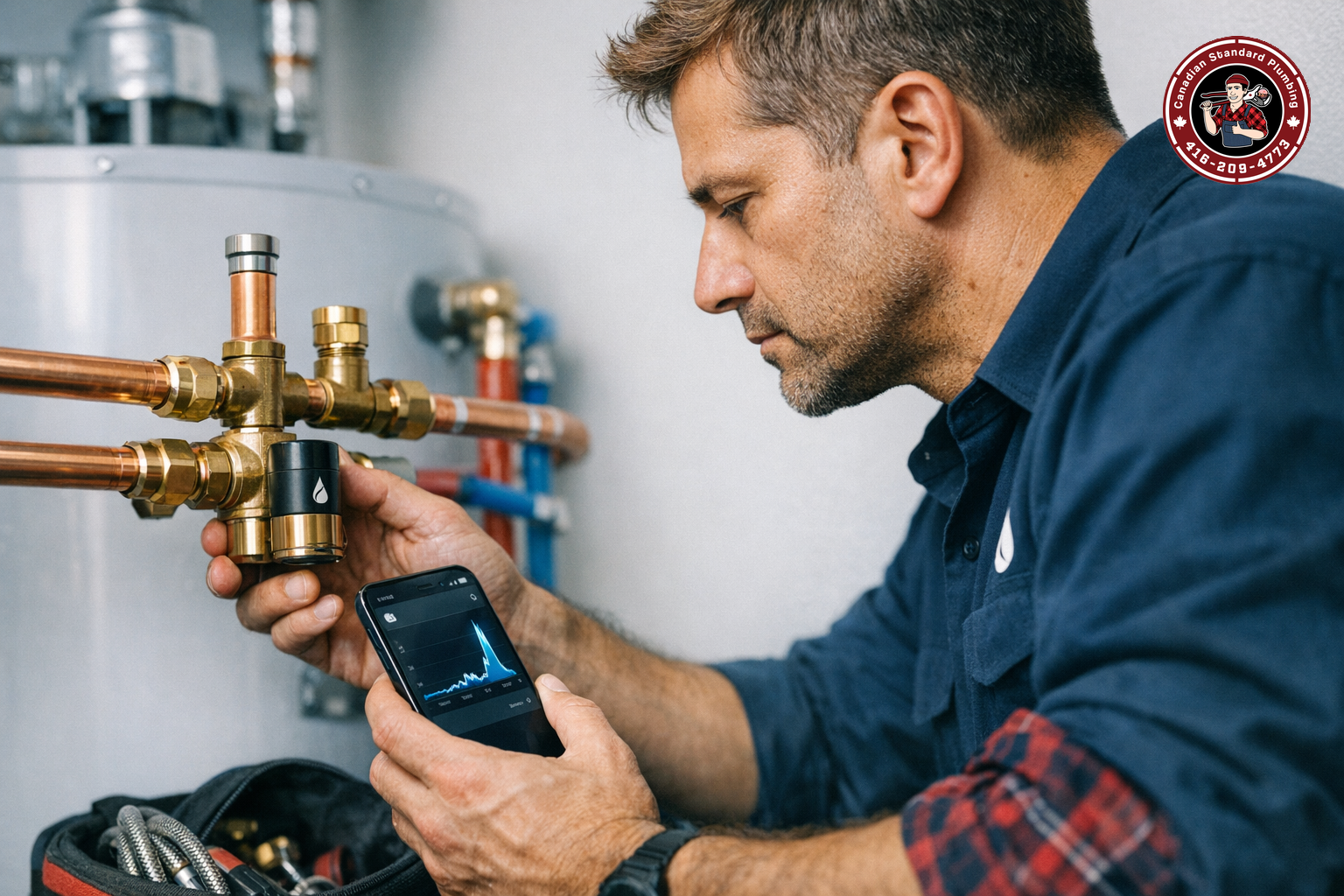
How a Smart Water Detection System Caught a Hidden Leak Before It Flooded a North York Basement

Last updated: July 12, 2026
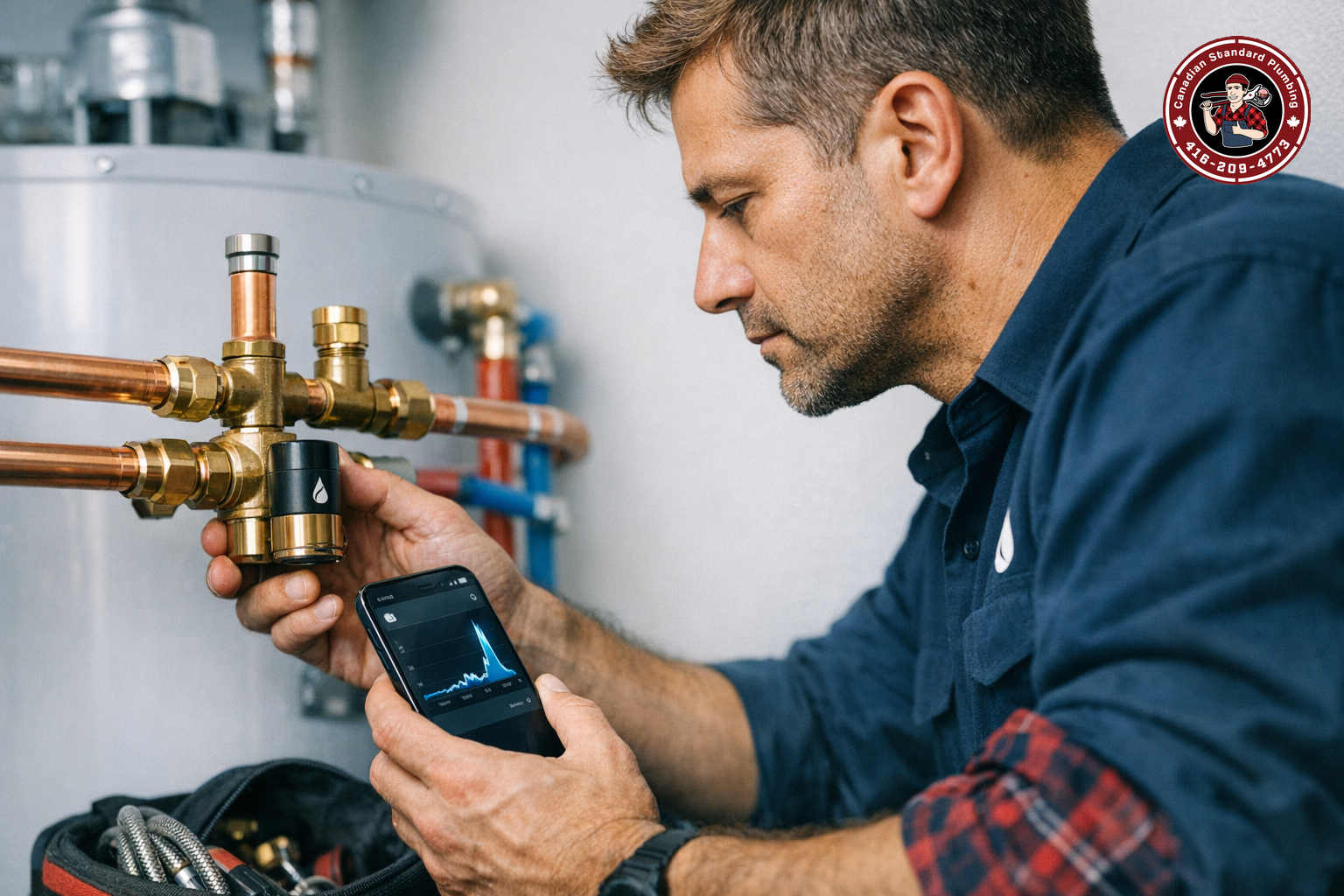
Picture a Tuesday night in mid-March. Nobody is running water, the house is quiet, and a smart water monitor on the main line notices something that shouldn’t be happening: continuous flow, hours long, with no fixture in use. That is exactly the pattern a slow supply-line leak behind kitchen cabinetry produces, and it is the pattern almost nobody catches on their own until drywall softens or a musty smell appears. We’re writing this guide because smart water leak detection system installation is one of the few upgrades that works as an early-warning system rather than a gadget, and homeowners and property managers across the Greater Toronto Area are only starting to understand what it can and can’t do.
- Who it’s for: Residential homeowners and property managers across the GTA
- Where it applies: Houses, condos, and light-commercial suites on a single main supply
- The problem: Silent, undetected supply-line leaks behind walls and cabinetry
- Detection method: Smart water monitor flow and pressure alerts, plus automatic shutoff
- Typical response: Isolate the supply, locate and repair the leak, then dry and verify
- Why it matters: Catching flow early narrows a repair to the pipe rather than the finishes around it
What We Found
When we arrived at 12:23 AM—less than 40 minutes after Sarah’s alert came through—we ran a full pressure and flow diagnostic using our electronic leak detection equipment. The data was unmistakable: the main cold-water supply line feeding the kitchen had developed a pinhole rupture, likely from corrosion of the older copper line where it ran through the rim joist behind the kitchen cabinetry. The leak was not gushing; it was weeping steadily at roughly 0.8 gallons per minute, which adds up to over 1,100 gallons per day if left uninterrupted.
Without an alert on the main line, a leak like this usually surfaces the slow way: a water bill that looks wrong, softening drywall, or a faint musty smell weeks later. By then the water has often reached the subfloor, the rim joist, and the insulation, which turns a plumbing repair into a building repair — structural drying, carpentry, and sometimes a mold assessment on top of the pipe work itself. Cabinetry is frequently the expensive casualty, because sealed cabinet boxes hold moisture against the wall long after the leak stops. We can’t quote any of that remediation work sight unseen; what we can say is that the scope grows with every hour the water runs, and we’ll always put our own portion in writing before we start.
What surprised us, honestly, was how consistently these silent copper pinhole leaks appear in North York and Thornhill homes built between 2000–2015. A clear pattern shows up in our service work: homeowners with hard water and slightly acidic municipal water supply (which North York has) see pinhole corrosion in older copper lines at a much higher rate than homeowners further west in Vaughan or Maple. The Moen Flo system doesn’t prevent the pinhole from forming—but it catches it in hours, not weeks.
How We Solved It
Our response that night followed a step-by-step protocol specifically designed for scenarios where the smart shutoff system has already isolated the main supply:
Confirmed the Moen Flo shutoff was closed
The smart monitor had already automated a valve closure to stop water flow the moment the pressure anomaly was detected. We verified the shutoff was holding pressure and had not re-opened due to fluctuations in the line.
Located the source using electronic leak detection
We used our acoustic and thermal imaging tools to pinpoint the rupture to the copper line behind the kitchen island cabinetry, roughly 8 feet from the main shutoff. This precision saved us from tearing into multiple wall sections.
Cut out and replaced the damaged copper section
We removed roughly 3 feet of the compromised copper line and replaced it with 1/2-inch PEX (cross-linked polyethylene) tubing, which is immune to pinhole corrosion and rated for 50-year service life in residential applications.
Pressure-tested the new section and re-opened the Moen Flo shutoff
We ran the line at 60 PSI for 10 minutes to confirm no leaks at the new crimp fittings, then manually re-opened the Moen Flo shutoff and verified water flow to the kitchen fixtures. The system’s app updated in real time to show normal flow patterns restored.
Dry and inspect the affected drywall and subfloor
When a leak is caught within hours rather than weeks, the water intrusion is usually limited to the immediate area. We use moisture meters and a thermal camera to confirm nothing is still wet in the wall cavity, the subfloor, or the joist below before anything gets closed back up. Patching the opening is normally straightforward drywall work — the point of catching it early is that it stays a patch instead of turning into structural drying and rebuilding.
A late-night emergency call-out, a PEX supply line replacement and an inspection of the affected drywall all add to the bill — but they add up to far less than an unchecked overnight leak that reaches flooring, cabinetry and framing. That is the trade-off a smart water monitor and automatic shutoff is really measured against: the cost of one controlled repair versus the cost of an uncontrolled escape of water. What drives the number on any given job is how long the water ran, how much finished material it touched, whether access has to be opened up, and whether the call falls outside normal hours. We give you a written quote before any work starts.
Result: What Changed
| Metric | Without Smart Monitor | With Smart Monitor (What Happened) |
|---|---|---|
| Time to Detection | 12–48 hours (discovery by homeowner) | 38 minutes (automated alert) |
| Water Wasted | 1,100–2,200 gallons | ~25 gallons (shutoff triggered) |
| Structural Damage | Subfloor saturation, rim joist rot, mold risk | None — minimal moisture intrusion |
| Repair Cost | Major restoration claim — water damage, structural repairs and mould remediation | One repair visit (emergency call-out plus supply line replacement) |
| Cabinetry Replacement | Custom oak cabinetry swollen and warped — typically a replacement, not a repair | No cabinetry damage (water stopped before it spread) |
What This Means for GTA Homeowners & Property Managers
If you’re a homeowner in North York, Thornhill, Vaughan, Richmond Hill, or anywhere across the Greater Toronto Area, or if you’re a property manager overseeing multiple rental units or light-commercial properties, Sarah’s case teaches three critical lessons that change how you should think about smart water leak detection system installation for your property.
Lesson 1: Silent Leaks Are the Costliest—and They’re Invisible to Homeowners
The majority of the residential water-damage claims we see across the GTA don’t come from burst pipes or overflowing bathtubs. They come from what we call “hidden leaks”—small ruptures or weeping failures in supply lines buried inside walls, under slabs, or in rim joists. A pinhole in copper tubing can leak 800–1,200 gallons per day without any visible sign until the drywall begins to sag or mold appears. By that point, you’re already looking at structural damage.
A smart water shutoff system like the Moen Flo doesn’t rely on homeowners noticing anything—it actively monitors pressure and flow 24/7. The moment flow patterns deviate from your baseline (which the system learns during normal use), it flags the anomaly and, if instructed, shuts off the water automatically. Sarah never would have caught that pinhole leak in time without the alert.
Lesson 2: Emergency Response Time Is Everything
We were able to reach Sarah’s North York home in under 40 minutes because she called immediately after the alert came through. During that window, the Moen Flo shutoff had already cut the water supply, so we arrived to a problem that was already contained—not escalating. If the leak had gone undetected for 8 hours (overnight, say), the water intrusion would have been 40–50 times worse. Our 24/7 emergency response capability in the GTA and York Region exists precisely for these scenarios, but even we can’t help if no one knows there’s a problem.
For property managers overseeing rental units or light-commercial spaces (restaurants, clinics, offices), this is especially critical. A leak caught at 3 AM in a multi-unit building can be contained instantly via smart shutoff. The same leak discovered at 8 AM the next day, after tenants complain, has already soaked the floor and walls. The gap between those two outcomes is what drives the repair bill — remediation, drywall, flooring, tenant disruption and closed business days. We’ll assess the situation, explain what’s driving the cost in your building, and give you a written quote before any work starts.
Lesson 3: Not All Leaks Require Full Repiping—But Some Do
In Sarah’s case, we only replaced the specific copper section that had failed. We didn’t advocate for a full copper-to-PEX conversion of her entire home. However, when we pressure-tested the older copper line, we found signs of slight oxidation in other sections. We recommended she consider a full cold-water repiping in PEX over the next 2–3 years to prevent a recurrence—but it wasn’t an emergency.
Many GTA homes built in the early 2000s are reaching the age where pinhole corrosion in original copper supply lines becomes a real risk. Water chemistry, pipe age, water velocity and original installation quality all play a part, and it varies from neighbourhood to neighbourhood — your local utility can tell you about the water in your area. If you own a home from that era still running its original copper, a smart water monitor is sensible insurance that catches a developing leak before it turns into a major water-damage claim. Full repiping can usually wait until you have early warning signs or repeat pinhole failures. We’ll walk your system, explain the trade-offs, and put a written quote in your hands before we touch anything.
How Smart Water Monitoring Works: The Technical Side
For readers considering a smart water shutoff installation—whether you’re a homeowner in Etobicoke, a property manager in Markham, or a light-commercial client in Aurora—here’s what the system actually does:
Baseline Monitoring: The Moen Flo system is installed on the main water supply line (typically at the meter or main shutoff). During the first 30 days, it learns your normal water-use patterns: how much water you use at different times of day, what peak flow rates are normal, and how long you typically go between uses. By day 31, the system has a complete baseline of “healthy” water behavior for your home.
Anomaly Detection: Any deviation from the baseline triggers an alert. This includes not just leaks, but also unusual consumption patterns (which can indicate a toilet running constantly, a fixture left open, or—occasionally—a burst water main in your street). The system is sensitive enough to detect a leak rate as small as 0.3 gallons per minute but smart enough not to false-alarm on the daily variation of a household with kids and fluctuating schedules.
Automated Response: When an anomaly is detected, Moen Flo first sends you a real-time alert via the mobile app. If you confirm there’s a problem—or if you’ve set the system to auto-shutoff mode—the internal solenoid valve closes the main supply within 2–5 minutes, stopping water flow to the entire home. This is what saved Sarah’s home: the shutoff was automatic, so water stopped flowing the instant the algorithm detected the pressure spike.
Why This Beats Traditional Methods: A manual shutoff valve (the knob under your sink or at the meter) requires you to know there’s a problem first. An older style water alarm simply makes noise if water touches a sensor—useful for sump pumps or finished basements, but useless if the leak is inside a wall. A Moen Flo system is proactive: it doesn’t wait for water to appear; it catches the pressure change or flow anomaly that happens before water ever reaches your basement or cabinetry.
We recommend Moen Flo to homeowners in the GTA because the pressure algorithm is calibrated for North American municipal water systems (which vary in pH and mineral content from region to region), and the hardware integrates with standard 3/4-inch copper or PEX supply lines without custom fittings. We’ve installed Flo systems on homes ranging from Richmond Hill to Concord, and the false-alarm rate is lower than competing products like Phyn. The Flo app is also straightforward—no learning curve for customers who aren’t tech-savvy.
Installation & Cost: What to Expect
If you’re considering a Moen Flo installation for your North York, Vaughan, or other GTA home, here’s what the process looks like and what you can expect to pay:
Pre-Installation Assessment: We visit your home to locate the main shutoff, check the material and size of the incoming supply line (copper, PEX, or galvanized), and confirm there’s adequate clearance for the Flo unit. For most homes in the GTA it’s a short visit. If the incoming line falls outside the range the unit is rated for, or if the main shutoff is inaccessible or seized, we’ll discuss alternative placements with you before anything is ordered.
Installation Labor & Hardware: A Moen Flo smart shutoff installation, fully supplied and installed, covers the Flo unit itself, the installation labour, connection of the incoming line with stainless steel braided connectors, and calibration of the baseline monitoring. What moves the number is how accessible your main shutoff is, the material and condition of the incoming line, and whether the existing valve needs attention at the same time — we confirm all of it in a written quote before we start. We also include a brief walkthrough of the app and how to interpret alerts.
Optional Add-Ons: If your existing shutoff valve is corroded or difficult to turn (common in older GTA homes), we can replace it during the same visit rather than making a second trip. If you want a secondary smart shutoff on your hot-water line (less common, but worth considering for light-commercial and multi-unit buildings), we’ll include that option in the same written quote so you can see exactly what each piece adds before you decide.
App & Monitoring: Moen Flo uses a free smartphone app for alerts and manual control. The system pairs with your home Wi-Fi network (2.4GHz), so it works as long as you have internet connectivity. For property managers with multiple units, Moen also offers a premium cloud dashboard for commercial deployments, but residential homeowners in Toronto, Thornhill, Markham, etc., use the standard consumer app at no extra cost.
Common Mistakes to Avoid
Over the past five years installing smart water systems across the GTA, we’ve seen homeowners and property managers make a few predictable mistakes:
Mistake 1: Installing the Smart Monitor and Then Ignoring Alerts – We had a client in Thornhill who installed a Moen Flo, then disabled notifications because the early alerts (like a slow toilet refill) were “inconvenient.” Two months later, a silent leak went undetected for six hours. The system was working; the homeowner had disabled the part that made it useful. Lesson: alerts are annoying by design. Don’t disable them.
Mistake 2: Assuming a Smart Shutoff Replaces Periodic Leak Detection Visits – A smart monitor is a real-time early warning system, not a full diagnostic. If you haven’t had a leak detection visit in years and you have pinhole corrosion forming in your supply lines, the monitor will alert you once the leak becomes significant enough to trigger an anomaly. A preventive leak detection visit, on the other hand, can sometimes catch slow corrosion before it ruptures. For older homes still on their original copper lines, we recommend both: smart monitoring plus leak detection visits on a regular cycle. We’ll give you a written quote for either before any work starts.
Mistake 3: Not Considering the System’s WiFi Requirements – Moen Flo requires a stable 2.4GHz WiFi connection. If your main water shutoff is in a basement corner or detached garage with poor signal, the system will disconnect periodically. We had a client in a Maple property who installed Flo on a supply line in an uninsulated garage, and the WiFi connection dropped every winter when the signal was blocked by ice on the eaves. Ensure your WiFi router has adequate range to the installation location, or plan to install a WiFi extender.
Smart Water Monitoring for Light-Commercial Properties
If you’re a property manager, small-business owner, or facilities coordinator overseeing a restaurant, clinic, dental office, small warehouse, or multi-unit residential building in the Greater Toronto Area, a smart water shutoff system becomes even more valuable than it is for a single-family home.
Why? Water damage claims in commercial spaces are dramatically more expensive. A leak in a restaurant’s prep area doesn’t just cost you the drywall repair—it costs you potential business interruption, food waste, and liability if a customer is injured due to a wet floor. A leak in a condo building affects multiple units and can trigger disputes between tenant and landlord over responsibility.
For light-commercial clients, we typically recommend a Moen Flo installation on the main supply line plus, in some cases, a secondary shutoff on the hot-water line or a water meter + flow sensor on specific sub-lines (e.g., the kitchen line in a restaurant, or the washroom line in a clinic). What drives the cost is how many points you monitor, how accessible the main and sub-lines are, and whether any repiping is needed to make room for the device — so we walk the space, then put a written quote in your hands before we start. The return on that investment is significant if it prevents even one catastrophic leak.
Frequently Asked Questions
Q: Can a Moen Flo system detect all types of leaks?
No—the Moen Flo detects leaks in the main supply line and any fixtures or appliances fed by that line (toilets, washing machines, dishwashers, outdoor faucets, water heaters, etc.). It will not detect a leak in the drain line (which is why a drain camera inspection is still useful separately), and it won’t detect a very slow leak in an outdoor garden line if the flow rate is below the system’s sensitivity threshold (typically 0.3 gallons per minute). For typical GTA homes, those exceptions are rare.
Q: What happens if my WiFi goes down—does the Moen Flo still protect my home?
Yes and no. The Moen Flo unit has local storage and will continue to monitor pressure and flow even if WiFi is disconnected. However, you won’t receive alerts on your phone, and you can’t manually control the shutoff remotely. If you’ve enabled auto-shutoff mode (which closes the valve automatically on anomaly detection), the system will still function—it will close the valve without needing to contact the cloud. Most homeowners we work with in the GTA keep the system in “alert-only” mode, where it notifies them before taking action, so WiFi disconnection is primarily an inconvenience, not a safety issue.
Q: If the Moen Flo automatically shuts off my water during a leak, what do I do if I’m away from home or at work?
The Flo app allows you to manually reopen the shutoff from your phone once you’ve assessed the situation. However, we typically recommend homeowners keep the system in “alert + manual shutoff” mode (not full auto-shutoff) so that you review the alert first before the water shuts off. In Sarah’s case, she had set auto-shutoff because she works nights and wanted protection while sleeping. If you’re away from home and the system triggers auto-shutoff, you can call us for an emergency visit to diagnose and repair—we’re available 24/7 across the GTA—and the fact that your water is already shut off means the damage is contained while we drive to your property. That’s actually the best-case scenario for a property you can’t immediately access.
Q: Is a smart water system worth it if I already have old pinhole leaks that I know about?
If you have active pinhole leaks, you should address those with pipe repair or repiping first—a smart monitor is not a substitute for fixing the underlying problem. However, once the initial leak is repaired, a smart monitor is valuable insurance against new pinholes forming elsewhere in the same copper line or in other parts of your plumbing. In North York and Thornhill homes built 2000–2010, multiple pinhole failures are common, so a monitor acts as an early-warning system for the next failure, buying you time to plan a full repiping before catastrophic damage occurs.
The Real Takeaway
Sarah’s pinhole leak didn’t happen because she was careless with her plumbing. It happened because copper supply lines in North York homes, especially those built in the early 2000s with slightly acidic municipal water, develop corrosion over time—it’s chemistry, not negligence. What made the difference was that she had a smart water leak detection system installed at her Toronto-area home, and that system was monitoring her water usage 24/7.
That is the value of an automatic shutoff: it can turn a potential catastrophe — water damage, structural repair, mold remediation, cabinetry replacement — into a single plumbing call and a drywall patch. The device doesn’t stop pipes from failing; it shortens how long the water runs before someone notices, and that is usually what decides how much damage you’re left with.
If you own a home or manage a rental property in the GTA built before 2012 with original copper supply lines, if you’ve had even one pinhole leak in the past five years, or if you simply want to eliminate the risk of coming home to a flooded basement, a Moen Flo smart shutoff system is one of the highest-ROI investments you can make in your property’s protection.
Ready to Get Protected?

Canadian Standard Plumbing
We install Moen Flo smart water shutoff systems across North York, Thornhill, Vaughan, and all of the Greater Toronto Area. Available 24/7 for emergency leaks and same-day installations.
🎧 Listen to article
- How We Found a Hidden Slab Leak Under a Vaughan Kitchen — Before It Destroyed the Hardwood
- Why Is My Water Heater Making a Popping Noise at Night? — Our Honest Answer
- A Customer Asked: “My Hot Water Runs Out After 8 Minutes — Is My Bradford White Tank Dying or Just Sediment-Lo
- Bradford White vs Rheem vs Navien: Which Water Heater Holds Up in Toronto’s Hard Water Conditions
- How We Found a Slab Leak Under a Vaughan Bungalow That 2 Other Plumbers Missed — Camera Inspection Saved the D