A Customer Asked: “Why Is My Water Heater Making a Popping Sound?” — A Master Plumber’s Honest Answer

Last updated: July 10, 2026
—A Richmond Hill homeowner asked us last month after hearing what they described as gunshot-like cracks from their basement.
The short answer: popping is almost never an explosion risk, but it usually means sediment has built up inside your tank and is being superheated. You don’t need to turn it off yet—but you do need a technician to inspect it within the week. In most cases, a flush runs $245–$395 and solves it. If the tank is corroded or the heating element is failing, you’re looking at replacement ($1,650–$2,400 installed for a 40–50 gallon Bradford White or Rheem tank).
- Popping = sediment buildup in the tank; mineral deposits are being flash-heated and cracking.
- A tank flush ($245–$395) solves most cases if caught early—this is preventive maintenance we wish more homeowners did.
- Ignoring it can lead to tank failure ($1,650–$2,400 replacement) or a leaked tank spilling 40+ gallons into your basement.
- Emergency service (24/7 availability) costs an extra $185–$285 over standard rates if you call after hours.

The Short Answer
A water heater making popping sound is usually caused by sediment—calcium and mineral deposits—settling on the bottom of your tank. When the heating element fires up, it superheats the water trapped beneath that sediment layer, and the water flashes to steam momentarily. That steam pocket collapses, and you hear the pop.
This is most common in hard-water areas across the GTA—especially in Markham, Aurora, and North York, where mineral content in the municipal supply is higher. It’s not immediately dangerous, but it signals that your tank’s efficiency is dropping and its lifespan is shrinking.
The fix? Have us come flush the tank ($245–$395, typically a one-hour job). If the tank has corroded or the heating element has failed, replacement is the next step. Most homeowners in the GTA facing that bill opt for a Navien or Rinnai tankless unit ($3,800–$5,200 installed) to avoid the same problem in five years.
The Full Answer
What Sediment Actually Does Inside Your Tank
Every tank water heater (whether Bradford White, Rheem, or Navien’s entry-level line) collects sediment over time. Hard water contains dissolved minerals—mainly calcium carbonate and magnesium. As water heats and cools, those minerals precipitate out and settle like silt on the tank floor.
This layer insulates the heating element from the water directly above it. The element gets hotter trying to reach your set temperature, and the water trapped in the sediment bed superheats. When it reaches boiling, steam pockets form and collapse violently. That’s the pop.
I didn’t fully appreciate how loud this gets until a Vaughan homeowner described it as “someone firing a nail gun in my basement at 3 AM.” She’d ignored the sound for two weeks. When we arrived, the tank had already begun rusting from the inside out.
Sediment buildup reduces heating efficiency by 20–40%, shortens tank life by 5+ years, and creates the popping sound. A flush costs $245–$395 and prevents tank failure.
Why This Happens Faster in the GTA Than Elsewhere
Toronto, Vaughan, Thornhill, and the York Region municipalities all draw from Lake Ontario and regional aquifers with notably high mineral content. The water hardness here (measured in parts per million of calcium carbonate) ranges from 120–180 ppm depending on your exact neighborhood.
Soft-water regions (like parts of BC) see sediment buildup take 8–10 years. In the GTA, we see heavy sediment in 4–6 years. This is why we recommend a tank flush every 18–24 months for homeowners in Richmond Hill, Markham, and King City. Without it, you’re essentially running on borrowed time.
One of our Maple clients installed a whole-home water softener after their second tank replacement—that investment ($2,500–$4,000 upfront) paid for itself in avoided tank replacements over the next decade.
The Three Levels of Popping and What Each Means
Level 1: Occasional quiet pops (1–2 per week, barely audible from upstairs). This is early sediment. A flush will fix it, and you’re still in the preventive zone. Cost: $245–$395, one hour.
Level 2: Regular loud pops (multiple per day, audible throughout the house, especially mornings). Sediment is heavy. A flush is still the first move, but the tank may already be corroding internally. If the flush doesn’t eliminate the sound within 48 hours, the heating element or tank walls are compromised. Cost: flush $245–$395 first; if unsuccessful, tank replacement $1,650–$2,400.
Level 3: Violent pops with rumbling, combined with low water temperature or leaking from the tank base. The tank is failing. Flush won’t help—replacement is immediate. You also risk flooding your basement. This is an emergency callout if it’s after hours: $185–$285 surcharge applies. Cost: tank replacement $1,650–$2,400 same-day if parts are in stock.
How a Tank Flush Actually Works (and Why DIY Isn’t Safe)
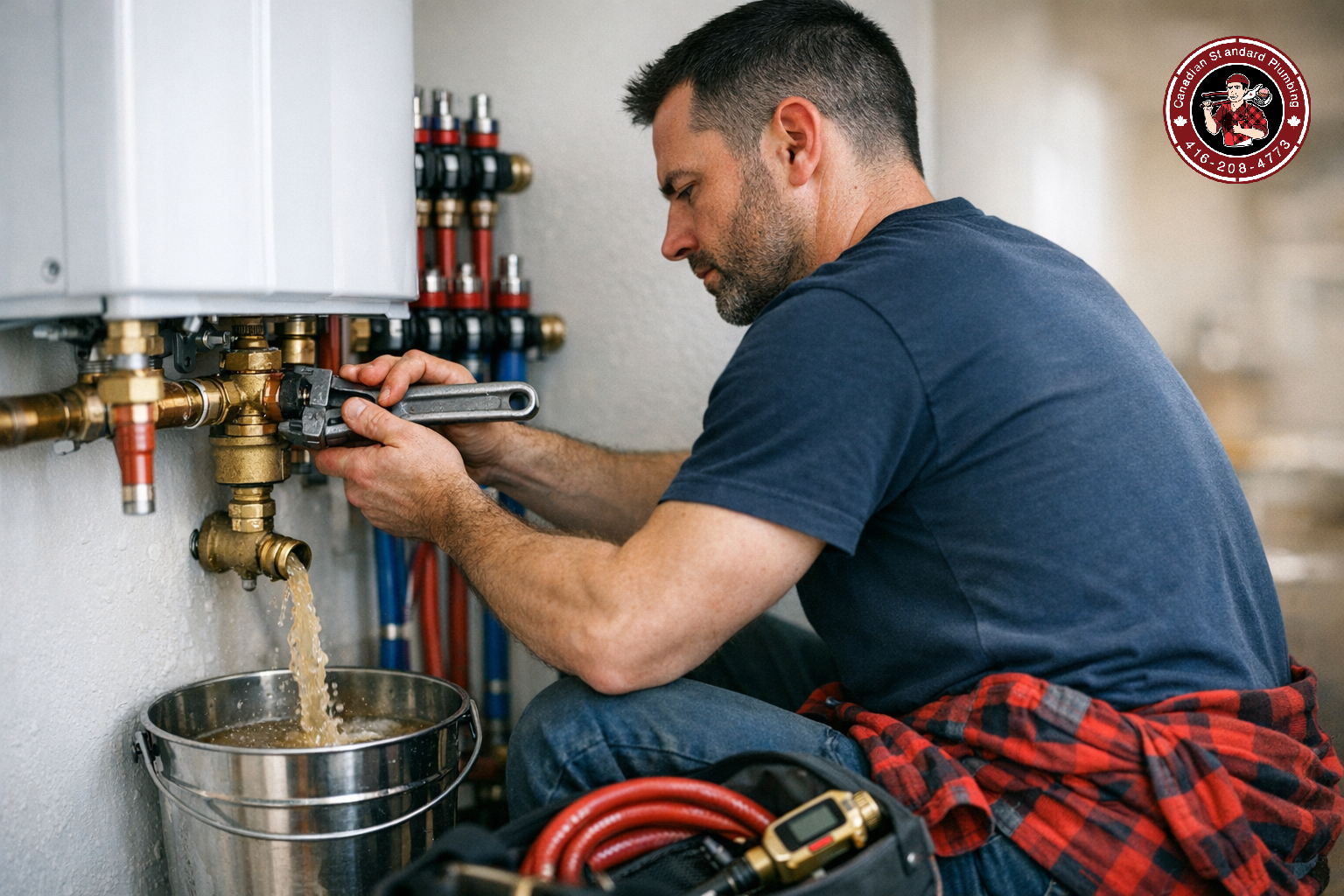
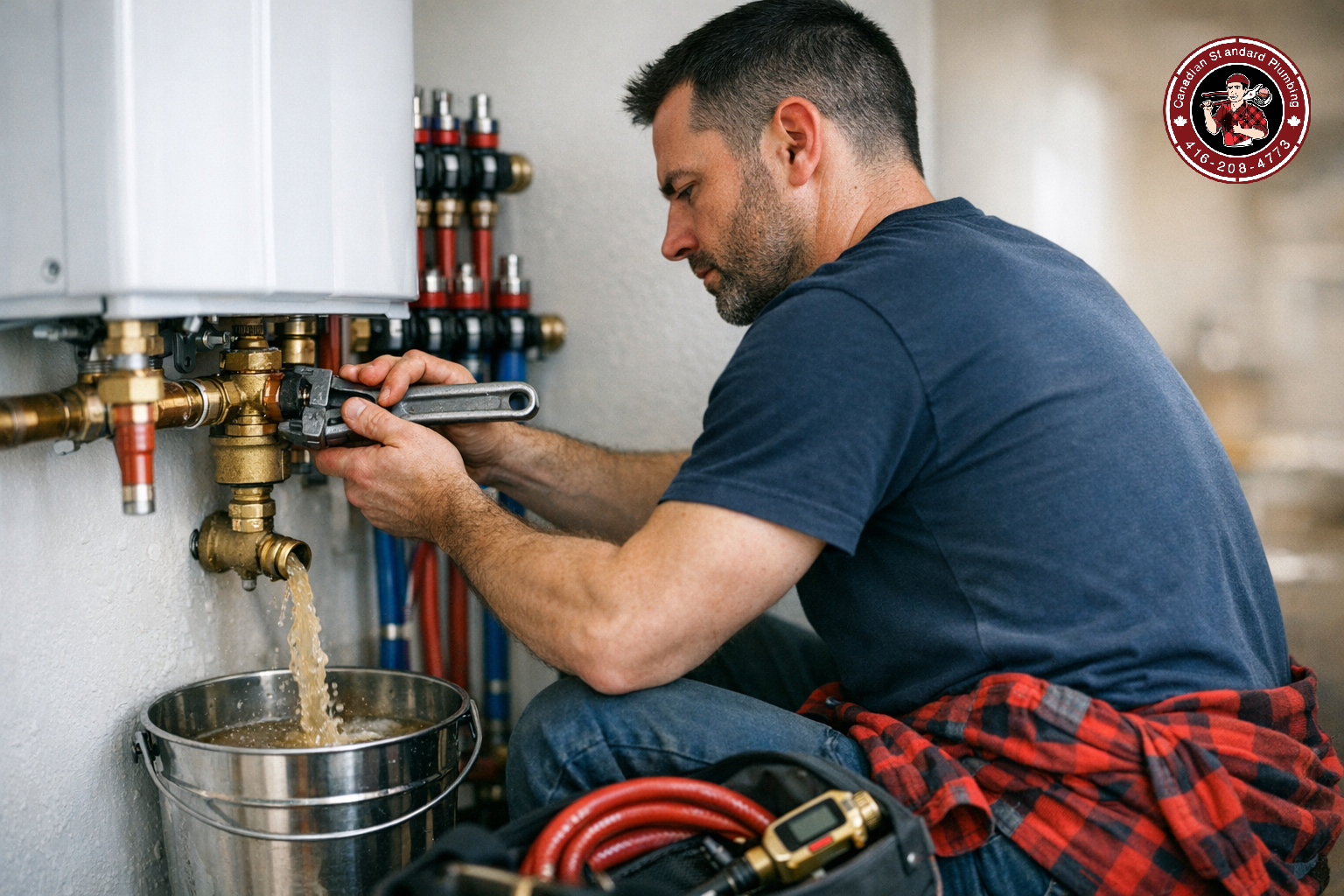
A proper flush involves draining the entire tank, flushing sediment through a drain line into a bucket or sump system, then refilling. Sounds simple—and it would be, if your basement shutoff valve didn’t fail halfway through (we get 2–3 emergency calls per month from a half-finished DIY where the shutoff broke and flooded the house).
Our process: we isolate the main water supply, close the shutoff valve to the tank, open the drain cock, and carefully siphon the sediment. Then we backfill with fresh water and run the tank through a heat cycle to confirm everything’s working. Takes 45–60 minutes. Cost: $245–$395 depending on sediment volume and how clean the drain valve is (corroded valves add time).
If you attempt this yourself without proper isolation, a broken shutoff valve stops your entire water supply. We’ve had customers call at midnight after turning off the main by hand and being unable to turn it back on—that becomes an emergency $895–$1,250 whole-home shutoff replacement, plus the flush they were trying to save money on.
Tank Replacement vs. Tankless: When Popping Means Time to Upgrade
If your popping tank is over 8 years old, a flush buys time but rarely solves the underlying corrosion. Most homeowners in that situation should consider replacement—and here’s where the equation shifts.
A traditional tank replacement (40–50 gallon Bradford White or Rheem) costs $1,650–$2,400 installed and lasts another 8–10 years before sediment returns. A tankless unit (Rinnai or Navien) costs $3,800–$5,200 installed, has no sediment risk, costs 15–28% less to operate, and lasts 15–20 years.
We had a Vaughan property manager who owned three rental units, each with an aging 40-gallon tank. Every winter, tenants called about no hot water. We converted all three to a single Navien tankless serving the building. Their monthly gas bill dropped 28% (they tracked it), and they haven’t had a tenant complaint in two years. The upfront cost was $5,200; they’ve already saved $3,400+ in gas—and eliminated the emergency callouts that cost $185–$285 in surcharges.
Emergency Response and After-Hours Costs
If your tank is popping at 2 AM and you’re panicking about a flood, we offer 24/7 emergency callouts across the GTA and York Region. Sub-one-hour response is standard for us in Toronto, Etobicoke, North York, and Thornhill.
The fee structure: standard daytime diagnostic is $295–$445 for a leak detection visit and written report. After hours (11 PM–7 AM, weekends, holidays), add $185–$285 to any service. If you need emergency tank replacement on a Sunday, budget $2,085–$2,685 total (base replacement $1,650–$2,400 plus surcharge).
Most customers find that a Wednesday afternoon flush ($245–$395 with no surcharge) is smarter than waiting until the tank fails on a Friday night.
When the Answer Is Different
Tankless Water Heaters Don’t Pop—But They Do Fail Differently
If you have a Rinnai, Navien, or similar tankless unit making noise, it’s not sediment—it’s scale buildup in the heat exchanger or a mineral-blocked inlet filter. Tankless units circulate water at high pressure through a narrow tube, so mineral blockage appears as reduced flow or temperature errors, not popping.
We see homeowners buy cheap $1,500 import tankless units online, then call us in a panic when the unit displays an error code and won’t fire. Most of those units have non-stocked parts, and the repair cost ($400–$700) nearly matches the original purchase price. This is why we recommend Rinnai or Navien from day one—parts are in stock, diagnostics are straightforward, and the warranty is actual support.
Commercial / Multi-Unit Buildings: Different Scale, Same Problem
If you manage a light-commercial property or apartment building in Concord, Woodbridge, or Maple, a popping water heater is even more urgent. A single failed 100+ gallon tank floods not just your basement—it floods mechanical rooms, damages electrical panels, and triggers building-code violations.
We recommend preventive flushing every 12 months for light-commercial tanks. That’s $395–$445 per flush, which sounds expensive until a 40-unit building’s tank fails without warning and the remediation cost is $8,000+ (tank replacement, water damage assessment, code compliance inspection).
Noise Might Not Be the Tank—Check Your Pipes First
Sometimes homeowners blame the water heater for sounds that are actually loose pipes or water hammer (pressure surges when a valve closes suddenly). Water hammer is loud, metallic banging—easy to confuse with tank popping.
If the noise comes from the walls or pipes, not the tank itself, the fix is pipe strapping or a pressure-relief expansion tank ($145–$280 installed). We’ll diagnose which on the first visit—no charge for that assessment.
No. Tanks are designed with pressure relief valves that vent excess pressure safely. A popping tank will eventually fail from corrosion, but it won’t explode like a bomb. That said, a failed tank can rupture suddenly and flood your basement—which is why we don’t ignore the warning sign.
Frequently Asked Questions
Can I just drain my water heater myself to stop the popping?
You can drain it, but only if your shutoff valve is reliable and you’re confident isolating the water supply. We recommend hiring a technician—draining improperly (especially with a faulty shutoff valve) creates emergency situations that cost $895–$1,250 to repair. A professional flush is $245–$395 and takes one hour. DIY risk rarely justifies the savings.
How often should I flush my water heater to prevent popping in Toronto?
In the GTA, we recommend a flush every 18–24 months. High hard-water areas like Markham, Aurora, and North York should flush every 12–18 months. This costs $245–$395 per flush and prevents the sediment buildup that leads to popping, corrosion, and premature tank failure.
If my tank is popping, should I replace it with another tank or upgrade to tankless?
If the tank is under 6 years old, a flush ($245–$395) often solves the problem. If it’s 8+ years old and popping, replacement makes sense. Tank replacement costs $1,650–$2,400; tankless (Rinnai/Navien) costs $3,800–$5,200. Tankless saves 15–28% on gas, lasts 15–20 years, and eliminates sediment risk. Most customers in Richmond Hill and Vaughan choosing replacement now pick tankless for the long-term value.
What’s the cost difference between a daytime service call and a 24/7 emergency callout?
A standard daytime diagnostic is $295–$445. A 24/7 emergency callout (11 PM–7 AM, weekends, holidays) adds $185–$285 to any service. For a tank replacement on a Sunday night, expect $2,085–$2,685 total. Most homeowners benefit from scheduling a routine flush ($245–$395 daytime) before the tank reaches emergency status.
The Bottom Line
A water heater making a popping sound in Toronto, Vaughan, Richmond Hill, or anywhere in the GTA is sediment buildup, not an explosion. But it is a warning. A flush ($245–$395) solves early cases. A replacement ($1,650–$2,400 for tank, $3,800–$5,200 for tankless) solves advanced cases.
The cost of ignoring it? A failed tank that floods your basement, plus emergency fees of $185–$285 if it happens at 2 AM on a Sunday. Better to act now.
We’re available 24/7 across the GTA and York Region. Call us for a sub-one-hour response and an upfront quote—no surprises.
Canadian Standard Plumbing
Licensed Master Plumber serving the Greater Toronto Area and York Region. 5.0-star rating across 169+ Google reviews. Sub-one-hour response, 24/7 emergency service.
🎧 Listen to article
- A Customer Asked: “Why Is My Water Heater Making a Popping Noise at Night?” — A Master Plumber’s Honest Answer
- A Customer Asked: “My Hot Water Runs Out After 8 Minutes — Is My Bradford White Tank Dying or Just Sediment-Lo
- A Vaughan Customer Asked: “Why Is My Water Heater Popping After 8 Years?” — The Real Cause
- Bradford White vs Rheem vs Navien: Which Water Heater Holds Up in Toronto’s Hard Water Conditions
- Rinnai vs Navien Tankless Water Heaters: Which One Handles a Toronto Hard-Water Supply Without Early Scale Bui