A Customer Asked: “My Hot Water Runs Out After 8 Minutes — Is My Bradford White Tank Dying or Just Sediment-Loaded?” — A Master Plumber’s Honest Answer

Last updated: July 2, 2026
Straight answer: If your Bradford White tank runs out of hot water far sooner than it used to, it’s almost never the tank “dying”—it’s usually sediment insulating the heating element, a failed dip tube (the cold-water inlet pipe inside the tank), or a faulty thermostat. The fix ranges from a flush-and-inspect visit (if sediment is the culprit) all the way to a full replacement if the tank itself has failed structurally, and we give you a written quote before any work starts. You absolutely should not DIY-flush it if you suspect a failed dip tube—that’s when you call us.

- Sediment buildup is the most common culprit—a flush and inspection often restores capacity in a single visit.
- A cracked or separated dip tube feels like a dead tank, and replacing it is not a DIY job—we’ll quote the repair-versus-replace decision in writing.
- Bradford White tanks in harder-water areas of the Greater Toronto Area (Vaughan, Thornhill, Richmond Hill) tend to accumulate scale faster, which shortens service life compared with softer-water areas.
- We take these calls across Toronto, Etobicoke, North York, Markham, and York Region.
Table of Contents
- The Short Answer
- The Full Answer
- Sediment: The Most Common Culprit
- Dip Tube Failure: Why It Feels Like the Tank Died
- The Faulty Thermostat Nobody Talks About
- Hard Water in the GTA and York Region
- When the Tank Is Actually Dying
- Related Question We Often Hear
- FAQ
The Short Answer
If you’re a homeowner in Toronto, Vaughan, Thornhill, Richmond Hill, or anywhere in York Region and your hot water runs out much faster than it used to, the tank itself is probably fine. What’s killing your supply is most likely sediment (calcium, magnesium, rust) insulating the heating element—a treatable issue. We come out, inspect the tank and its connections, and if sediment is the diagnosis, a flush and descaling usually restores capacity in the same visit. We confirm the scope and give you a written quote first. Done.
If the flush doesn’t restore capacity, the dip tube (the cold-water inlet pipe inside the tank) has likely failed. At that point we walk you through repair versus a full replacement—tank or tankless—and price the options in writing before we touch anything. If you’re in a rental in Etobicoke or North York and the landlord has ignored your requests, we can document the failure in writing for your tenant board claim.
Sediment means a flush and descale. A failed dip tube usually means replacing the tank. A faulty thermostat is a targeted repair. Each path gets its own written quote before work begins. Don’t try to flush a failed dip tube yourself—call us and we’ll diagnose it on site anywhere in the GTA.
The Full Answer: Why Your Bradford White Runs Out So Fast
Sediment: The Most Common Culprit
Here’s what happens: Hard water (common in Vaughan, Thornhill, Maple, Concord, and Richmond Hill) deposits calcium and magnesium inside your tank. Over time, this sediment settles on the heating element at the bottom of the tank and forms an insulating blanket. The heating element burns hotter trying to heat water through that sediment layer, and eventually, it either fails or becomes so inefficient that it can only heat a small volume of water before the tank empties.
You’ll notice: Hot water runs for 7–10 minutes, then goes lukewarm, then cold. If you wait 20–30 minutes, you get another 7–10 minutes of hot water. That cycle repeats. It’s the heating element fighting through sediment, recovering, then fighting again. Not a dead tank—a suffocated one.
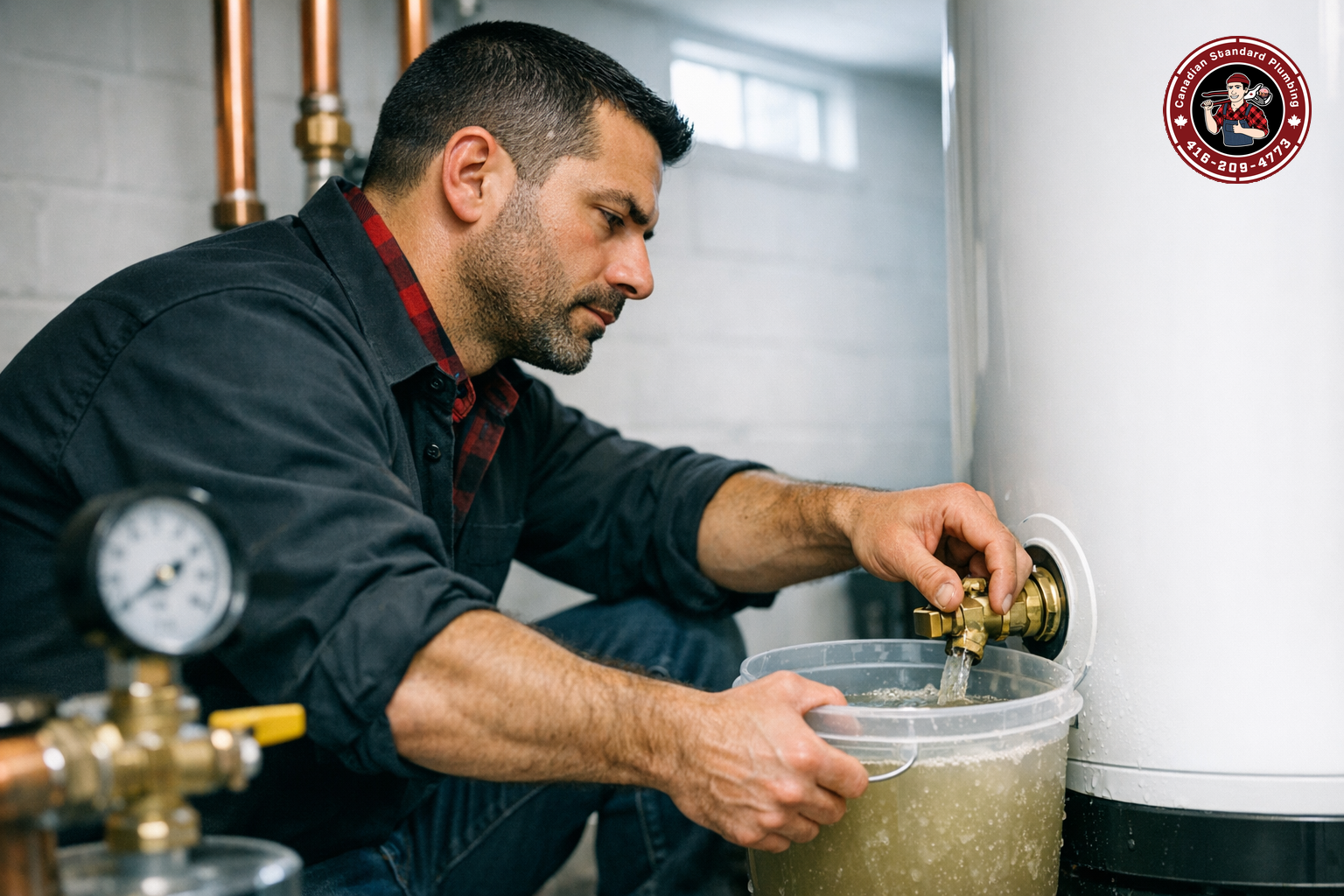
The fix: We connect a drain hose to the drain valve at the base of your tank, open it, and let the sediment run out until the water coming off the valve is clear. Then we reverse-flush the tank with clean water. If the tank itself is still sound — which it usually is at this stage — you’ll get your full usable hot water back. What the job costs depends on the tank, how much sediment has built up and how accessible the connections are, so we look first and give you a written quote before any work starts. We do this in Markham, Aurora, North York, and Etobicoke regularly.
On a tank that has never been flushed, the water coming off the drain valve usually starts out rust-coloured and gritty and gradually runs clear. That sediment is the reason hot water runs out early: it takes up space that should be holding water. A flush often restores noticeably more usable hot water, but it can’t fix a tank that has already corroded through — that’s the call we make on site, and we’ll tell you honestly which one you’re looking at before we quote anything in writing.
Dip Tube Failure: Why It Feels Like the Tank Died
Inside every water heater tank is a dip tube—a long plastic pipe that runs from the cold-water inlet at the top down to the bottom of the tank. Its job is to direct incoming cold water to the bottom so it gets heated. If that tube cracks, separates from its fitting, or deteriorates (PVC dip tubes from 2000–2020 were prone to this), cold water enters at the top and mixes with the hot water. You lose heating capacity instantly.
The symptom is identical to sediment: a short run of hot water, then it goes cold. But here’s how we tell the difference. We drain the tank and watch what comes out — heavy sediment shows itself immediately as gritty, discoloured water. If the tank drains clean and the hot water is still dying early, a failed dip tube is the likely cause, and on most tanks that isn’t a serviceable part. The fix is tank replacement, and we’ll confirm the diagnosis before recommending it — book a diagnostic visit and we’ll put the findings and the quote in writing.
A replacement 40–50 gallon tank install covers removal and disposal of the old tank, the new tank, re-connection of the water and gas or electrical connections, venting checks where applicable, and testing of the temperature and pressure relief valve. What it costs comes down to the tank you choose, the condition of the existing connections and how tight the access is — we quote it in writing before we start. We handle these replacements in King City, Woodbridge, Concord, and all York Region areas with same-day or next-day scheduling.
If you’re considering a tankless upgrade instead (Rinnai or Navien), it eliminates the dip-tube problem entirely: no tank, no dip tube, and hot water for as long as you need it. The cost depends on the unit, the gas supply, the venting route and the condensate drainage, so we assess those on site and give you a written quote. One Vaughan property manager we work with had three aging 40-gallon tanks serving rental units; we replaced them with a single Navien tankless for the building, and per their own reports their monthly gas bill dropped about 28%.
The Faulty Thermostat Nobody Talks About
Less common than sediment or dip tube failure, but real: the thermostat (the temperature sensor on the heating element) dies. When it fails, it tells the element to shut off prematurely—even though the tank is only half-heated. You get 8 minutes of hot water, then it cuts out because the thermostat thinks the tank has reached 120°F when it’s actually at 95°F.
We diagnose this by checking the actual water temperature at the outlet while the tank is running. If the reading is lower than your set temperature, and sediment and dip tube both check out, it’s the thermostat. That’s a repair, not a replacement, so your tank lives on for a few more years. We’ll put the cost of the part and the labour in a written quote before we touch anything.
Hard Water in the GTA and York Region: Why Bradford White Tanks Fail Faster Here
This is where your neighborhood matters. If you live in Vaughan, Thornhill, Maple, Richmond Hill, or Markham, your water is harder than areas closer to Toronto proper. That means more sediment buildup, faster dip tube deterioration, and a shorter lifespan overall. A Bradford White tank in soft-water areas (parts of Etobicoke or North York near the lake) can run 12–15 years. In Thornhill or Richmond Hill? You’re looking at 8–10 years before the first major issue.
If you’re in a hard-water zone and your tank is past 7 years old, flushing it regularly becomes essential — ask us how often makes sense for your water and your tank. We also recommend installing a Moen Flo smart water monitor so you can track water usage patterns and catch leaks early. A monitor that flags a pinhole leak in a basement supply line while it’s still weeping gives you the chance to deal with a small repair instead of drywall, flooring and mold remediation later. We’ll give you a written quote for the monitor and the install before we start.
When the Tank Is Actually Dying: Rust, Leaks, and Structural Failure
A tank is genuinely failing when you see rust-colored water at the tap (internal corrosion), pooling water under the tank (the steel shell is rusting through), or you smell rotten eggs (bacteria colonizing a failed anode rod). If your 8-minute problem is accompanied by ANY of these, the tank is beyond repair. You need replacement, full stop.
When replacement is the right call, the cost depends on the tank size, the venting and gas or electrical work involved, and how accessible the space is. We’ll walk you through the options and put a written quote in your hands before any work begins, and we’ll confirm the manufacturer’s warranty coverage that comes with the unit we install. Call us and we’ll get you booked in as quickly as our schedule allows.
Related Question We Often Hear
Short answer: if sediment is truly your problem, yes—we’ve seen homeowners do it. Longer answer: we don’t recommend it for three reasons. First, you need to isolate the cold-water supply properly or you risk flooding the basement, and isolation-valve attempts that go sideways are a call we take more often than you’d think. Second, if sediment is blocking the drain valve, forcing it can snap the valve off, turning a maintenance job into a full tank replacement. Third, you won’t know whether the real culprit is sediment, a dip tube, or the thermostat—so you flush, the problem persists, and you’ve spent your afternoon and still need us. A proper diagnosis is the cheap part of this. If it’s sediment, we fix it on the same visit. If it isn’t, we know exactly what to replace, and you’ll have a written quote before we do.
When the Answer Is Different: Rental Properties and Landlord Obligations
If you’re a tenant in North York, Etobicoke, or Toronto proper and your landlord has been ignoring your hot water complaints, Ontario law requires landlords to maintain adequate hot water supply (a minimum of 110°F at the tap). If your tank fails, it’s their responsibility to replace it. We’ve written formal inspection reports twice in the last 18 months for tenants taking their landlords to the Landlord Tenant Board—both resulted in the landlord replacing the tank within 30 days.
A formal report documents the exact failure, its safety implications, and what the repair involves — and we’ll quote it in writing before we begin. If you’re in this situation, call us and we’ll guide you through the next steps.
FAQ
If the water coming out is clear and the tank has no visible rust or leaks underneath, it’s usually a sediment or dip tube issue rather than a failing tank. A hands-on inspection tells us which one we’re dealing with, and we give you a written quote before any work starts. If the tank body is rusting or pooling water underneath, that’s structural failure and replacement is the only real fix.
Yes, especially in hard-water areas like Vaughan, Thornhill, and Richmond Hill. We’ll recommend an interval based on your water quality and your unit’s own manual, and we’ll put the cost of the flush in writing before we touch anything. The principle is simple: sediment that gets removed on a schedule doesn’t get the chance to insulate the bottom of the tank and shorten its working life. Skip it long enough and the tank itself becomes the problem instead of the sediment.
If you’re already replacing the tank, tankless is worth considering. Units from makers like Rinnai and Navien deliver continuous hot water and take tank sediment and dip tube failures off the table. The trade-off is maintenance: in hard-water areas they need regular descaling per the manufacturer’s instructions, so you’re swapping one maintenance routine for another. Which way it goes usually comes down to the age and condition of your current tank, your household’s hot water demand, and the venting and gas work the swap would require. We’ll walk you through both options and quote each in writing.
A Moen Flo won’t prevent sediment buildup or dip tube failure, but it WILL flag leaks and unusual water usage patterns early and can shut the water off automatically. If a corroded tank or a supply connection starts weeping, that early alert is the difference between a wet floor and a soaked ceiling below. It’s worth serious consideration for homes in Markham, Aurora, and King City where the mechanical room sits next to finished basement space — and we’ll quote supply and installation in writing.
What We’ve Learned After 10+ Years of Hot Water Emergencies
The most common mistake we see: homeowners wait. Hot water starts running short years before the tank actually quits, and by the time we get the call the tank is often corroding from the inside and the dip tube has already given up — at that point a flush can’t save it and replacement is the only honest answer. Call us while it’s still a performance complaint and we can usually service the unit, buy you time, and let you budget for the replacement on your schedule instead of during an after-hours emergency.
Second: don’t DIY isolation-valve work. Old shutoff valves seize up over time, and the handle or stem can snap off mid-turn — which leaves you with water spraying and no way to close it. We get these calls late at night, and by then the repair is always bigger than the one the homeowner set out to do. If a valve under your sink or at your main feels stiff, call us before you force it. We’ll put the replacement in a written quote before we start, and we can add a proper inline shutoff while we’re there.
Third: Your neighborhood’s water hardness matters enormously. If you’re in Thornhill, Vaughan, or Concord, assume your tank will be harder hit by sediment than a neighbor in Toronto. Plan for flushes sooner, expect replacements earlier, and consider water softening if your home is 10+ years old.
A King City client renovating their primary bathroom had cracked terrazzo around the toilet from years of a slow leak nobody had noticed. We did a full rough-in repipe of the bathroom waste line in PEX and installed a Toto Aquia IV — no leaks since. What drives cost on a job like this is scope: how much of the waste line has to be opened up, what the subfloor looks like once the tile comes off, and the fixtures you choose. We put all of that in a written quote before any work starts. It’s also exactly the kind of slow, hidden leak a smart water monitor and shutoff is designed to flag early, before the floor pays for it.
Ready to Stop Running Out of Hot Water?
If your hot water runs out after a few minutes and you’re in Toronto, Vaughan, Thornhill, Richmond Hill, Markham, Aurora, North York, Etobicoke, or anywhere in York Region, we can come out and diagnose it. We’re available 24/7 for emergency calls—you won’t be waiting until Monday morning. If it’s sediment, we can often deal with it on the same visit. If it’s a failed dip tube, we’ll give you a written quote for the replacement plus same-day or next-day scheduling, whichever suits you. And if it’s something else entirely, you’ll know exactly what you’re facing instead of guessing and spending money on flushes that don’t work.
Canadian Standard Plumbing
Professional service available 24/7. Fast response from Daniel and our team, with a written quote before we start.
🎧 Listen to article
- A Customer Asked: “Why Is My Water Heater Making a Popping Noise at Night?” — Our Honest Answer
- Rinnai vs Navien Tankless Water Heaters: Which One Handles a Toronto Hard-Water Supply Without Early Scale Bui
- How We Found a Slab Leak Under a Vaughan Bungalow That 2 Other Plumbers Missed — Camera Inspection Saved the D