Camera Inspection vs Pressure Testing: Which Method Actually Confirms a Leak in a GTA Commercial Building’s Hidden Pipes


Drain Camera Inspection vs Pressure Testing: Which Confirms a Hidden Pipe Leak in a GTA Commercial Building?
Published August 25, 2026 · Updated August 25, 2026
On drain camera inspection vs pressure testing hidden pipe leak commercial building GTA — which is more accurate: pressure testing is the more accurate method for confirming a leak exists, and camera inspection is the more accurate method for locating and diagnosing it — which is exactly why on a real commercial job we often run them together. What each one costs depends on access, building size and how much pipe has to be isolated, so we give you a written quote before any work starts.
[HERO_IMAGE]
If you’re a property manager for a Vaughan retail plaza or a Markham medical clinic staring at a water bill that jumped for no visible reason, this is the decision in front of you — and picking the wrong test first can cost you two weeks and a demolished ceiling. This is for people responsible for a building’s envelope and budget, not for a homeowner chasing a dripping faucet.
- A drain camera cannot see a pressurized water-line leak — it only travels inside drain, waste and vent piping, so it will never find a pinhole in a copper supply riser feeding a Thornhill café.
- Pressure testing proves a leak exists but not where it is — a section that won’t hold pressure tells you the leak is somewhere in that isolated run, which could still be a long stretch of pipe above a drop ceiling.
- Camera inspection and a full leak detection visit are priced separately, and on commercial buildings we frequently quote both because they answer different questions — you get the numbers in writing before we begin.
- A camera IS the more accurate tool for drain-side leaks — cracked clay, offset joints, root intrusion, back-pitched sections and failed cast iron under a Toronto restaurant slab all show up visually on video.
- Neither method beats isolation — shutting valves zone by zone and watching the meter is the cheapest first move in any commercial building, and it costs nothing but a technician’s time.
- A Moen Flo smart monitor and shutoff catches the next hidden leak automatically instead of leaving you to discover it on a quarterly water bill; ask us for a written quote on supply and installation.
Drain Camera Inspection vs Pressure Testing: Which Is More Accurate for a Hidden Pipe Leak?
Here’s the comparison that actually matters when you’re deciding what to authorize. Note the row most articles skip: which piping system the method can even touch. Potable water supply and drain/waste/vent are two entirely separate systems in a building, and half the confusion we hear on the phone comes from treating them as one.
| Attribute | Drain Camera Inspection | Pressure / Hydrostatic Testing | Acoustic + Thermal Detection |
|---|---|---|---|
| System it works on | Drain, waste & vent only | Either — supply lines or isolated drain sections | Pressurized supply lines, hydronic loops |
| Answers “is there a leak?” | Sometimes — only if damage is visible | Yes — definitively, pass or fail | Usually, if the leak is active |
| Answers “where is it?” | Yes — with sonde locating, to a point on the floor | No — narrows to an isolated run only | Yes — usually within a small radius |
| Diagnoses the cause | Excellent — roots, offsets, scale, back-pitch, cracks | Poor — tells you nothing about why | Limited — confirms behaviour, not condition |
| Typical GTA cost | Quoted in writing before work starts | Part of a full leak detection visit with written report | Part of a full leak detection visit with written report |
| Business disruption | Low — one access point, drain out of service briefly | Moderate to high — water off to the tested zone | Low — but needs quiet, often after hours |
| Produces evidence for insurance | Strong — video file, timestamped | Strong — documented pass/fail on record | Moderate — thermal images, technician report |
Method 1: Drain Camera Inspection — What a Camera in a Sewer Can Actually Tell You
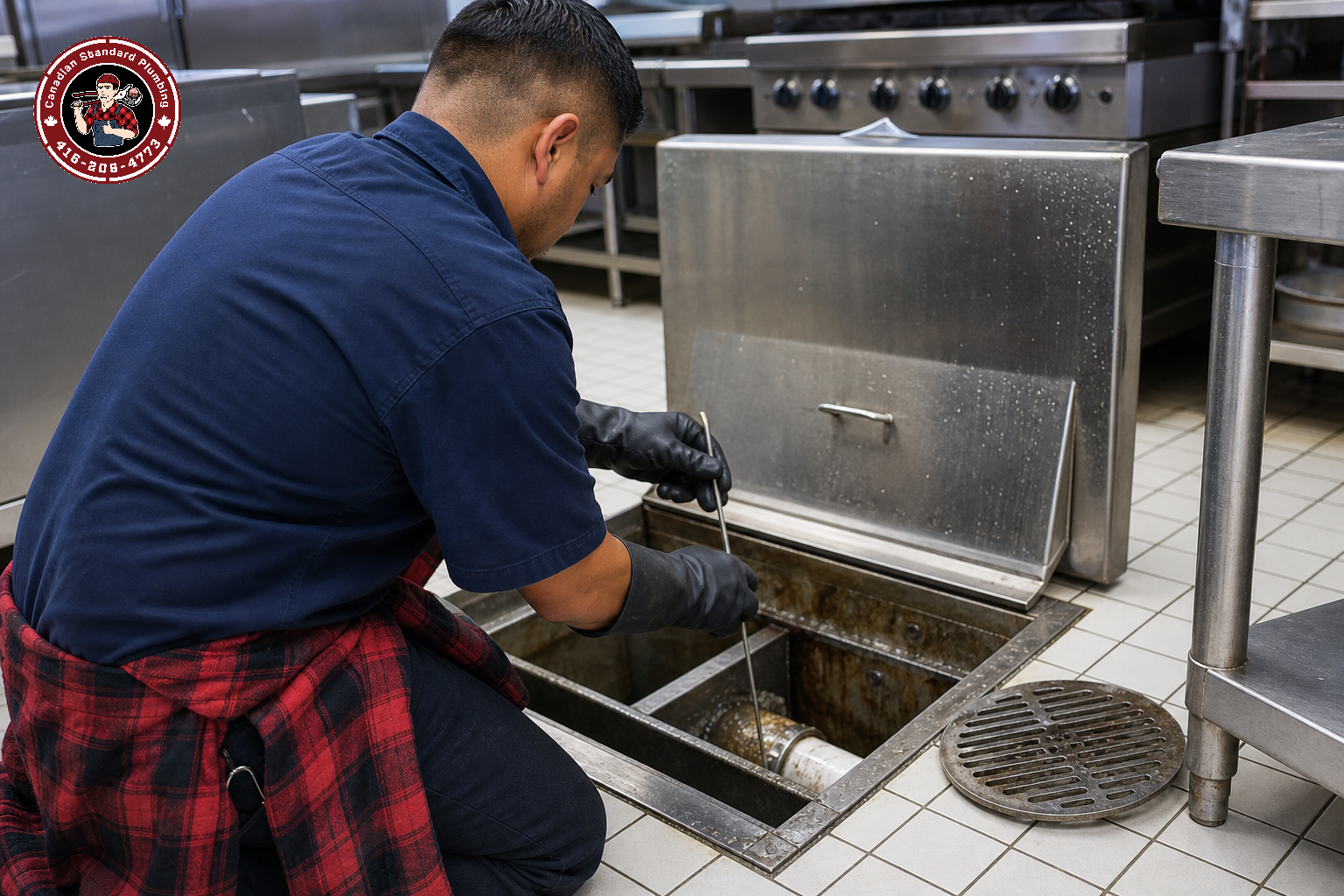
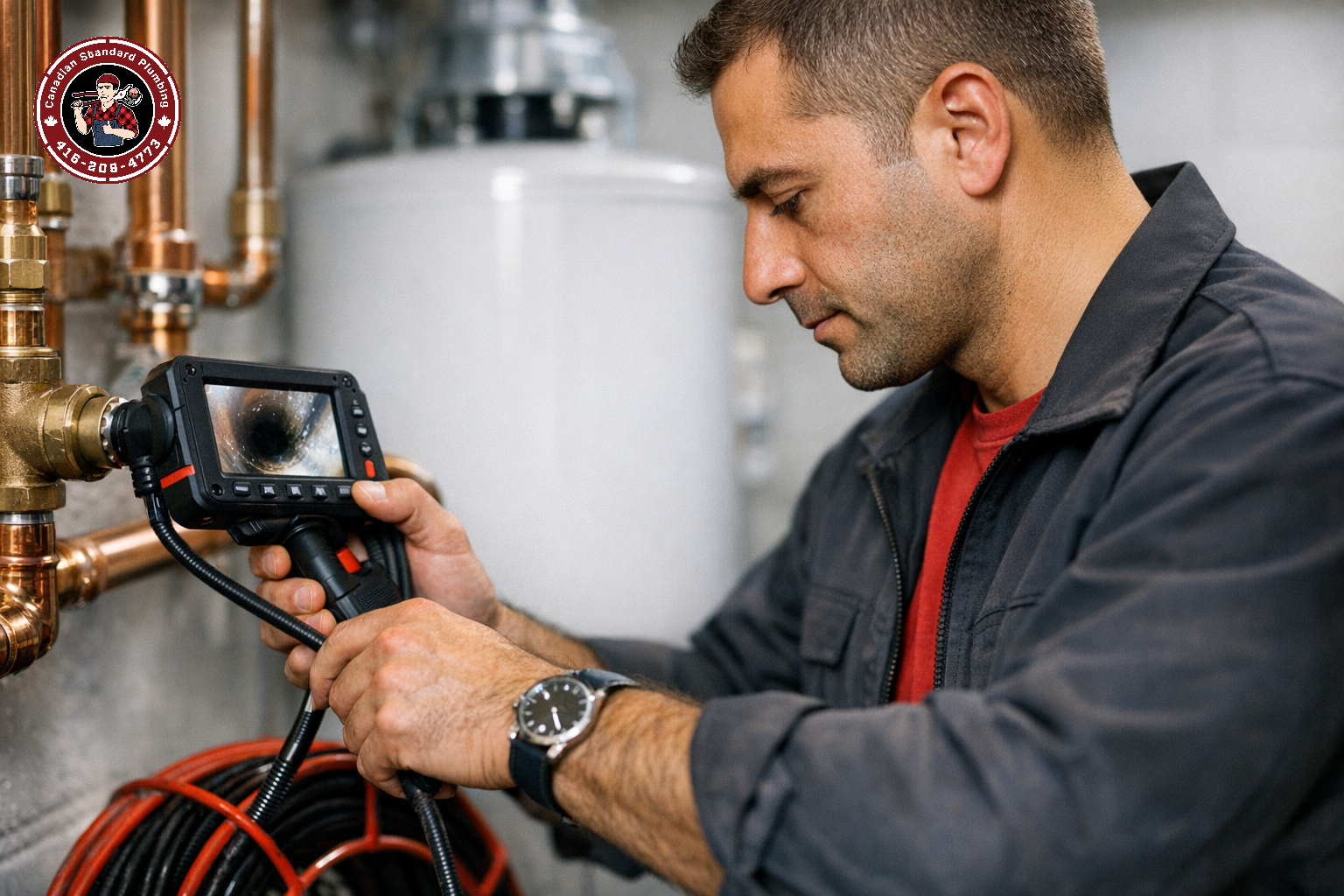
Drain camera inspection in a GTA commercial building means feeding a self-levelling video head on a push rod through a cleanout and watching the interior wall of the pipe on a monitor in real time. In a Toronto restaurant or a Woodbridge warehouse, that camera tells you things no other method can: whether cast iron has channelled out along the bottom, whether a joint has offset after settlement, whether tree roots have found a hairline crack in a clay lateral, whether a section is back-pitched and holding standing water.
Here’s the honest limitation nobody puts in their marketing. A camera sitting inside a drain sees the inside of the pipe. Water leaking out through a crack on the far side of the pipe wall is, from the camera’s point of view, invisible — you see the crack, not the leak. That’s still enormously useful. But it’s inference, not proof.
The second limitation is the one that catches property managers off guard: a drain camera has no access to your pressurized water supply. If the leak is a pinhole in copper feeding the washroom group of a Richmond Hill office, a camera down the floor drain will show you a perfectly clean pipe — and you will have paid for an inspection that could never have found it.
Where the camera earns every dollar: locating. Our camera heads carry a sonde transmitter, and a receiver above ground tracks it to a point you can mark with chalk on the slab. That’s the difference between opening one square metre of concrete and opening ten.
A drain camera inspection is the most accurate tool for diagnosing drain-side problems and pinpointing their location on the floor plan. It cannot see into pressurized water lines at all, and it shows you damage rather than proving water is escaping. We quote the inspection in writing before we start, so you know the scope and the cost up front.
Method 2: Pressure and Hydrostatic Testing — The Method That Proves It
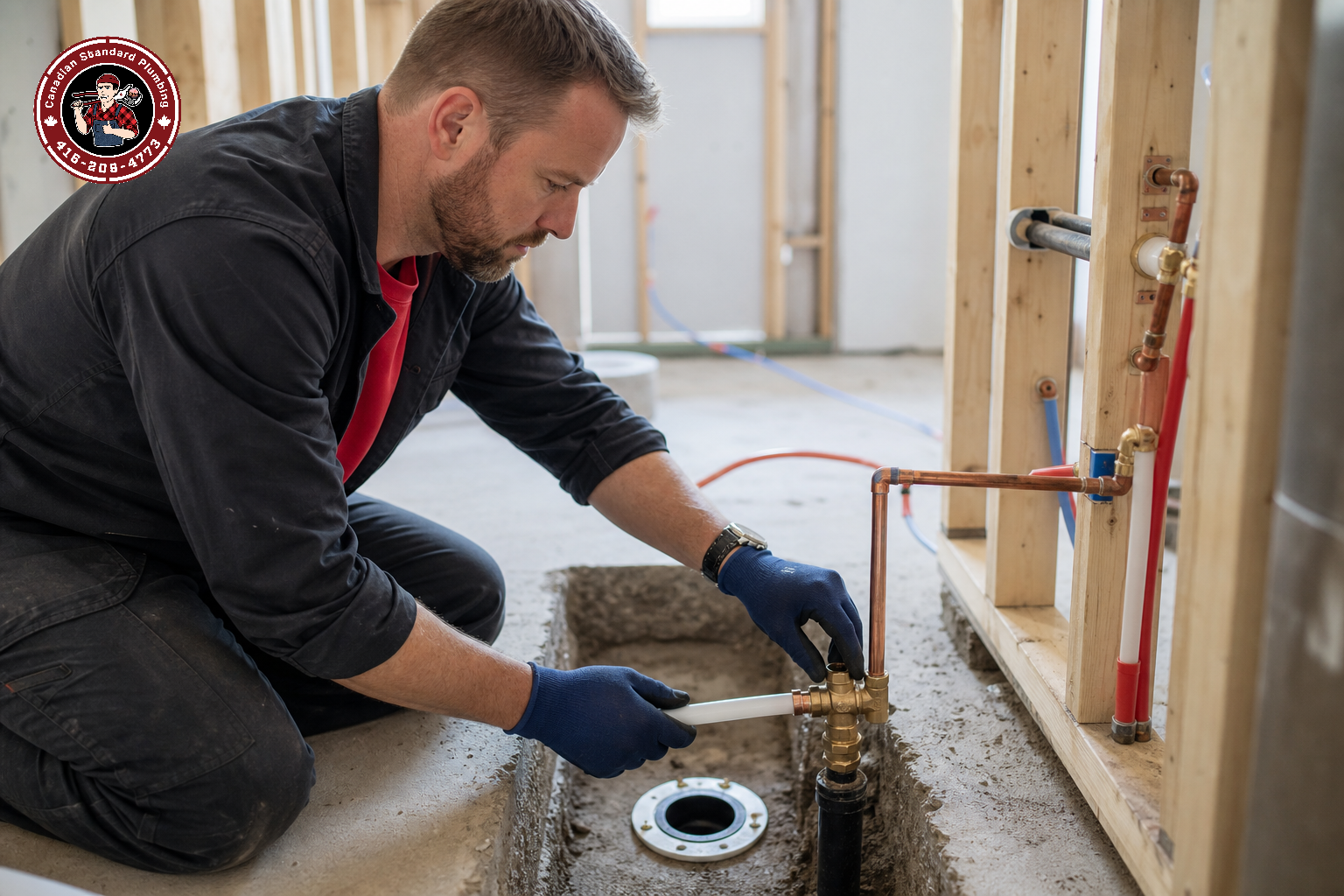
Pressure testing a hidden pipe leak in a commercial building works by isolating a section of piping, bringing it to a controlled test pressure with water or air, and watching whether it holds. If the gauge falls, water or air is escaping. There’s no interpretation involved. That binary answer is why insurers and building engineers respect it.
On the drainage side, the equivalent is a hydrostatic test — plugging the line at the cleanout, filling it, and watching the water level. If the level drops, the drain is leaking somewhere below the plug. That’s how you separate “the pipe is ugly” from “the pipe is failing.”
“A camera shows you a scary-looking pipe. A pressure test tells you whether that scary-looking pipe is actually losing water. We’ve seen forty-year-old cast iron under a Toronto commercial kitchen look like the inside of a cave and still hold a hydrostatic test — and we’ve seen tidy-looking copper fail one in under ten minutes.”— Canadian Standard Plumbing Team
The weakness is equally clear. A failed test says “somewhere in this isolated run.” In a two-storey Markham clinic, that run can pass through joists, chases and a drop ceiling over a treatment room you’re not allowed to open during business hours. Pressure testing tells you whether. It rarely tells you where without further work.
It also costs you access. Testing means the tested zone is out of service — and in a café or a retail unit, that usually means an evening or a Sunday. After-hours work carries a surcharge over our standard rate, which we put in writing before we book, and for most operators it still works out cheaper than closing during trading hours.
Method 3: Acoustic, Thermal and Tracer Gas — The Third Option Most Comparisons Ignore
Acoustic and thermal leak detection in a GTA commercial building bridges the gap between the other two methods, and it’s the one missing from almost every “camera vs hydrostatic test” article on page one. A ground microphone or a correlator listens for the specific hiss of water escaping a pressurized line through concrete. Thermal imaging reads the temperature signature of wet material behind finished walls. Tracer gas — an inert hydrogen-nitrogen mix introduced into a drained line — rises through slab and finds a sensor at the escape point.
These techniques answer the exact question pressure testing can’t: where in this failed run? That’s why we bundle them into our leak detection visit rather than selling them separately. The visit includes a written report, and we quote it in writing before we attend.
The catch is noise. Acoustic work in a Concord warehouse with compressors running, or a Vaughan plaza with rooftop HVAC cycling, is difficult during the day. We frequently do it after close. Cold helps thermal imaging — a January morning gives sharper contrast between wet and dry gypsum than a humid August afternoon does.
When to Choose Which: Matching the Method to the Symptom
The Sequence We Actually Run on a GTA Commercial Leak Call
Order matters more than tool choice. Running a camera on a job that turns out to be a supply-side pinhole is wasted money, and we’d rather not take it. This is the sequence that keeps commercial diagnostic bills honest.
Read the meter with everything closed
Every fixture off, every appliance idle. If the low-flow indicator on the meter still creeps, the leak is on the pressurized supply side. If it’s dead still, we stop thinking about supply lines entirely. This costs nothing and eliminates half the possibilities.
Isolate by zone with the building’s valves
Close the riser or branch valves one at a time, re-reading the meter after each. In a multi-tenant Thornhill plaza this alone often narrows a leak to one unit before any equipment comes off the truck.
Choose the branch: supply or drainage
Meter moving = supply side, go to pressure testing and acoustic. Meter still but water appearing = drainage or condensate, go to camera and hydrostatic. This single fork determines everything after it.
Run the confirming test on the chosen branch
Pressure or hydrostatic test to prove the leak exists in a defined run. This is the step that produces the pass/fail your insurer or your board wants in writing.
Run the locating test to mark the spot
Camera with sonde on the drainage side, acoustic or thermal on the supply side. The deliverable is a chalk mark on the floor or ceiling grid — not a general area.
Document, then repair, then re-test
Video file, thermal images and a written report go to the owner or property manager. After the pipe repair, the same test gets re-run so the closure is documented too.
Steps one and two are free. We tell people that on the phone. Honestly, a fair number of GTA commercial “hidden leak” calls die at step two when we find a running flushometer in a washroom nobody uses — and everybody’s happier for it.
Our Verdict: Which Method Is More Accurate for a Hidden Pipe Leak?
Asking whether drain camera inspection or pressure testing is more accurate for a hidden pipe leak in a commercial building is like asking whether a thermometer or an X-ray is more accurate. They measure different things. But since you need a decision, here are the buyer profiles.
If you’re buying or leasing a GTA commercial property
Camera first. You need to know the condition of the underground drainage before you inherit it. Buildings in older Toronto and Etobicoke commercial strips frequently still have original cast iron or clay laterals, and replacing a failed lateral is an order of magnitude more expensive than the inspection that would have found it. We’ll give you a written quote for the inspection before we book it.
If your water bill jumped and nothing is visible
Isolation and pressure testing, inside a leak detection visit that ends with a written report. A camera is the wrong tool here and any plumber selling you one before checking the meter isn’t thinking. A rising bill with no drain symptoms is a supply-side story until proven otherwise. What the visit involves depends on the size of the building and how buried the line is, and we put a written quote in your hands before we start.
If you have recurring backups plus a damp slab
Both, in that order — camera to see the defect, hydrostatic test to prove it’s actively leaking, camera sonde to mark the dig. On a Woodbridge or Maple industrial unit with slab drainage, this combination is what turns a guess into a scoped, quotable repair.
If you manage multiple tenanted units
Skip the debate and instrument the building. A Moen Flo smart water monitor and automatic shutoff that we supply and fit runs its own micro pressure test on the supply line every night and closes the valve when flow behaviour goes wrong. For a property manager juggling three buildings across Vaughan and Richmond Hill, that kind of protection tends to look small next to a single flood remediation. We’ll quote the supply and install in writing before anything is ordered.
Our Take After Years in GTA Mechanical Rooms
What commercial clients overweigh is the technology. Everyone wants to know whether we use a self-levelling head, what resolution the camera is, whether the correlator is the newest model. What actually determines whether you find the leak is sequence and patience — the boring part where a technician stands at a meter for twenty minutes with a notepad while the HVAC hums overhead.
What clients underweigh is documentation. A camera inspection with no saved video file is worth about a third of what you paid. When you go back to a landlord, an insurer, or a strata board six months later, the timestamped footage and the written test result are the whole argument. Ask for the file before the truck leaves.
The one thing we’d tell a friend running a café or a clinic: don’t let a diagnostic become a demolition. If a contractor’s plan is “open the ceiling and look,” you’re paying for their guess with your drywall. Insist on a locate before a cut. And if someone half-starts a DIY valve swap in a commercial washroom without isolating the main first, we’ve been called out to the aftermath more than once — valve snapped off, nobody able to stop the flow. A cheap idea on a Friday afternoon turns into an emergency call-out that evening.
Frequently Asked Questions
Can a sewer camera detect a pipe leak on its own?
A sewer camera detects the damage that causes a leak — cracks, offset joints, root intrusion, channelled cast iron — but it cannot see water escaping through the pipe wall, because the lens is inside the pipe looking at the interior surface. In GTA commercial buildings we pair a camera inspection with a hydrostatic test when proof of an active leak is required for insurance or a repair sign-off, and we quote that combination in writing before we mobilise.
Should I use a plumber with a camera for a commercial inspection, or is a pressure test enough?
Use a camera when you need to know the condition and exact location of drainage piping, and a pressure test when you need documented proof that a run is losing water. For a pre-purchase inspection on an older Toronto or Etobicoke commercial building with cast iron or clay drainage, the camera is the higher-value spend — condition data is what changes your offer price.
How much does leak detection cost for a commercial building in the GTA?
What a leak detection visit costs across the Greater Toronto Area and York Region depends on how much work it takes to find the source: meter isolation, acoustic and thermal scanning, and pressure testing where applicable, plus the size and layout of the building. A drain camera inspection is a separate scope of work, and after-hours or overnight attendance for businesses that can’t shut down during trading hours is priced differently than a scheduled daytime visit. We look at the site, explain what’s driving the number, and give you a written quote before any work starts.
Can a hidden leak in a commercial building be found without opening walls or slab?
Yes — in most cases a hidden leak can be located non-destructively using valve isolation, acoustic listening equipment, thermal imaging and camera sonde tracing before anything is cut open. The goal on every commercial job in Markham, Vaughan or North York is a single marked access point rather than exploratory demolition, which is why we locate before we cut.
Sources
- Ontario plumbing installation and testing requirements for building drainage and water distribution systems — Ontario Building Code, Government of Ontario
- Municipal water metering, leak identification and high water bill guidance for Toronto property owners — City of Toronto Water Services
- Smart water monitor and automatic shutoff functionality referenced in this article — Moen Flo
- Service pricing, service area and 24/7 emergency response referenced throughout — Canadian Standard Plumbing
Canadian Standard Plumbing
We’re an owner-operated plumbing business — Daniel Klasner and our team. We handle commercial and residential leak detection, drain cleaning and camera inspection, fixture work, pipe repair and repiping, renovation rough-ins, smart water monitor and shutoff installs, and frozen or burst pipe work across Toronto, Vaughan, Markham, Richmond Hill and York Region. Emergency response available, and a written quote before we start.
{
“@context”: “https://schema.org”,
“@type”: “FAQPage”,
“mainEntity”: [
{ “@type”: “Question”, “name”: “Can a sewer camera detect a pipe leak on its own?”, “acceptedAnswer”: { “@type”: “Answer”, “text”: “A sewer camera detects the damage that causes a leak — cracks, offset joints, root intrusion, channelled cast iron — but it cannot see water escaping through the pipe wall, because the lens is inside the pipe looking at the interior surface. In GTA commercial buildings we pair a camera inspection with a hydrostatic test when proof of an active leak is required for insurance or a repair sign-off.” } },
{ “@type”: “Question”, “name”: “Should I use a plumber with a camera for a commercial inspection, or is a pressure test enough?”, “acceptedAnswer”: { “@type”: “Answer”, “text”: “Use a camera when you need to know the condition and exact location of drainage piping, and a pressure test when you need documented proof that a run is losing water. For a pre-purchase inspection on an older Toronto or Etobicoke commercial building with cast iron or clay drainage, the camera is the higher-value spend — condition data is what changes your offer price.” } },
{ “@type”: “Question”, “name”: “How much does leak detection cost for a commercial building in the GTA?”, “acceptedAnswer”: { “@type”: “Answer”, “text”: “Leak detection in the Greater Toronto Area and York Region is quoted flat for a visit with a written report, covering meter isolation, acoustic and thermal work, and pressure testing where applicable. A drain camera inspection is billed separately and quoted before we arrive, and after-hours or overnight work carries a stated surcharge over the standard rate for businesses that can’t shut down during trading hours.” } },
{ “@type”: “Question”, “name”: “Can a hidden leak in a commercial building be found without opening walls or slab?”, “acceptedAnswer”: { “@type”: “Answer”, “text”: “Yes — in most cases a hidden leak can be located non-destructively using valve isolation, acoustic listening equipment, thermal imaging and camera sonde tracing before anything is cut open. The goal on every commercial job in Markham, Vaughan or North York is a single marked access point rather than exploratory demolition, which is why we locate before we cut.” } }
]
}
{
“@context”: “https://schema.org”,
“@type”: “Article”,
“headline”: “Camera Inspection vs Pressure Testing: Which Method Actually Confirms a Leak in a GTA Commercial Building’s Hidden Pipes”,
“datePublished”: “2026-08-25”,
“dateModified”: “2026-08-25”,
“author”: { “@type”: “Organization”, “name”: “Canadian Standard Plumbing” },
“publisher”: { “@type”: “Organization”, “name”: “Canadian Standard Plumbing” },
“inLanguage”: “en”
}